Glenn’s Trumpet Notes

News & Tips for Trumpet & Cornet Students

  • March 2026
    S M T W T F S
    1234567
    891011121314
    15161718192021
    22232425262728
    293031  
  • Enter your email address to subscribe to this blog and receive notifications of new posts by email.

    Join 89 other subscribers
  • Subscribe

Posts Tagged ‘Taps’

“Taps” at Rainy Veterans Day Ceremony at Lynnwood Veterans Park

Posted by glennled on November 19, 2011

NW Junior Pipe Band (center) plays as firing squad awaits (right)

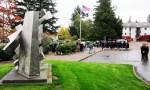
For one second on this special Veterans Day, the time was exactly 11:11:11 on 11-11-’11. A few minutes later, I sounded “Taps” for all our veterans, including me (Navy, Vietnam). Prior to the ceremony, Martin Spani, Commander of VFW Post 1040 of Lynnwood, had stationed me where the silver sculpture stands on a knoll in the Veterans Park in downtown, just south of the library. “After the NW Junior Pipe Band plays ‘Amazing Grace,'” he said, “the firing squad will fire three volleys. When they come to Present Arms, you play ‘Taps.'” And that’s just how it happened, probably very similar to many thousand other ceremonies this day across America, except for our pouring-down rain.

Out of curiosity, I looked for the plaque that would tell me about the stainless steel sculpture where I stood to sound “Taps”—it’s untitled (1979) by Bruce West.

Steven A. Rintanaki, Cpl, USMC, of Lynnwood, died Al Anbar Province, Iraq, 9/16/2004 - Portrait by Michael G. Reagan

The guest speaker was Michael G. Reagan, Edmonds artist, who spoke about his foundation’s Fallen Heroes Project. “Our mission,” he says, “is to honor the American Fallen Heroes for their ultimate sacrifice during the war against terrorism. The foundation will provide the resources to produce and distribute to each family a hand-drawn portrait of their Fallen Hero, created by artist Michael G. Reagan, free of charge. Each portrait is intended to show our Love and Respect for these Heroes and their families.” See http://www.fallenheroesproject.org/.

Commander, VFW Post 1040

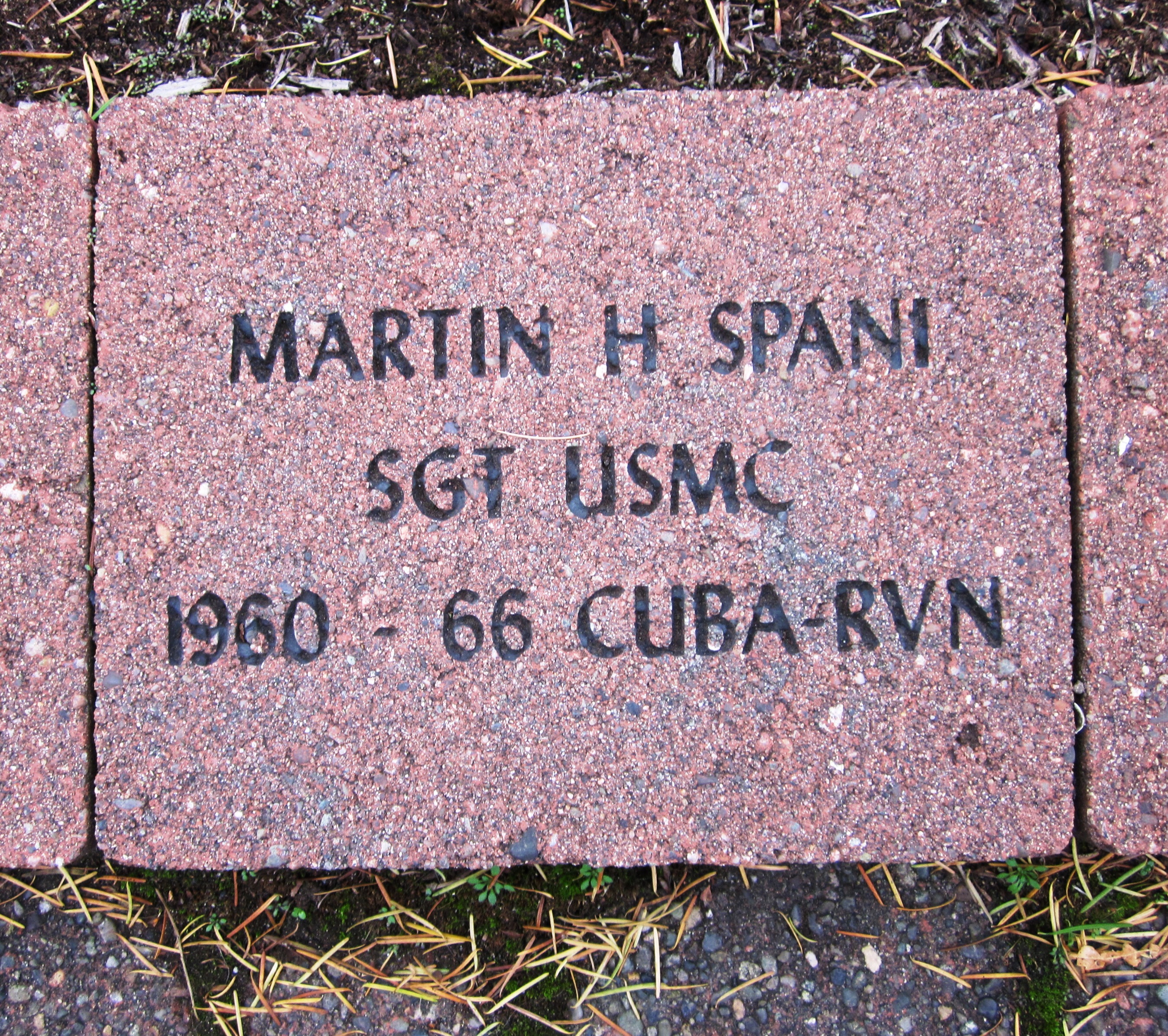
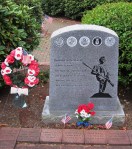
If you donate $30 to VFW Post 1040, you can have a 7″ x 9″ inscribed memorial brick installed in Veterans Memorial Park in downtown Lynnwood in honor of a veteran, living or deceased. Currently, 805 such bricks line the pathways and plantings in the park. See http://www.vfwpost1040.org/index.php.

Click on any image to enlarge it.

Posted in Ceremonies & Celebrations | Tagged: , , , , , , , , | 4 Comments »

“Taps” for Japanese-American WWII Veteran at Evergreen Washelli in Seattle

Posted by glennled on August 21, 2011

Yesterday, I played “Taps” as part of the military honors accorded a Japanese-American veteran who served in World War II after having first been interned at the Minidoka War Relocation Center in Hunt, Idaho with his family. Born in 1923 in Seattle, he was 18 when the U.S.A. entered the war. Within a year after internment, he enlisted in the Army. He served as a translator of Japanese for the Military Intelligence Service during the reconstruction of Japan. He died 25 December 2010. His wife, also born in Seattle, died 14 July 2011. They were married 61 years.

The graveside service at Evergreen Washelli Cemetery in Seattle was led by the head minister of Seattle Betsuin Buddhist Church. Near the end of the service, the Honor Guard carefully unfolded the American flag and dramatically displayed it to the family and friends. That was my signal to sound “Taps.”

I now own my version of “Taps.” Before, I had been experimenting with slight variations in the way I would play those 24-notes. But as of yesterday, I realized that I’ve now worked out every detail of how I play it. I’ve chosen the key signature, tempo, rhythm, phrasing, and dynamics. I know when to breathe, I know when to use vibrato, I know how long to hold each fermata, I know when to make the notes swell and when to let them fade. Whether loud or soft, I keep the tone solid.

The Honor Guard then folded the flag and presented it to a gentleman in a dark suit. Afterwards, he thanked me.

“Are you his son?” I asked.

“Yes.”

“A good life?” I asked.

“Yes, a wonderful life, a wonderful man!”

I said I served in the Navy and thanked him for his father’s service. I said I would like to know more about his story. “It’s my honor and privilege to play for him today.”

Posted in Ceremonies & Celebrations | Tagged: , , , , , , , , , , , , , , , , , , , | Leave a Comment »

“Taps” for the Father

Posted by glennled on July 22, 2011

“When all three of us salute the casket, that’s when you play ‘Taps,’” said the Sergeant of the Honor Guard, dressed to perfection in his military uniform.

About an hour later, the hearse drove up to the gravesite, and the pall bearers lifted the casket onto the frame directly above the dark, rectangular hole dug into the earth. As the large crowd gathered, a gentleman in a suit introduced himself and called me by name. He had

In Brice's Garden

seen me, dressed in all black, holding my cornet. He is the son of the deceased father, being laid to rest last Saturday alongside the body of his wife in the Resthaven 2 Section of Evergreen Washelli Cemetery along Highway 99 in north Seattle.

“I am a Vietnam veteran,” he said.

“So am I,” I replied. “It’s my honor and privilege to do this.”

He went to be seated at his place among the family and friends directly in front of the grave. From where I was standing near a distant Japanese maple tree, I saw the preacher say a few words, no more than five minutes, to the large crowd at the gravesite, and then I saw the three Washington National Guardsmen, two men and a woman, salute the casket. For the second time that day, I sounded the 24-notes of “Taps.”

The Honor Guard lifted the flag off the casket and carefully folded it into the familiar triangle. One passed it to the other, who took it to the son.

We have often seen this ritual, have we not, always done the same way, as our veterans are laid to rest in peace around the world? The guardsman kneels in front of the person, the widow or widower, the mother or father, the son or daughter, the sister or brother, whomever, and presents the flag, one white-gloved hand below, one above, and, looking him or her in the eyes, whispers something very short and dignified. Then the Honor Guard marches away and leaves.

With the gift of a perfectly folded flag, in one moment after a lifetime, the United States of America thanks the son and the surviving family for the armed service of the father. I shall never know how it feels to give or receive that flag. How could one maintain one’s composure at such a moment?

But I can give them “Taps,” and this I know: it’s all about love and honor before God—for that’s all there is to life.

Posted in Ceremonies & Celebrations | Tagged: , , , , , , , , , , | Leave a Comment »

Playing “Taps” for Medal of Honor Recipients at Evergreen Washelli Memorial Park in Seattle on 16 July

Posted by glennled on July 2, 2011

Photo by Thad Westhusing, http://www.thadsworld.net

Until this year, I did not realize that Evergreen Washelli Memorial Park is the final resting place for one Silver Star and six Medal of Honor recipients. The Silver Star recipient and two of the Medal of Honor recipients fought in Vietnam. Another two Medal of Honor recipents fought in World War II, and the other two fought in the Spanish/American War. These wars span 77 years, from 1898 to 1975.

I am so lucky. Just before the conclusion of a special ceremony for the public on Saturday, 16 July, I get to play “Taps” to honor these very special men. It is said that playing “Taps” is the most sacred duty of a bugler. I feel it. The last time I felt it, I was in high school when I played “Taps” at a ceremony in my home town, Sinton, Texas, on either Memorial Day or Veterans Day. I want to feel it again.

The ceremony begins at 10:30 a.m. with a half-hour concert by the Washington Letter Carriers Band. Next comes the Parade of Colors at 11 a.m., followed by The National Anthem, Pledge of Allegiance, and Invocation. The speaker is Major General James (“Jimmy’) M. Collins, Jr., U.S. Army (Ret.). The program concludes with a salute from members of the Washington Army National Guard, followed by “Echo Taps,” the Benediction, and the Retiring of the Colors at about noon.

To pay tribute to these fallen heroes and to thank them and their families for their selfless and courageous service to our country, Evergreen Washelli is creating a permanent marker which will tell each medal recipient’s heroic story. You are invited to attend the ceremony, witness the unveiling of their permanent memorials, visit their graves, read their stories, and see images of the medals received. Their names: Albanese, Horton, Leisy, Nakamura, Bloch, Fadden and Alakulppi.

Posted in Ceremonies & Celebrations | Tagged: , , , , , , , , , , , , , , , , , , , | Leave a Comment »

Taps, Sousa, and Tchaikovsky at Veterans’ Memorial Cemetery in Seattle on Memorial Day

Posted by glennled on June 3, 2011

Veterans Memorial Cemetery, photo by Thad Westhusing, http://www.thadsworld.net

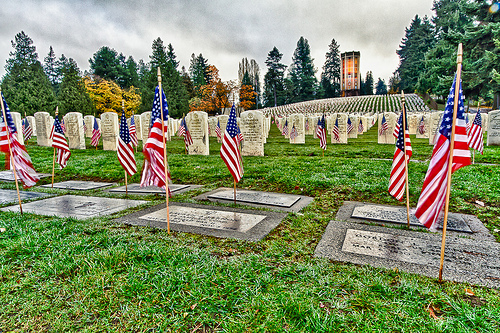
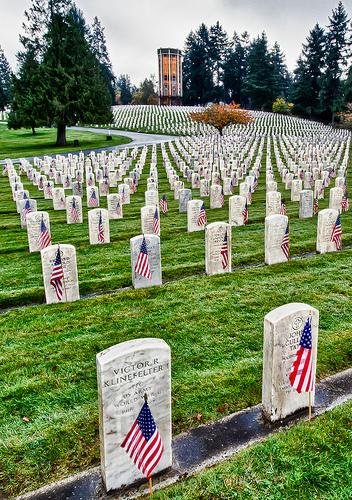
Picture 5,000 white marble markers on the graves of veterans interred at Veterans’ Memorial Cemetery in north Seattle on the grounds of the larger Evergreen Washelli Cemetery. Imagine at least 700 people gathered there for the 85th Annual Memorial Day Celebration. That’s what happened Monday, 30 May. “Ya shoulda been there”–such sights to see and sounds to hear! I especially enjoyed the prominent role of music in the celebration.

It began with a prelude concert by the 50-member Symphonic Wind Ensemble from Seattle Pacific University (SPU), conducted by Gerry Jon Marsh. Among the pieces they played was a patriotic march, a well-loved overture, and an uplifting medley of the anthems of the five military branches. First, John Philip Sousa’s magnum opus, “Stars and Stripes Forever,” stirred the crowd, as it always does. In fact, it is so popular that in 1987, Congress made it the National March of the United States.  As Sousa wrote in his autobiography, ” … Suddenly [while aboard ship returning from Europe to New York in 1896], I began to sense a rhythmic beat of a band playing within my brain. Throughout the whole tense voyage, that imaginary band continued to unfold the same themes, echoing and re-echoing the most distant melody. I did not transfer a note of that music to paper while I was on the steamer, but when we reached shore, I set down the measures that my brain-band had been playing for me, and not a note of it has ever changed.”

Then came the 1812 Overture, written in 1880 by Pyotr Ilyich Tchaikovsky to commemorate Russia’s defense of Moscow against Napoleon’s advancing Grande Armée at the Battle of Borodino on 7 September 1812. At this battle, there were an estimated 100,000 casualties. Napoleon won a Pyrric victory and then captured Moscow, facing little resistance. The Russians had burned part of the city, and Napoleon’s army was weakened, its resources depleted and its supply lines overextended. Without winter stores, the army was forced to retreat. From mid-October through December, it faced several overwhelming obstacles on its long retreat:
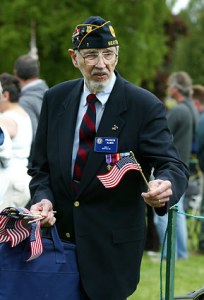
Seattle American Legion Post 1 Commander Francis "Frank" Albin. Photo by Greg Gilbert, The Seattle Times

frigid temperatures, famine, harassing cossacks and Russian forces barring the retreat route. Napoleon abandoned the army in December. By the time it reached the relative safety of Poland, the Grande Armée was reduced to one-tenth its original size.

On 20 August 1882, seventy years after the battle, the overture debuted in Moscow in the Cathedral of Christ the Saviour. Marsh says that Tschaikovsky opens the overture with the Russian hymn, “God Preserve Thy People,” and returns to it near the ending when the music depicts God’s intervention in the invasion, causing unprecedented severe winter weather to decimate Napoleon’s seemingly invincible French army.
 

The  SPU ensemble also played a medley of five military anthems in tribute to each branch and those who served in them: Army, Marines, Navy, Air Force and Coast Guard. Veterans in the crowd stood to the applause of the audience when their anthem was played.

The first Memorial Day ceremony at Evergreen Washelli (the Makah Indian word for west wind) occurred in 1927. Marsh says that the SPU ensemble has played at each of these ceremonies for more than 15 years. Students get class credit for doing so. They are required to perform community service once a school quarter, and this event satisfies that requirement for spring quarter. “They enjoy doing it,” he says. For more information about instrumental music at SPU, visit http://www.spu.edu/depts/fpa/music/mus_homepage.html. Since 1985, Marsh has also been the Musical Director of the Cascade Youth Symphony Orchestras (see www.cyso.us/). In 1998, Marsh was inducted into the inaugural Washington Music Educators Association (WMEA) Hall of Fame.

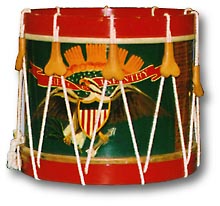
Cooperman Rope Tension Drum, Civil War era

Also performing was the SPU Drum Corps, under the direction of Dan Adams, using authentic drums from

Cavalry bugler, Civil War Gold Proof, U.S. Mint

the Civil War era. These rope tension drums have calf skin drum heads, says Marsh. The Drum Corps was featured during the Parade of Colors. As a clinician, Adams has presented workshops on drumming of the Civil War. For more information on such drums, see www.cooperman.com/ropedrums/civilwar.htm.

At the conclusion of the ceremony, two SPU trumpeters played an echo version of  “Taps.” A history of “Taps” can be found at www.tapsbugler.com. For a complete history you can order “Twenty-Four Notes That Tap Deep Emotions—The Story of America’s Most Famous Bugle Call” by Jari Villanueva at www.nationalcivilwarbrassmusic.org/GiftShop. Next year, 2012, marks the 150th year since the composition of “Taps” during the Civil War in July, 1862.

On Saturday, 16 July, there will be a special ceremony at the Veterans’ Memorial Cemetery to honor the six Medal of Honor recipients who are interred at Evergreen Washelli (see www.washelli.com). They are Lewis Albanese, William C. Horton, Harry D. Fadden, William K. Nakamura, Robert R. Leisy, and Orville E. Bloch. On that day, I am honored to be scheduled to sound “Taps,” the most sacred duty of a bugler.

Posted in Ceremonies & Celebrations | Tagged: , , , , , , , , , , , , , , , , , , , , | 2 Comments »

Newest Student from Lynnwood Attends School in Texas!

Posted by glennled on November 27, 2010

Have you heard of the Marine Military Academy? Neither had I when I got an email from a parent in Lynnwood inquiring about private lessons for her son, a trumpeter, coming home from Texas for vacation during the Thanksgiving and Christmas holidays. At first, I wondered, does “marine” refer to the navy, merchant marine, oceanography, biology, or what? No, none of the above—it’s the U.S. Marine Corps, of course! We arranged four one-hour lessons while he’s home in November, and I now have my 13th student.

The Marine Military Academy (MMA) is in Harlingen in south Texas, only about 11 miles from the Rio Grande River and the border with Mexico.  Forty-five years ago in 1965, it was established as a private college preparatory school for boys, grades 8-12 (see www.mma-tx.org). It is the only Marine prep school in the USA, and the typical enrollment is about 350-400.

My student is 17 and a senior. As a cadet at MMA, he plays in the school band. Three bugle calls get used regularly in the daily/weekly routine of school life: “Attention,” “Adjutant’s Call,” and “Taps.” For Pass in Review, the band plays the stirring march by John Philip Sousa known as “Semper Fi”—that’s short for Semper Fidelis (Latin, meaning “Always faithful”, the motto of the Marine Corps). And they play the moving “Marine Corps Hymn” (Halls of Montezuma), too, among many other pieces of music. For next year, he’s now considering three universities in Washington, Illinois, and Texas, and the Naval Academy in Maryland.

His dream is to play trumpet in The United States Marine Band, known as “The President’s Own” (see www.marineband.usmc.mil/). God bless the Marines and all our military and all our veterans, way back to the Revolutionary War, 1776-1783.

Trumpeters in “The President’s Own” Marine Band

Freedom is not free. It’s a universal, human desire, and its costs, for every generation on this precious globe, are high. In these Thanksgiving holidays, I pray he lives his dream, God willing.

Posted in New Students - Intro Posts | Tagged: , , , , , , , , , , , , , , , , , , , , , , , , , , , , , , , , | 2 Comments »

“Homey” Spring Recital for Trumpets & Piano

Posted by glennled on June 9, 2010

“Oh, no!” is sometimes a student’s first reaction to hearing that a recital is coming. But that soon turns to “OK,” and afterwards, the feeling is “Ah, that wasn’t so bad” and even “Wow! that was fun. I’ll do that again.”

It certainly was fun for me and my wife. Six of my students came with their trumpets and cornets and one of her piano students came to our home last Saturday to play music. We filled the living room with chairs for grandparents, parents, brothers and sisters, aunts and uncles. Four students played in the morning session, and three played in the afternoon. One trumpet student was away on an overnight school trip. Think of it: my first student began taking lessons with me just 10 months ago!

The printed program showed who played what and when. Most played two pieces, and a few played three. I accompanied the ninth grader on “Fanfare for the Common Man,” one of my favorities by Aaron Copland, first performed in 1942, during World War II.

After the program, everyone enjoyed cookies, sparkling apple cider, and conversation. My wife told them that after a few recitals, the group begins to feel like a little family.

Here’s the thing about recitals. Students should feel confident and comfortable with the music. Playing in front of people, including strangers, produces the jitters and the butterflies in one’s stomach. Good, that’s part of music education and development from students into performers. We all learn to handle these situations only by doing. It comes only through experience. But remember the good feeling that comes after a performance, even if it was not perfect? That’s one of the best lessons of the whole adventure: there is life after a recital! You live through it. It doesn’t kill you. And, in the end, it’s fun. And imagine experiencing this: people are proud of you, even if you’re not perfect, and they enjoy supporting and participating in your growth and progress. You feel good about yourself for having done it. We’re talkin’ acceptance and love. It’s all part of becoming your best.

Among the pieces played were “Lavender’s Blue,” “Mexican Hat Dance,” “Minor Rock,” “Doxy,” “Tattoo,” “Yankee Doodle,” “This Land is Your Land,” “Taps,” and “Feather Theme.”

Posted in Musical Events at Home, Recitals | Tagged: , , , , , , , , , , , | 2 Comments »