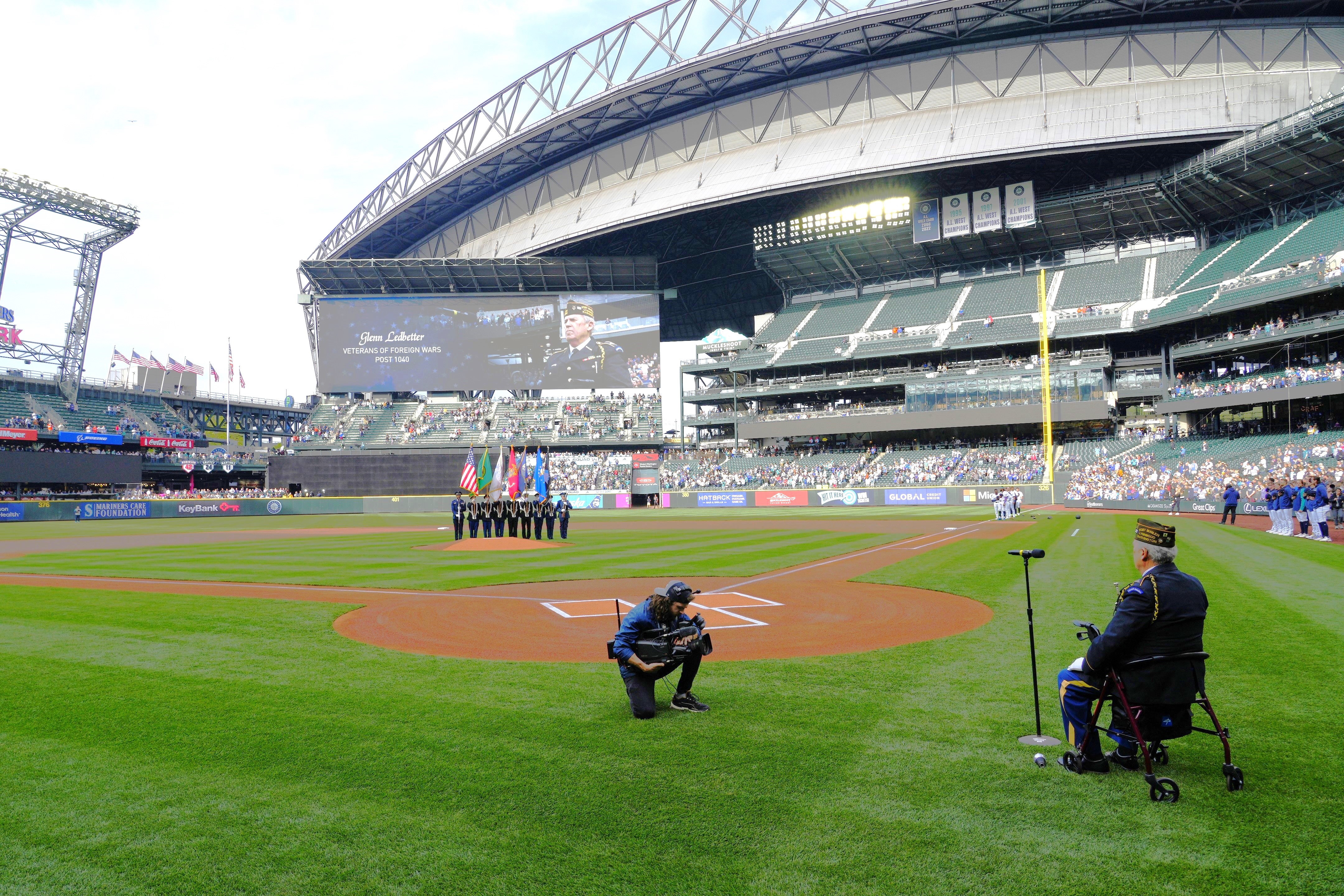
Awaiting cue to sound “Taps”—click to enlarge and read Jumbotron screen. Photo by Ben Van Houten, Seattle Mariners photographer
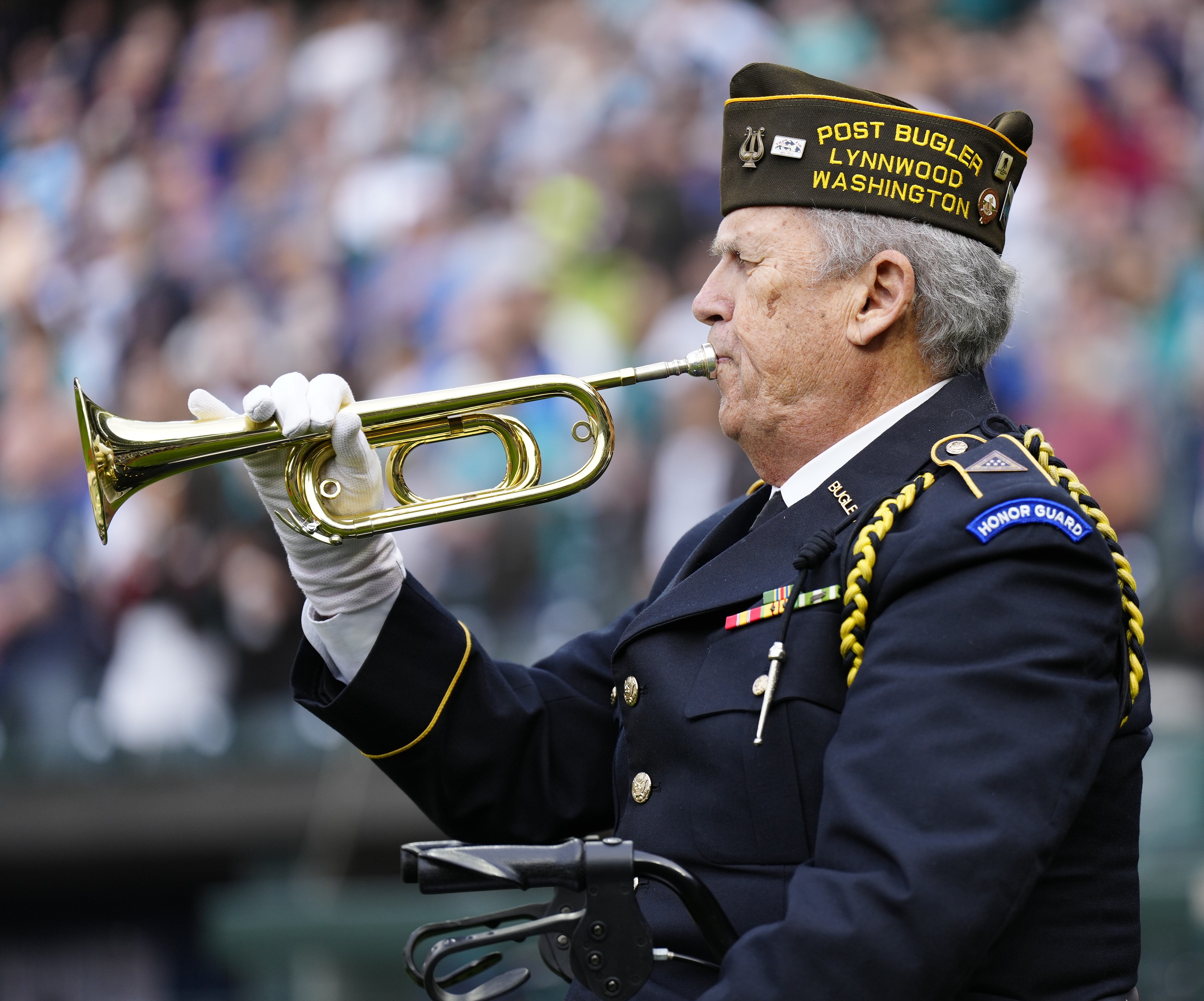
Glenn Ledbetter, VFW Post 1040 Bugler, Lynnwood, sounds “Taps.” Photo by Ben Van Houten, Seattle Mariners photographer.
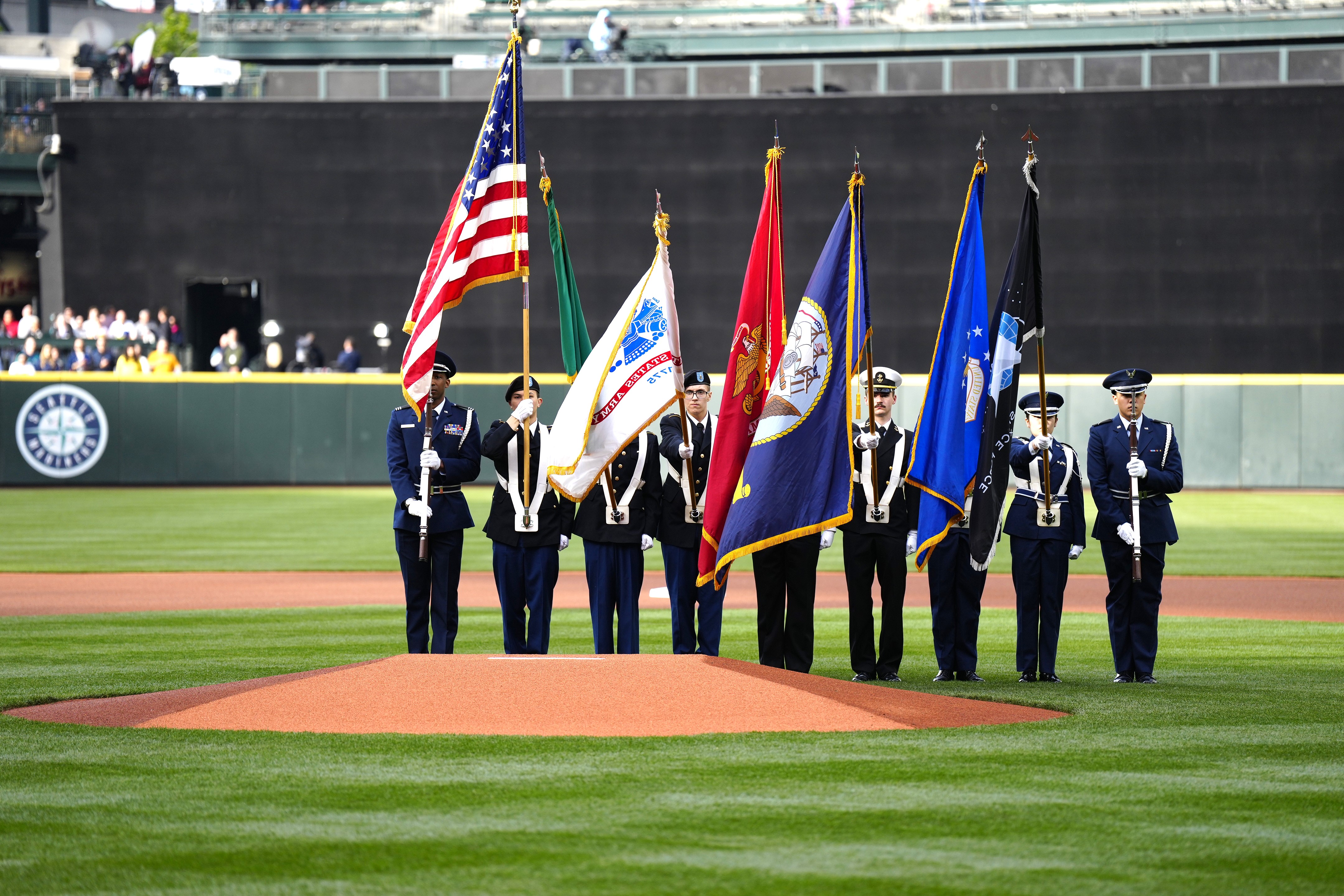
UW Joint Navy and Air Force ROTC Color Guard. Photo by Ben Van Houten, Seattle Mariners photographer.
The Seattle Mariners beat the Houston Astros, 3-2, at T-Mobile Park in downtown Seattle on Monday, 27 May. That was Memorial Day, and the Mariners’ pre-game activity was to “Remember and Honor” those military personnel who died in service to our country. The Joint Color Guard was comprised of University of Washington students who are in the Navy and Air Force ROTC programs. And one bugler was assigned to sound “Taps” after a moment of silence—me!
It was a dream come true! On 17 August 2014, I had sounded “To the Color” at a Mariners’ minor-league Aquasox game at the ballpark in Everett. And that inspired me to want to sound a bugle call at a Mariners game in Seattle. Ten years later, it happened, thanks to someone else. Unbeknownst to me, Monica McNeal, Gold Star Families of Washington, had referred me to the Mariners. Gold Star Mothers were also honored between certain innings of the game. Please see https://www.goldstarmoms.com. and my blog article of 2 November 2023.
I’ll be 84 next week. You’re never too old to have dreams and set goals—and if you need to, straighten your teeth!
Thus ends the “Lost Buzz Saga.” To read the whole story, please see my posts of 10, 12, and 21 June, plus this one, which is the climax. I invite your “Likes” and “Comments;” simply click on the links below this post.
The Mariners kindly recorded the pre-game activities. Here are the links for viewing the videos:
On Memorial Day this year, I sounded four bugle calls:
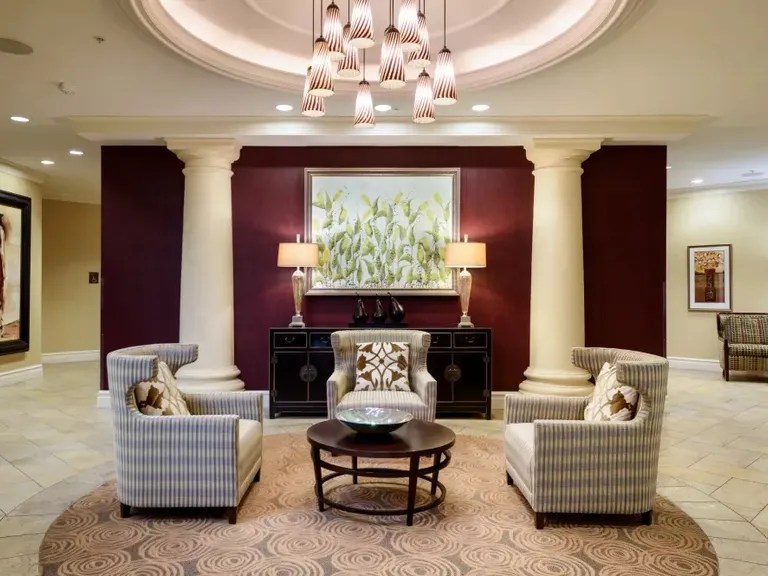
MorningStar Senior Living at Silver Lake, Everett
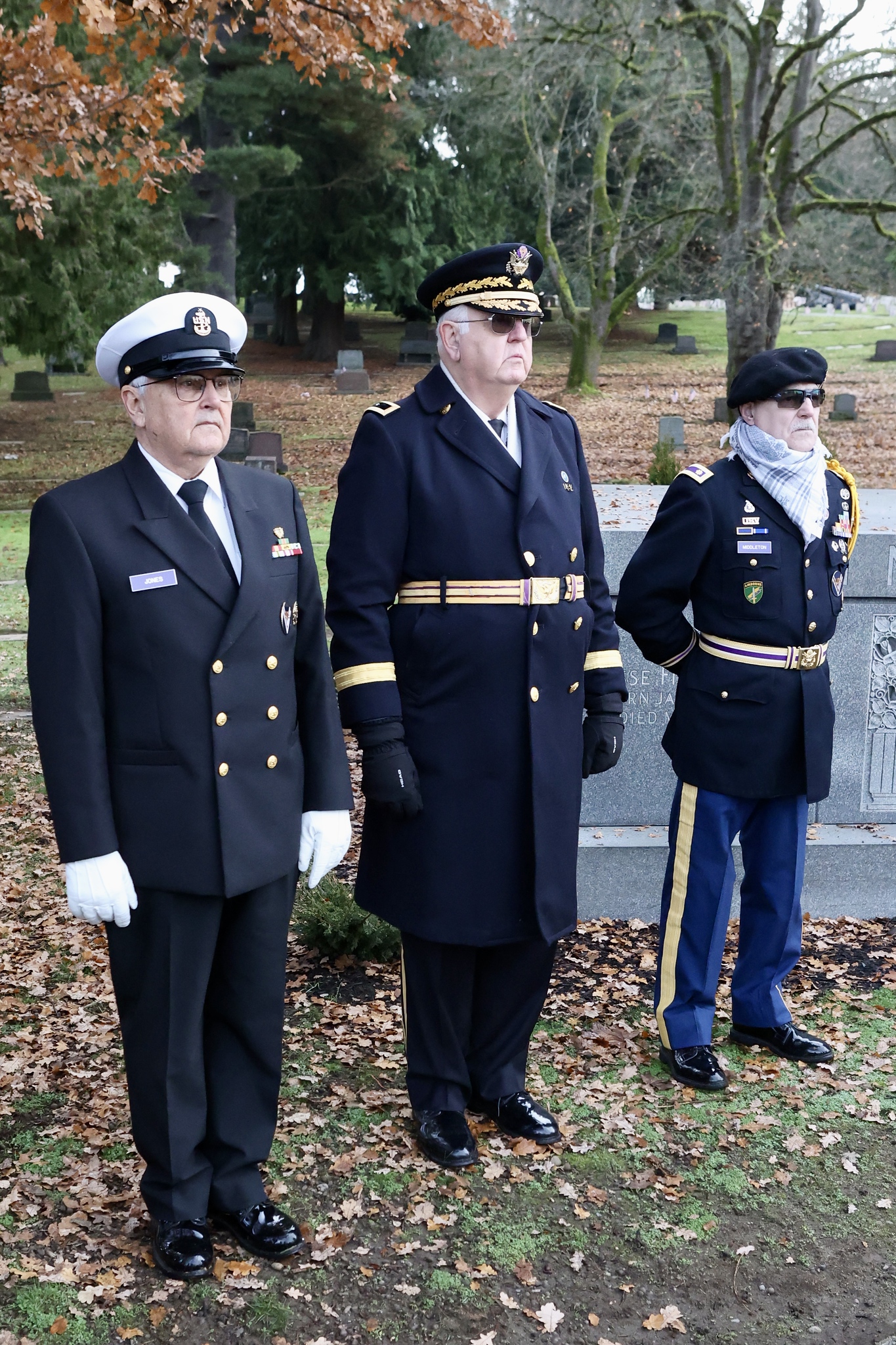
“Assembly” and “Echo Taps” at the ceremony hosted by VFW Post 1040 at Veterans Park in Lynnwood.
“Taps” at the retirement community, MorningStar Senior Living at Silver Lake, in Everett.
“Taps” at the Seattle Mariners baseball game at T-Mobile Park in Seattle.
Judah Deuman, a senior trumpeter at Lynnwood High School, played the “echo” part of “Echo Taps” with me.
Veterans Park, Lynnwood
These were very significant, “comeback” performances for me. I had not played in public for the past five months.
In my previous blog article, I divulged that during last December, I was having trouble playing my horns. My orthodontist predicted that I should be able to play my horns again by Memorial Day. Sure enough, it happened!
Now, what else could happen? Sciatica, that’s what. While sounding “Assembly” during the morning ceremony in Lynnwood, I discovered I could not hold a steady tone while standing, due to my lower back pain. So, for the rest of the day, I sounded “Taps” while seated on my walker and did just fine.
Who said that old age is just a number? Well, if that’s true, then jail is just a room.
The privilege of sounding “Taps” at the Mariners game that evening is presented in my next blog article.
In Paris, there’s a music museum. A friend told me about it several years ago, and finally, I found it and went to see it on 7 May—the Musee de la Musique in the 19th arrondissement, northeast of the Louvre and Eiffel Tower.
A docent on the second floor, who plays trumpet, told me about a special trumpet on display on the fourth floor. She said it was used at the premier of Verdi’s Aida in Cairo, Egypt in 1871, over the objections of Verdi himself. She could not leave her post and come upstairs to show it to me.
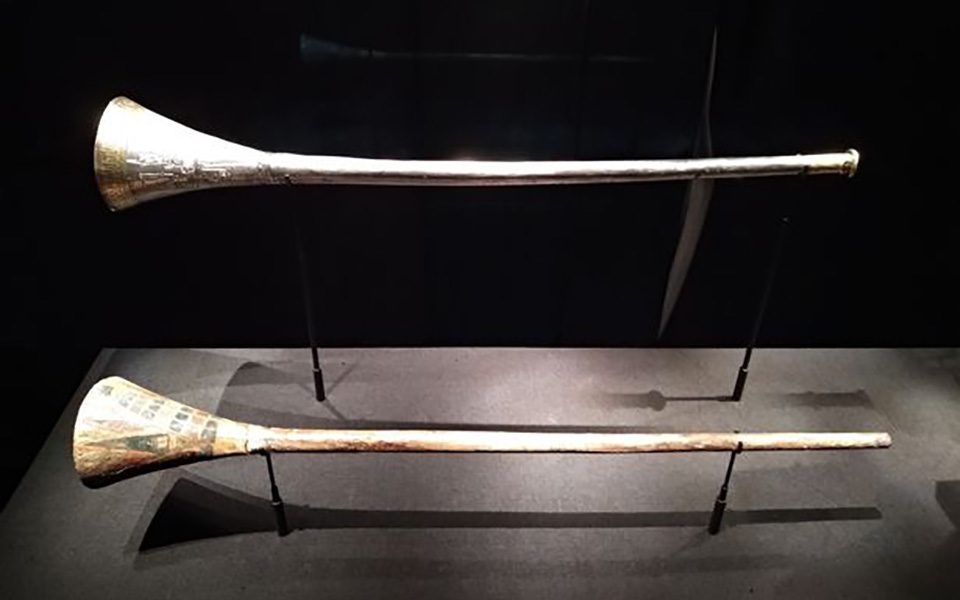
Egyptian trumpets found in King Tutankhamun’s tomb
But before I repeat what else the docent said, let me say something about the opera itself. The orchestral instrumentation calls for 6 Egyptian trumpets. They play the melody of the now-famous “Triumphal March,” when the victorious Egyptian troops parade into the city of Thebes after defeating the Ethiopian army.
The docent’s story was that Verdi insisted that the orchestra use authentic period trumpets which had no valves. The lead trumpeter, however, did not want to use them. So, in rehearsals the trumpeters used the Egyptian instruments, but at the premier, they brought trumpets with one valve. Verdi was furious, but there was nothing he could do. These trumpets became known as “Egyptian trumpets” or “Aida trumpets.”
So, I spent my time on the fourth floor. Until then, I had thought that valves were not added to natural trumpets until the 1830s. But I was thinking three valves, and I had always wondered how trumpeters could play the “Trumpet Voluntary,” written by the English composer, Jeremiah Clarke in the 1690s, without valves. Well, it turns out that that piece was the originally written for keyboard instruments. An organist would simply use the trumpet stop. [Maybe trumpeters at that time used keyed trumpets—but that’s another story for me to learn.] I did not see any four-valved trumpets on display.
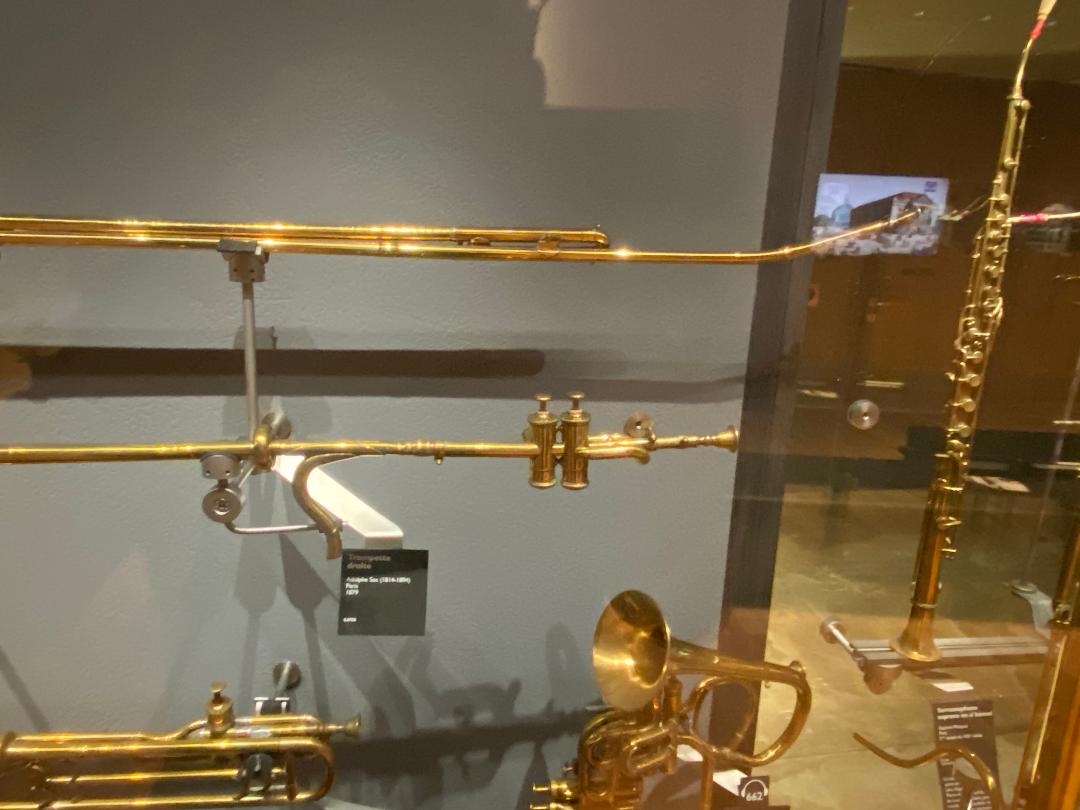
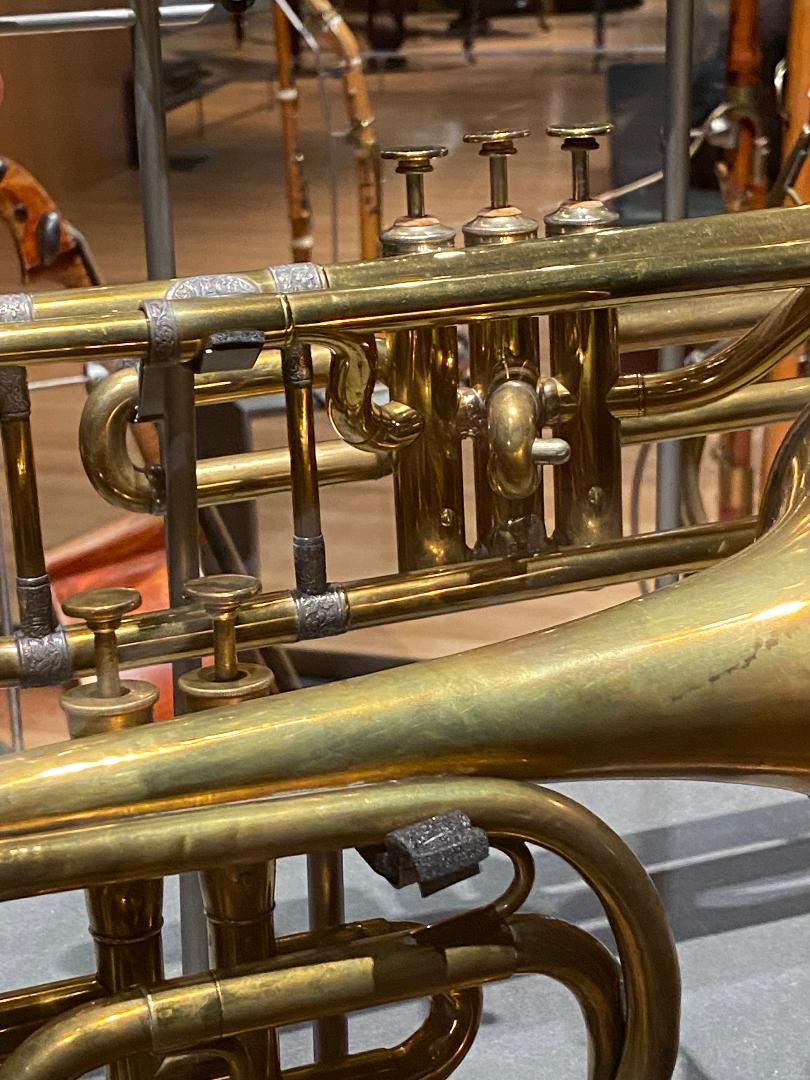
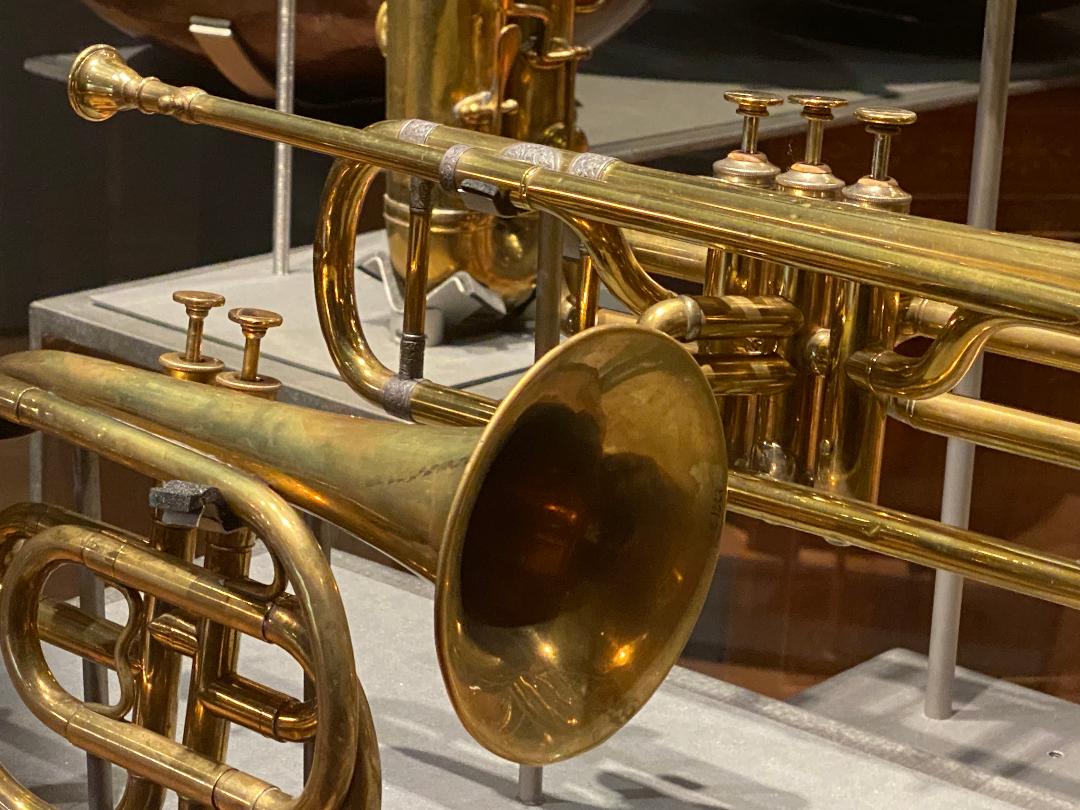
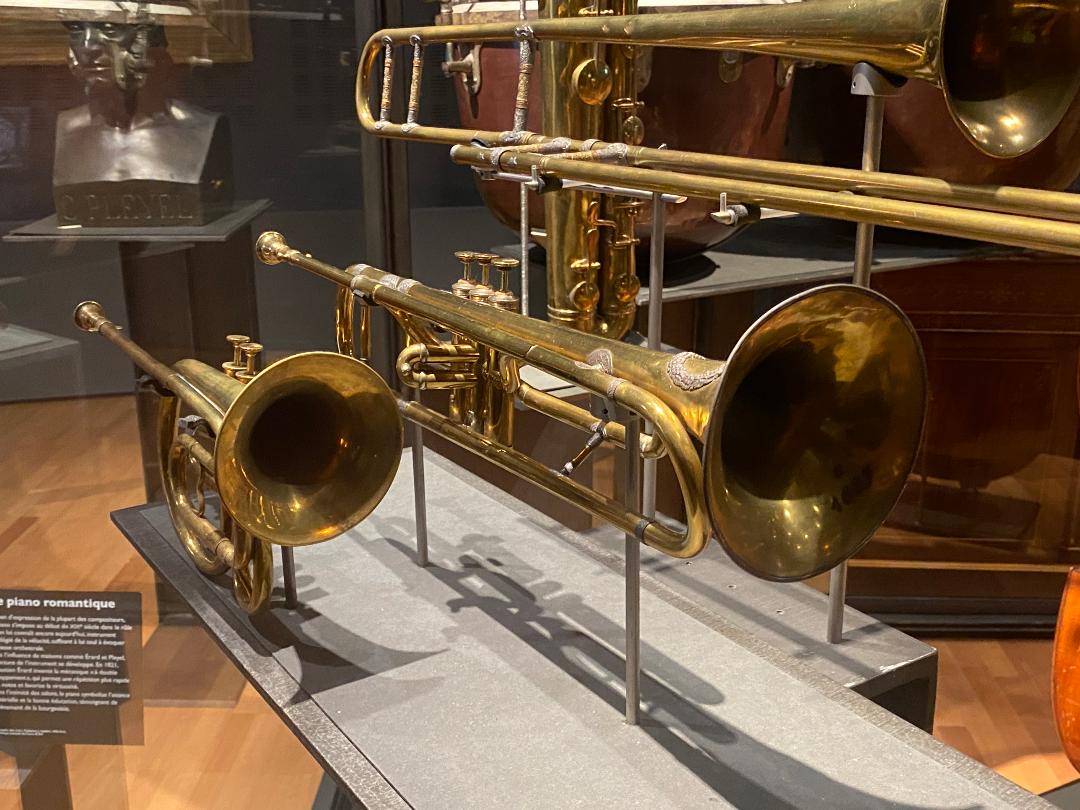
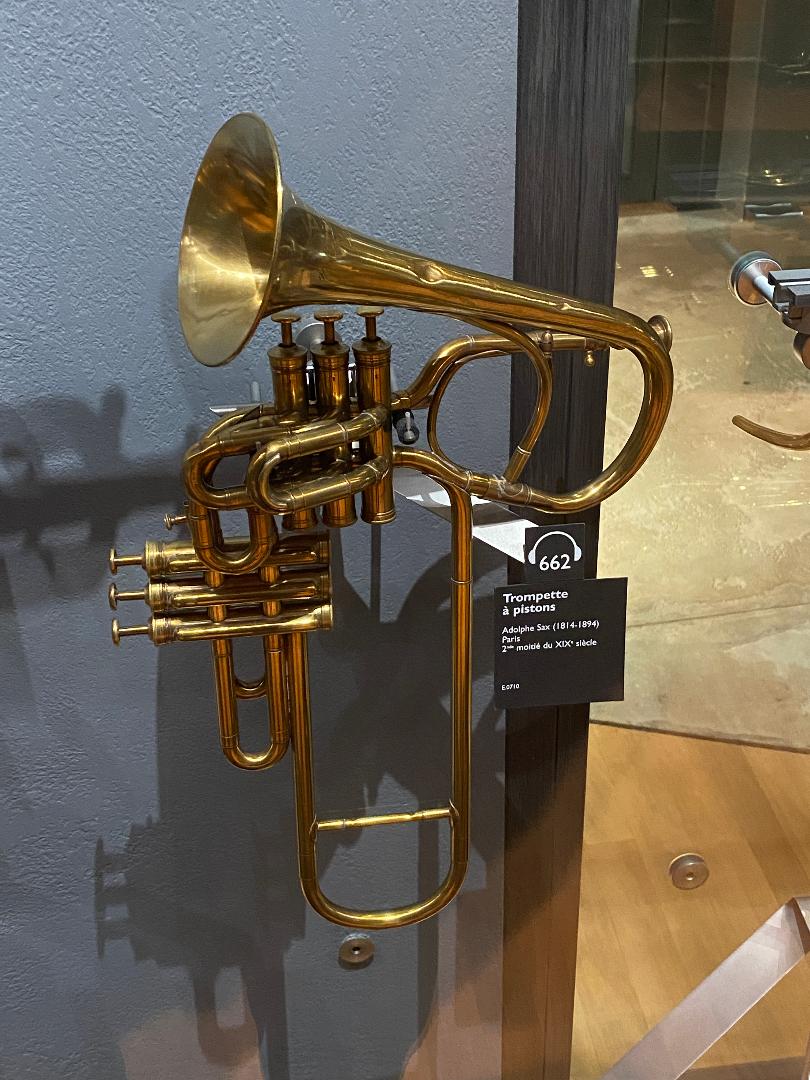
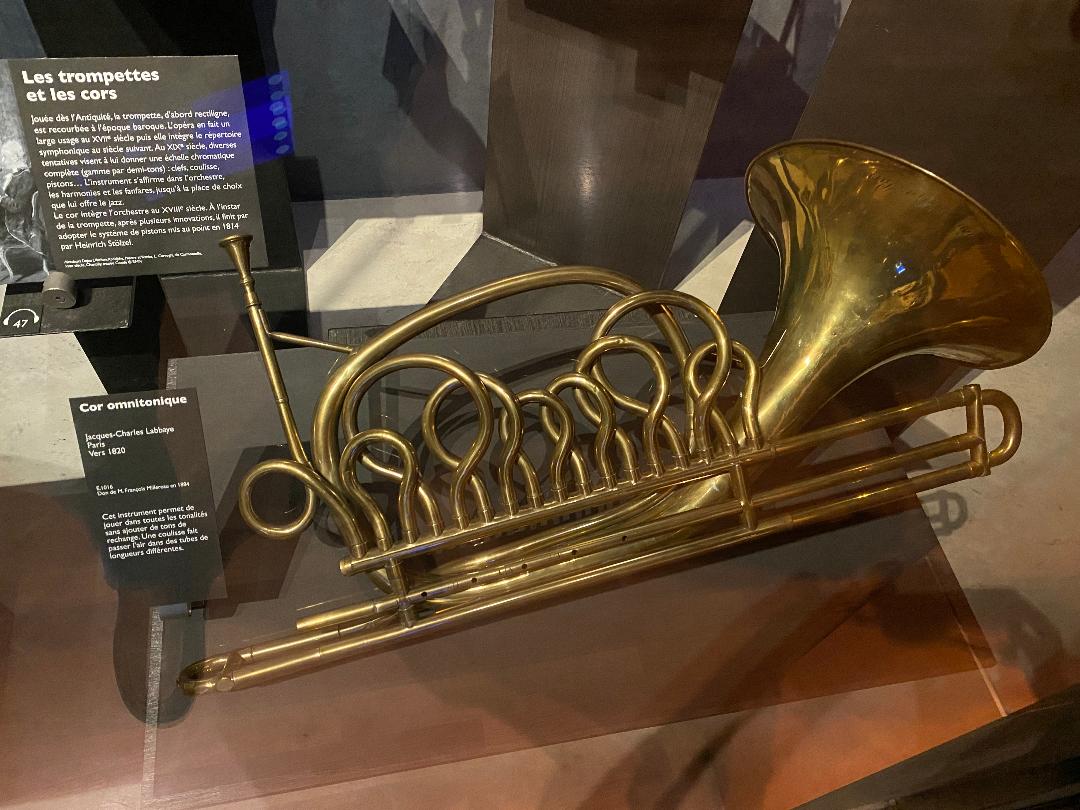
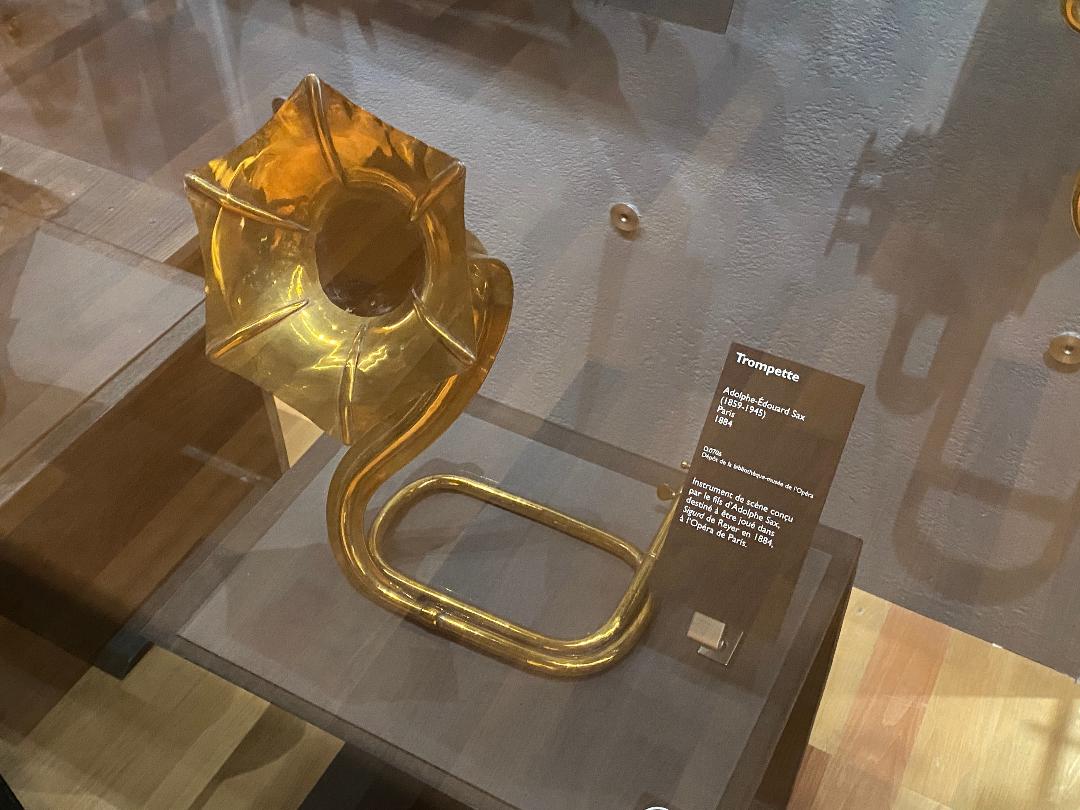
It also turns out that the transformation of the trumpet (from its natural straight or curved tubal shapes without values to curved, looped shapes with valves) did not take one giant leap from no valves to three valves in the 1830s. In other words, it did not suddenly leap from being able to sound only harmonic tones (like a bugle) to sound all notes in the chromatic scale. It progressed from having no valves to one valve, to two valves, to three valves during the period 1788-1830s. And for the first time in my life, I saw samples of such trumpets in the Paris Music Museum!
Classic 1871 “Egyptian” or “Aida” trumpet
Is this the display spoken of by the Museum Docent?
When did trumpeters begin to play “Trumpet Voluntary” on actual valved trumpets—does it take one, two or three values to play it? In the key of C, I think you could play it on a two-valved trumpet, if the first value permitted you to play the Ds and Fs and the second value permitted you to play the A (along with the first valve) and F#.
The most prolific baroque composer for trumpet was Giuseppi Torelli. He is thought to have composed his Sinfonia with Trumpet in D (G. 8) in the 1690s. Henry Purcell’s The Fairy-Queen was first performed in 1692. Handel’s Water Music Suite No. 2 heavily features trumpets. It premiered in 1717. Vivaldi composed his Concerto for Two Trumpets in ~1720s. Jean-Joseph Mouret composed his Suite de Symphonies in 1729. Its Rondeau is used as the theme music for PBS’s program, Masterpiece. Handel composed his Messiah in 1741. His Music for the Royal Fireworks (1749), especially movements 1 and 4, features trumpets. Leopold Mozart composed his Concerto for Trumpet in D Major in 1762. Hadyn composed his Trumpet Concerto in E-flat major in 1796. Hummel composed his Trumpet Concerto in E Major in 1803. Beethoven composed his Ninth Symphony in 1822-24. What kind of trumpets did trumpeters play for each of these? The first valve was invented in 1788. The second valve was added in 1815.
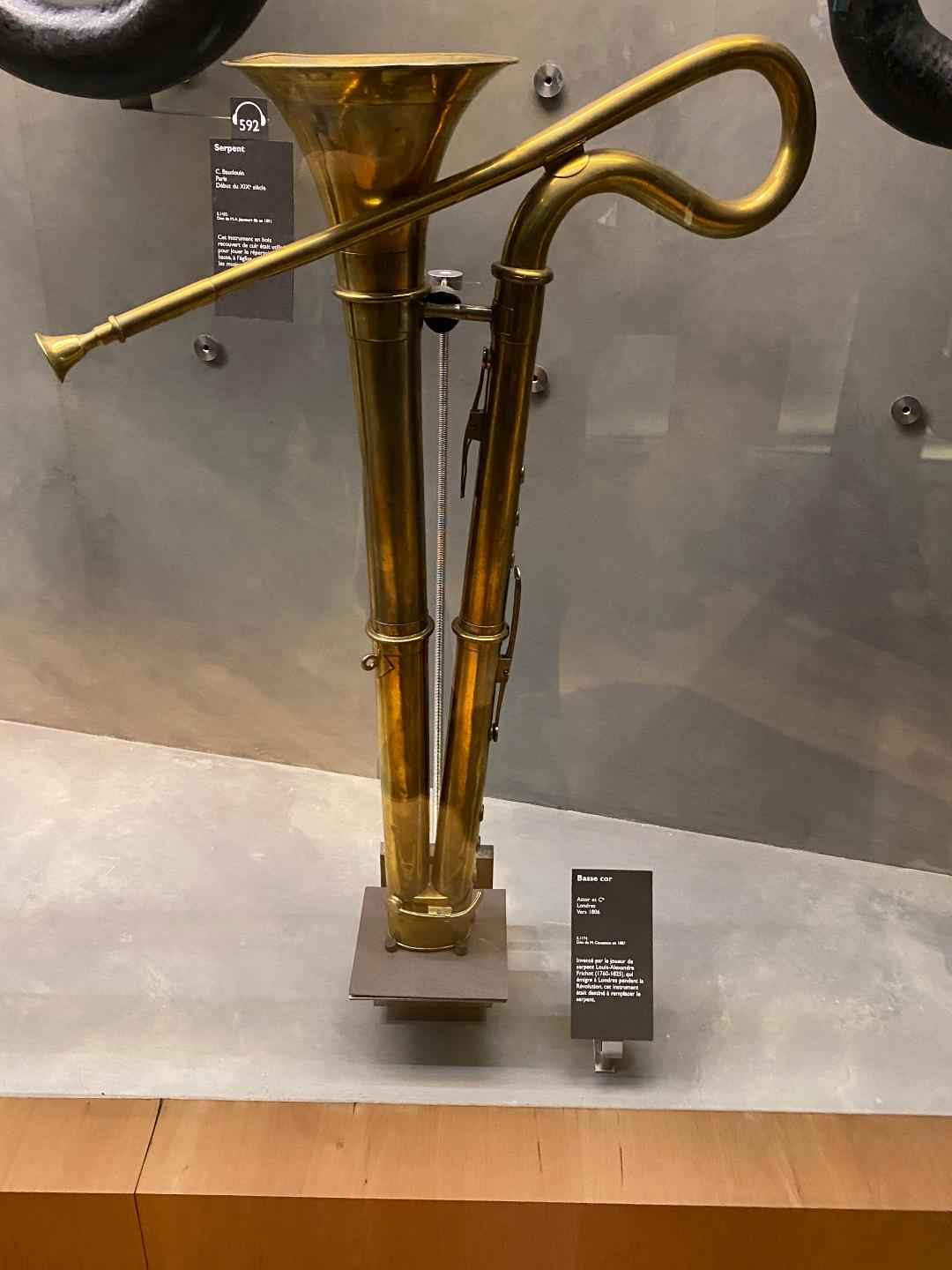
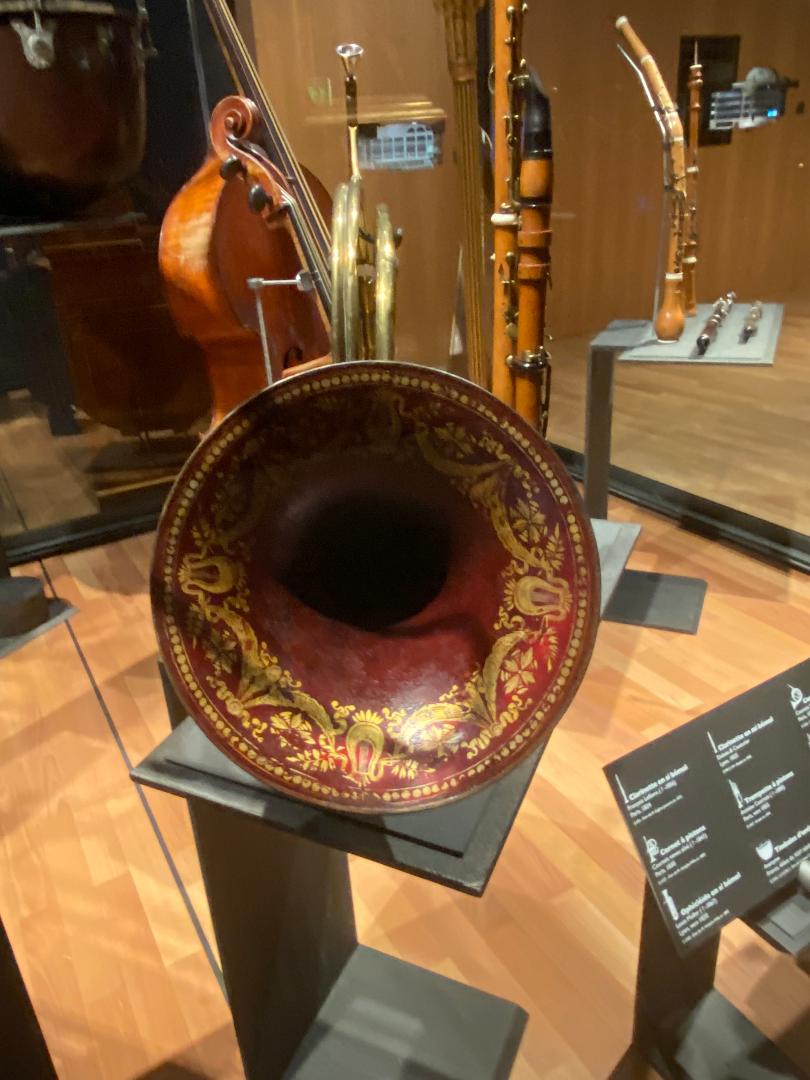
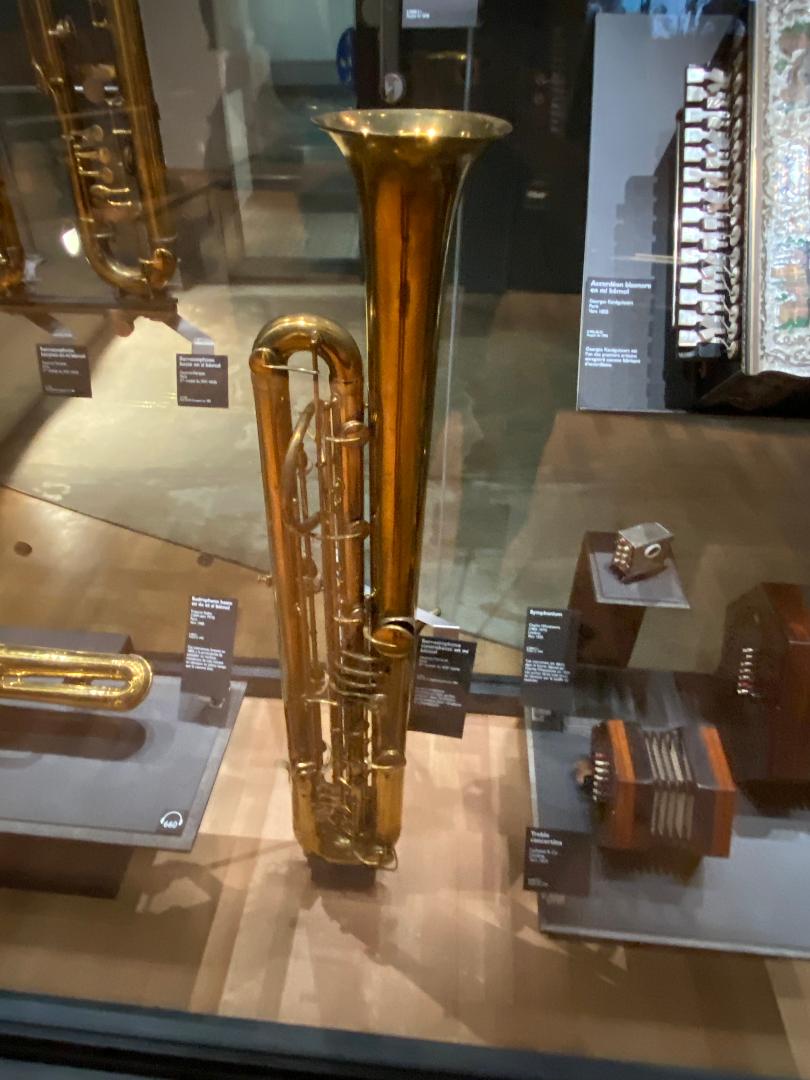
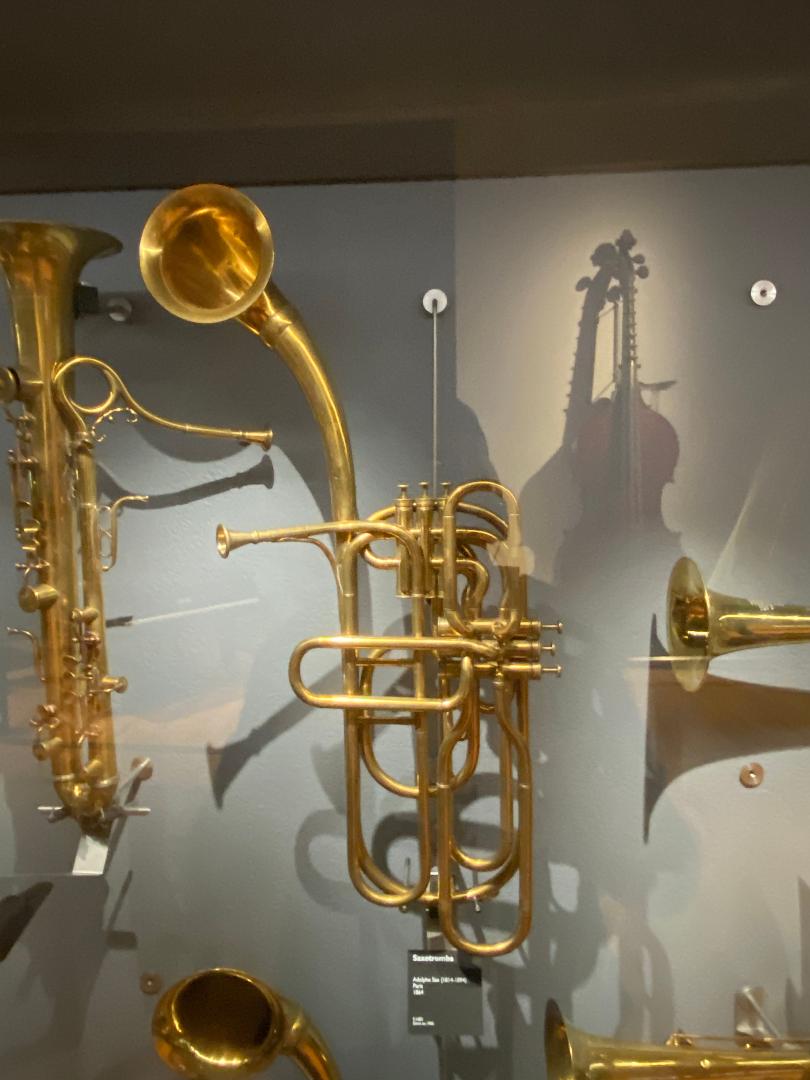
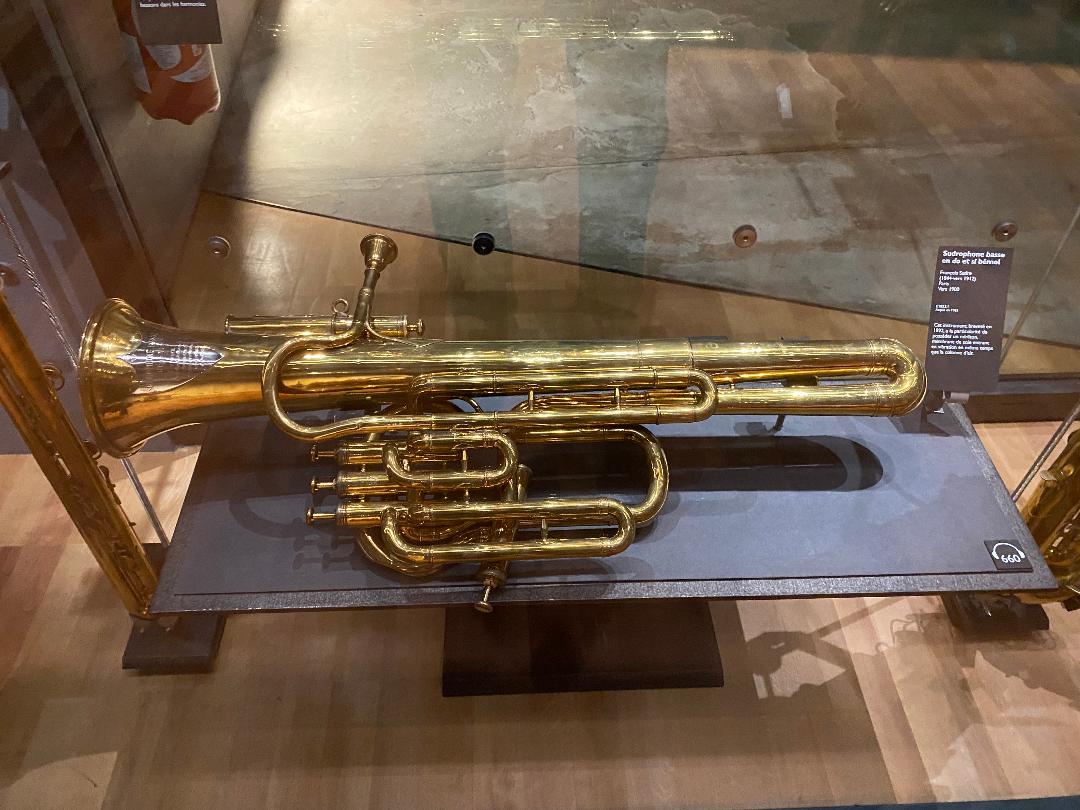
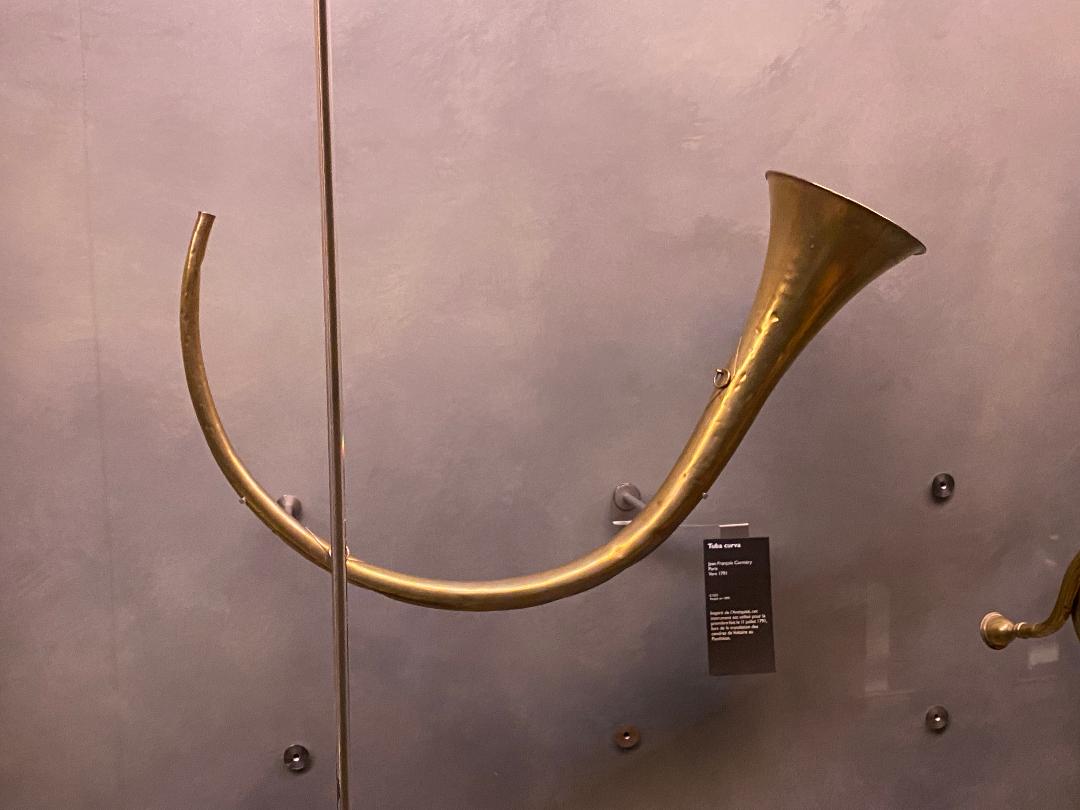
In the museum, I took many photos so that I can now give you a rudimentary tour showing the evolution of the trumpet. There are photos of some very weird-looking instruments, as well as shots of Chopin’s piano, some portraits of composers, and a video of a guest musician playing a forerunner to the French horn that looks somewhat like the modern mellophone. Please click on any photo to enlarge it.
Chopin’s PianoChopin’s piano (left)Video with Sound
In April, my wife and I went to Italy for the first time–Milan, Venice, and Florence, wow! Our overseas travels have usually been to the UK and Paris in July-August. But a huge magnet drew us into Italy this spring—our granddaughter was studying in her freshman year at New York University’s campus in Florence and her 19th birthday was in late April.
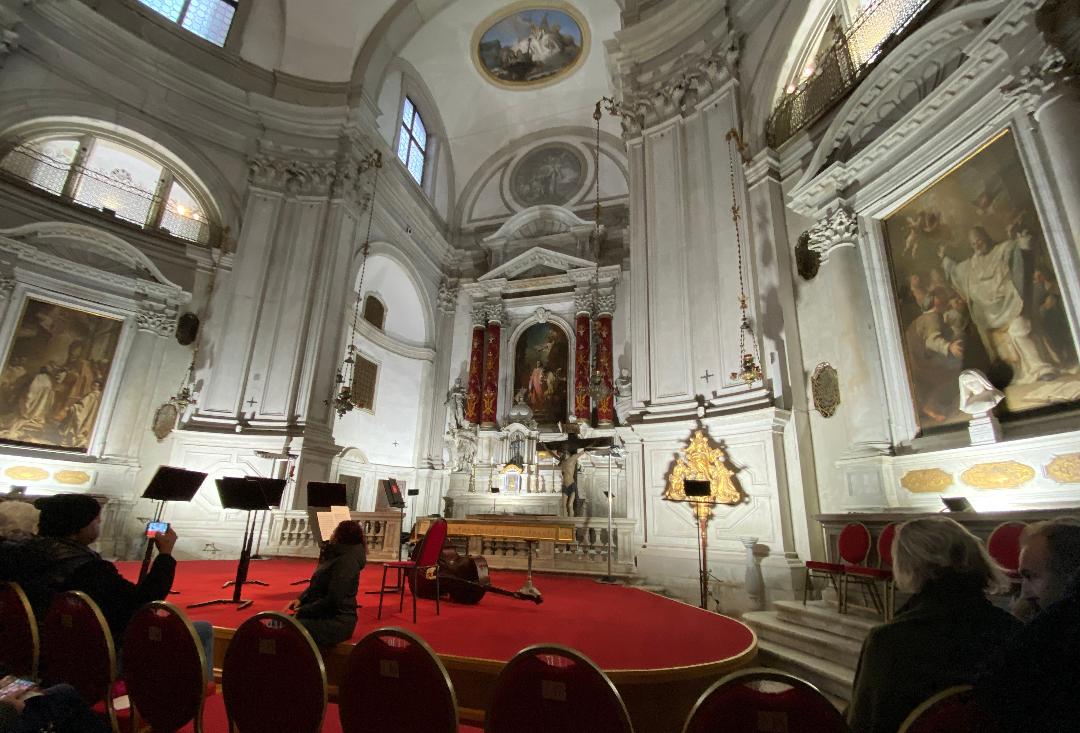
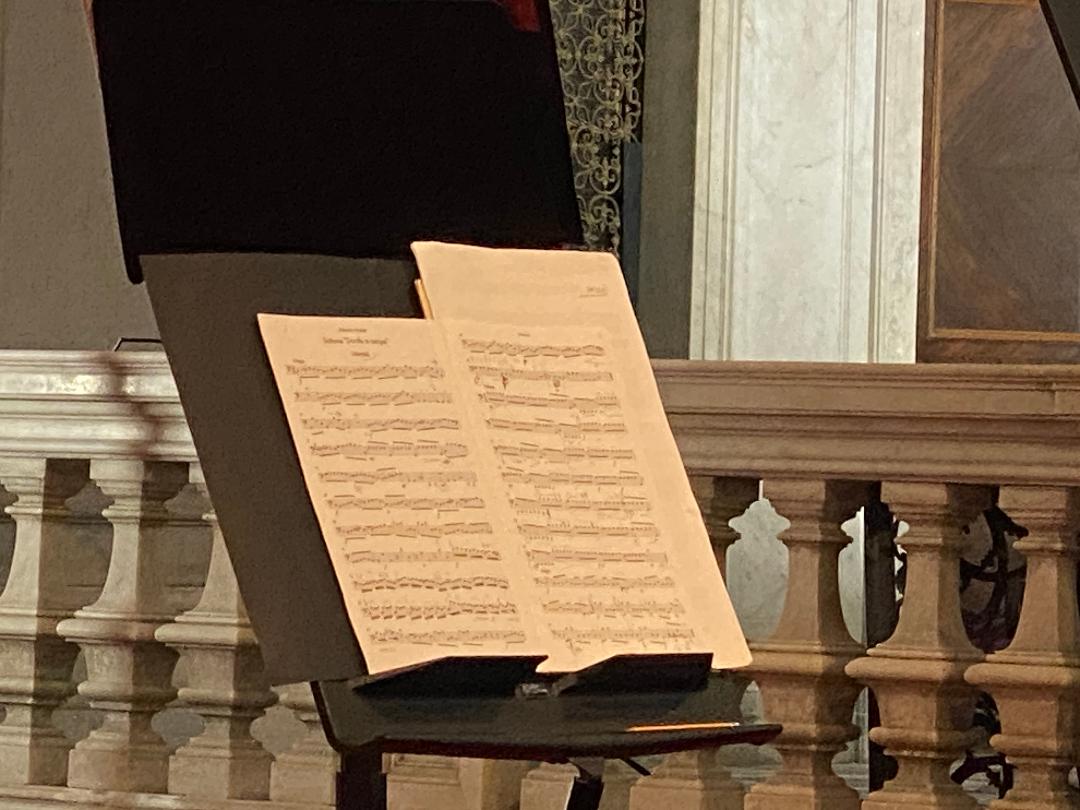
Stage before concert, Vivaldi’s Church, Venice
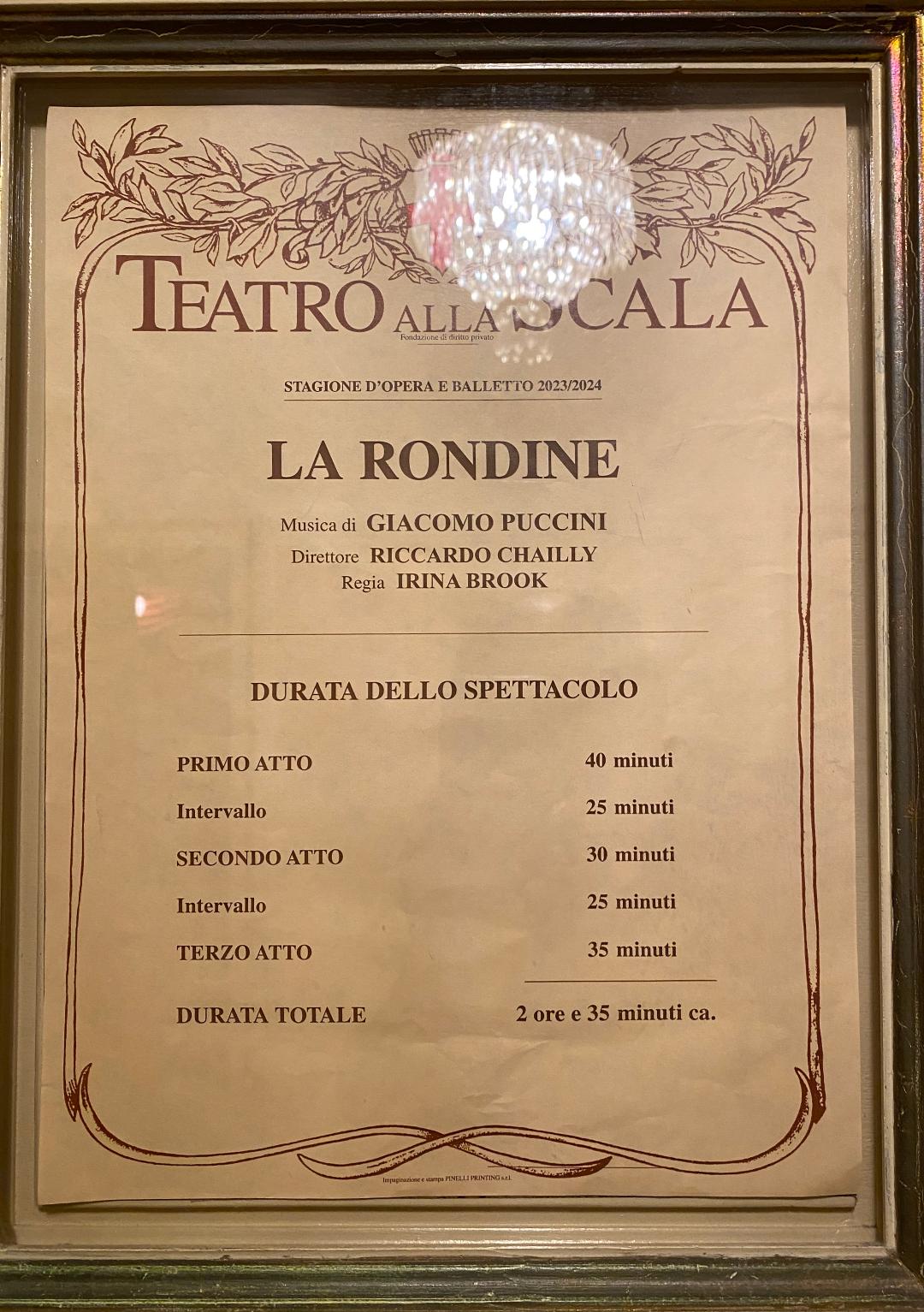
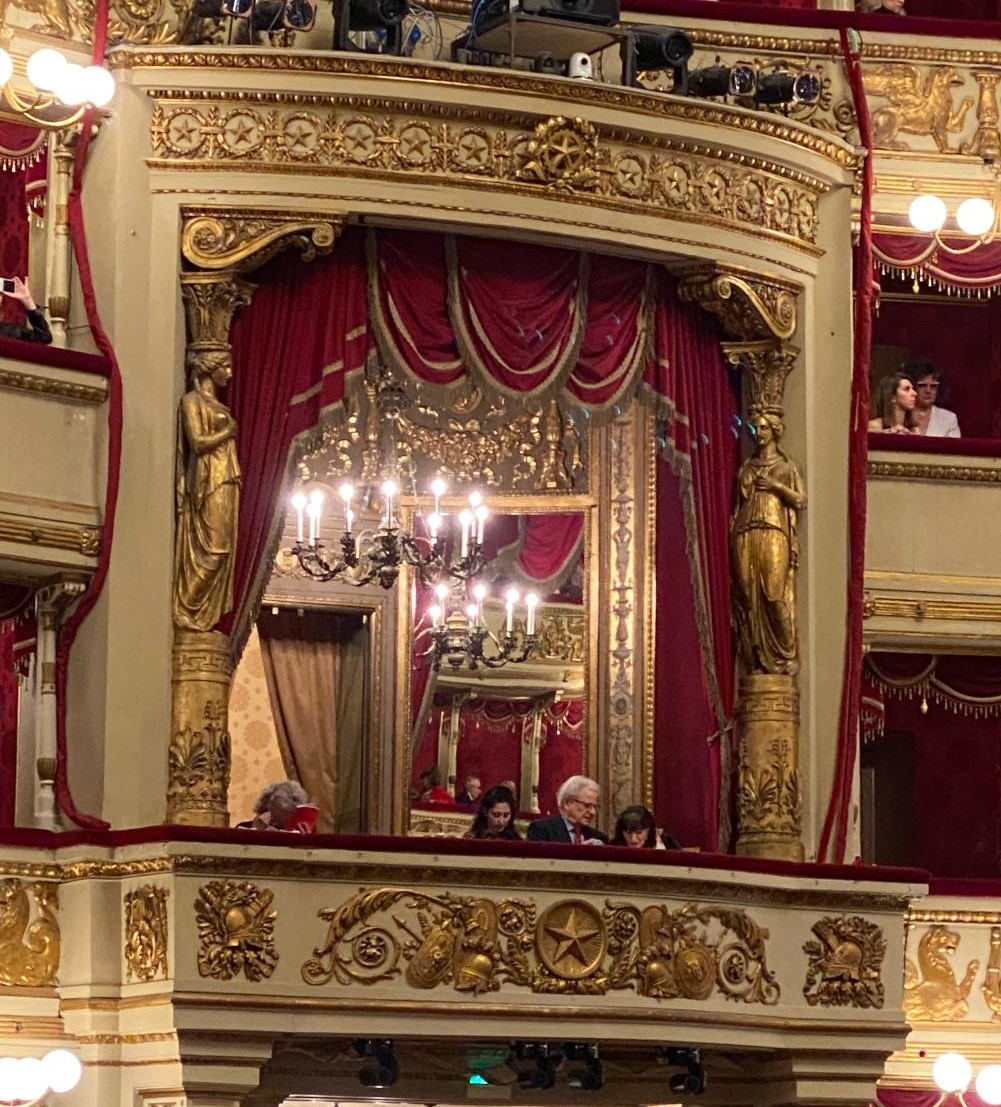
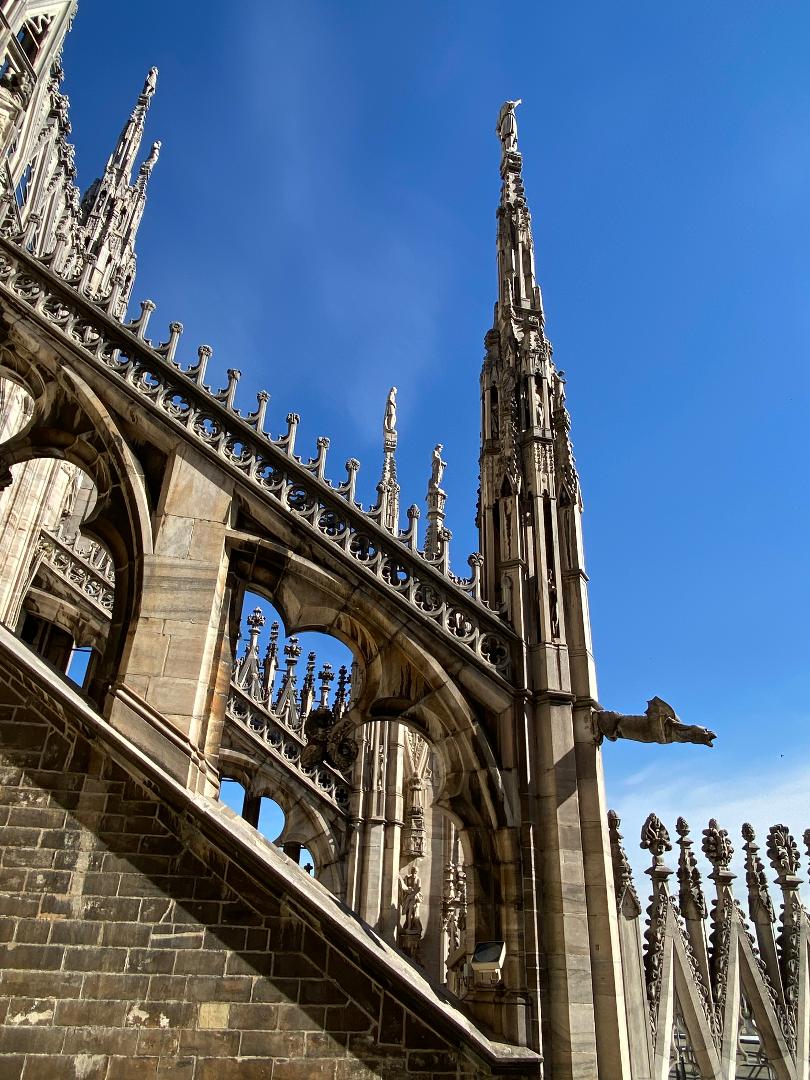
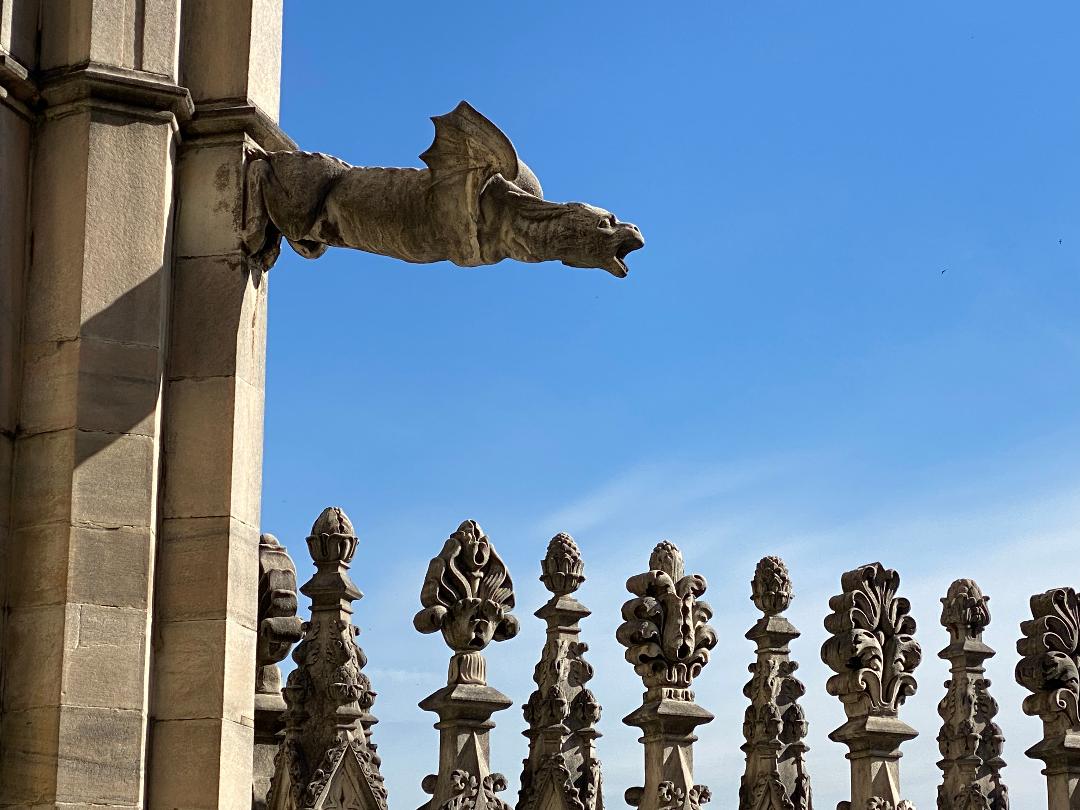
Our first stop was Milan to see the magnificent Milan Cathedral. Then we saw “The Last Supper” painting by Leonardo da Vinci at St. Maria delle Grazie church. Next, we attended an opera at the fabulous Teatro Alla Scalla. At the cathedral, we saw not only the interior but also a portion of the rooftop. At the opera house, we saw Giacomo Puccini’s La Rondine (The Swallow).
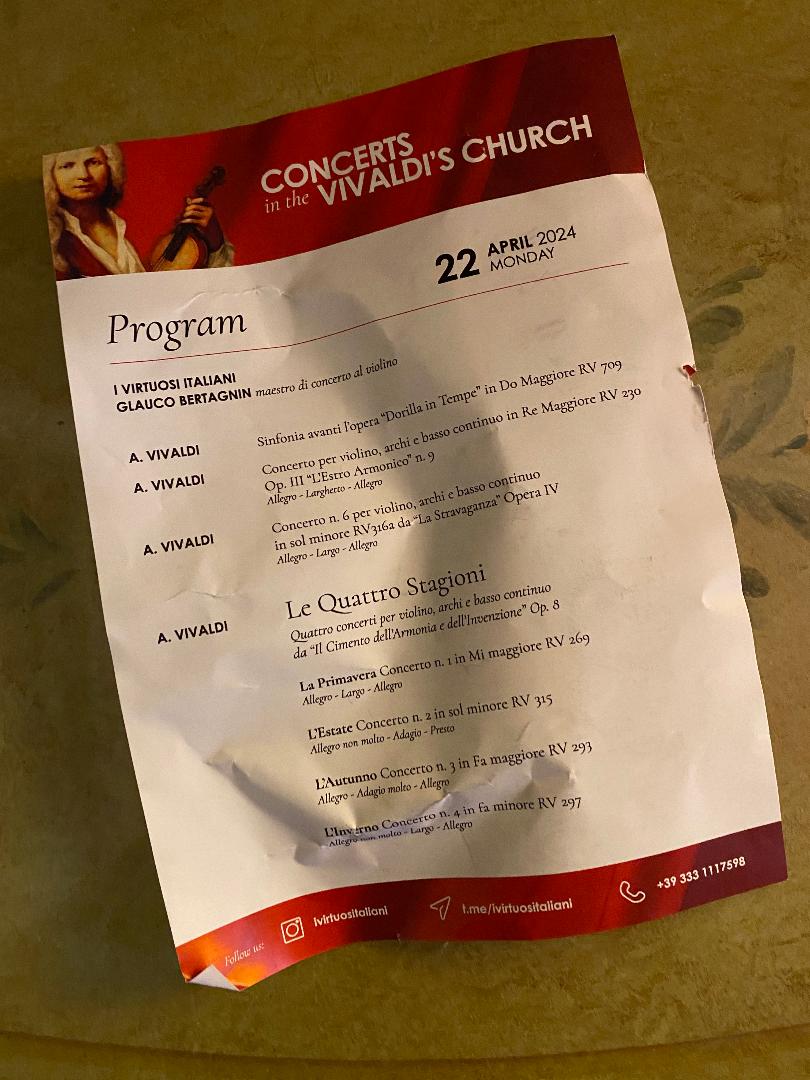
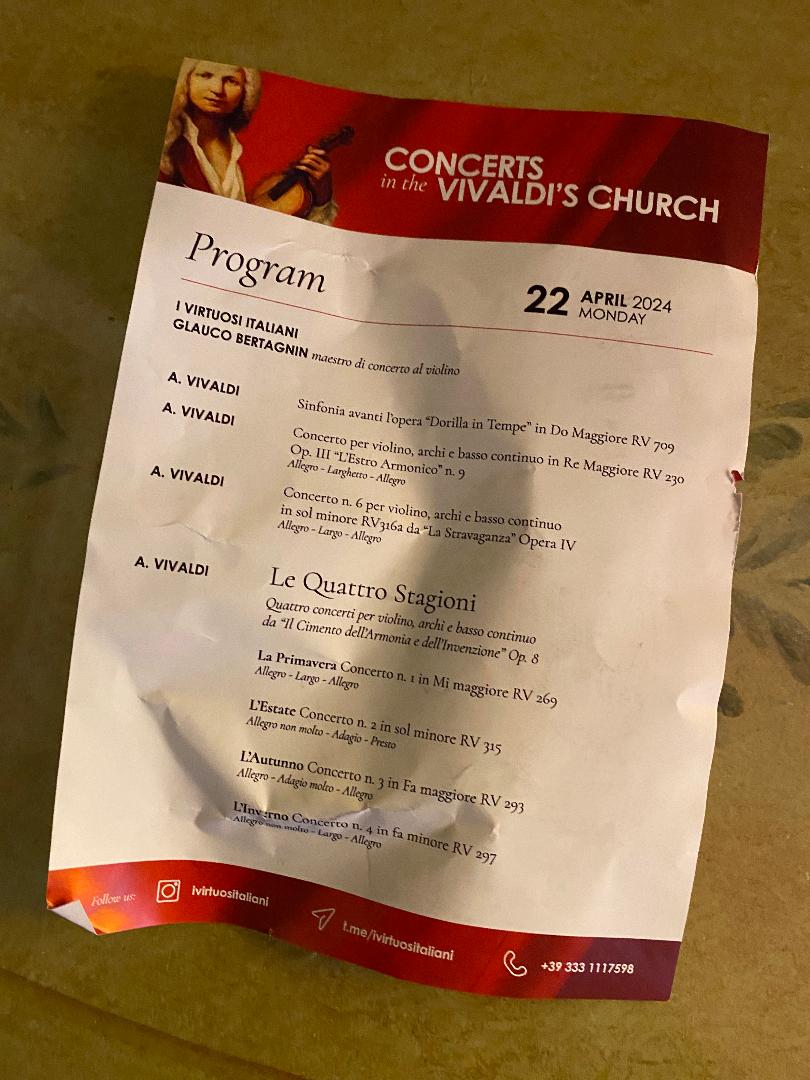
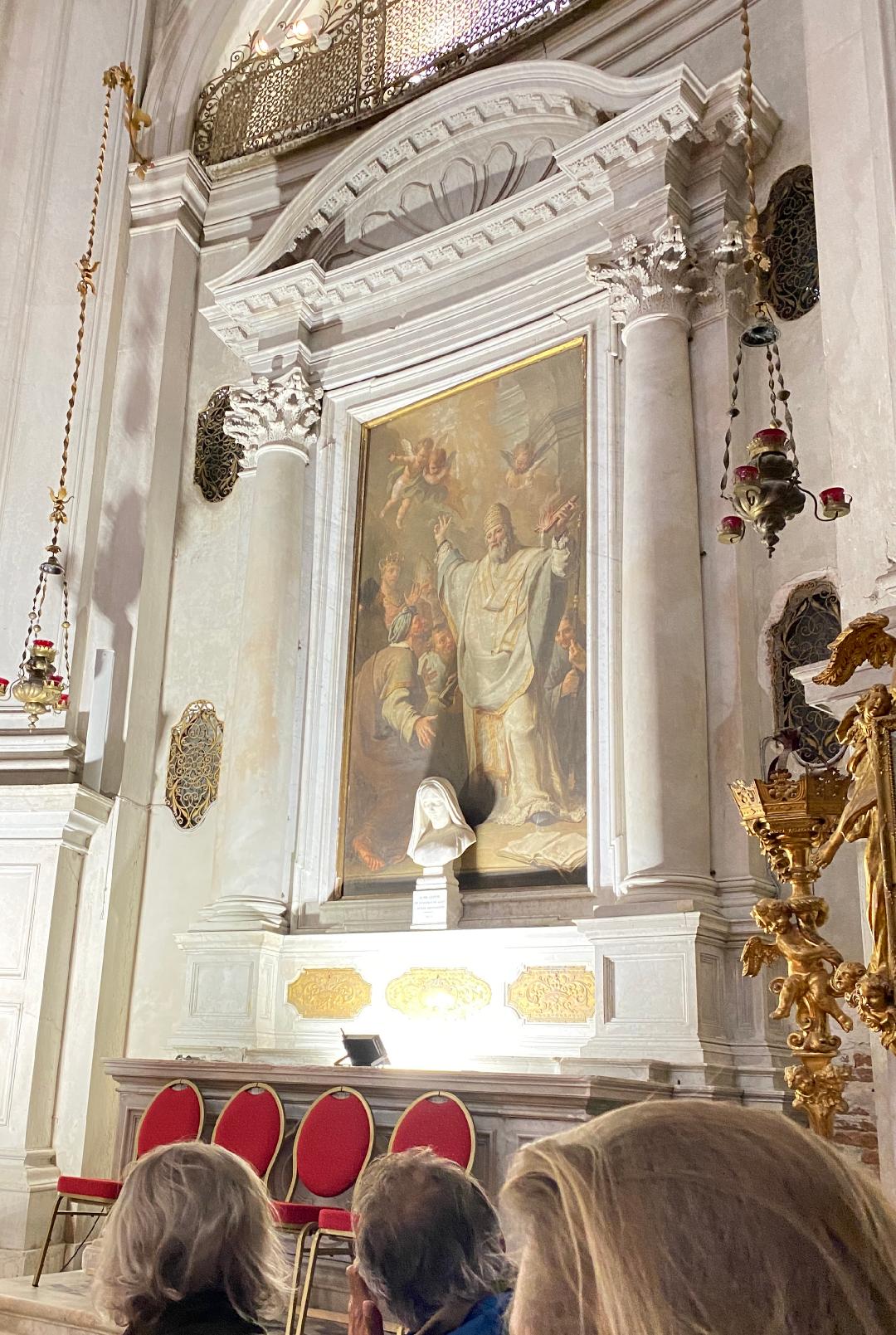
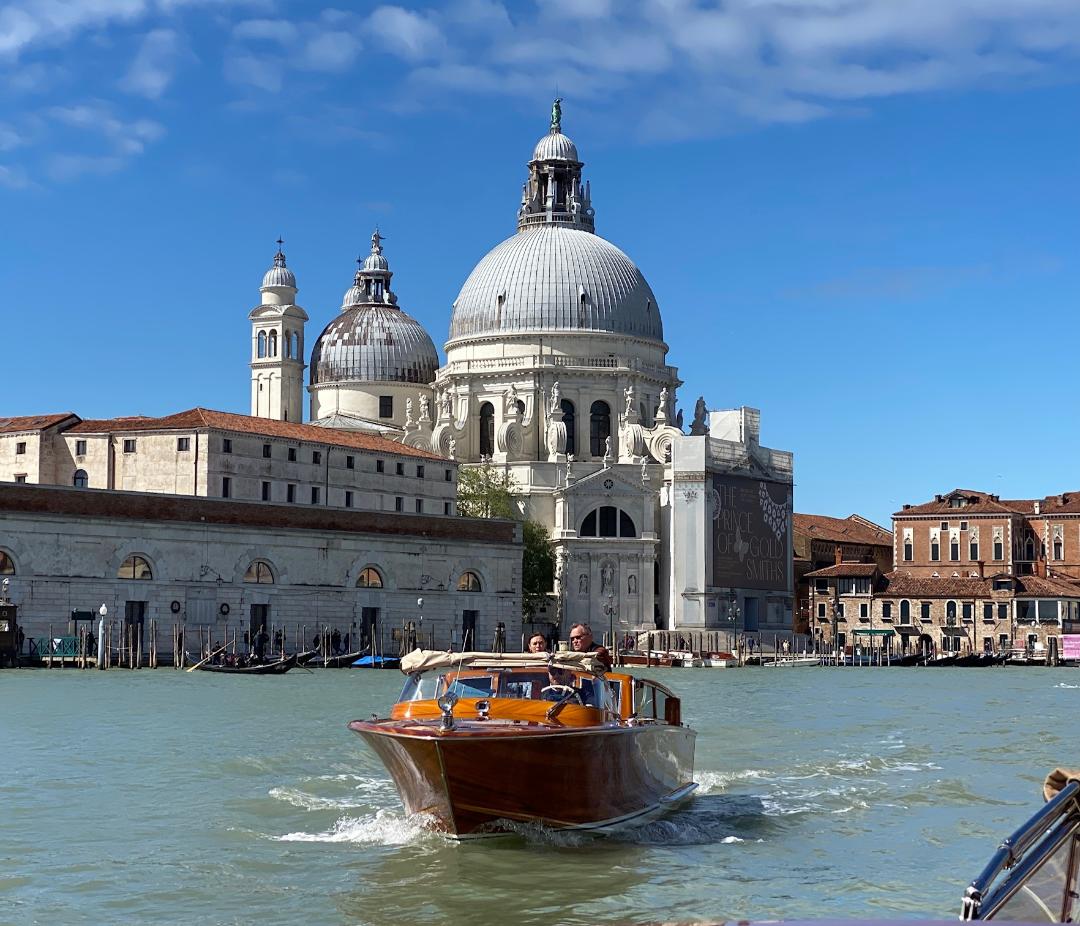
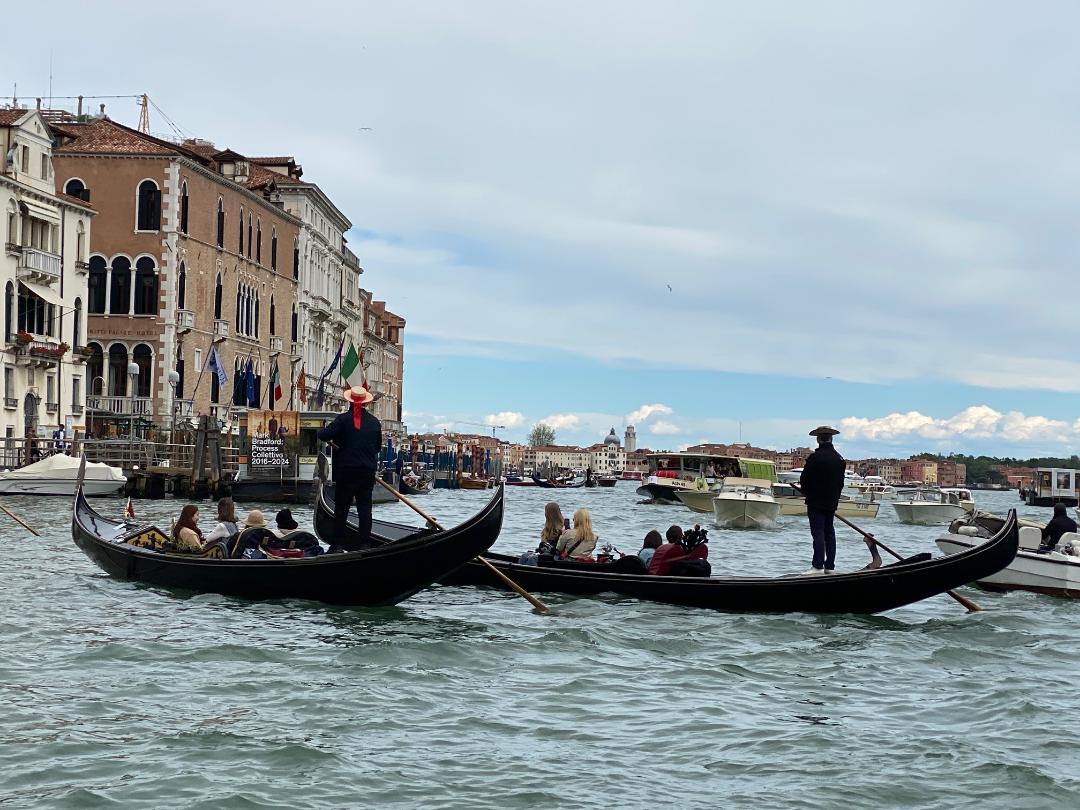
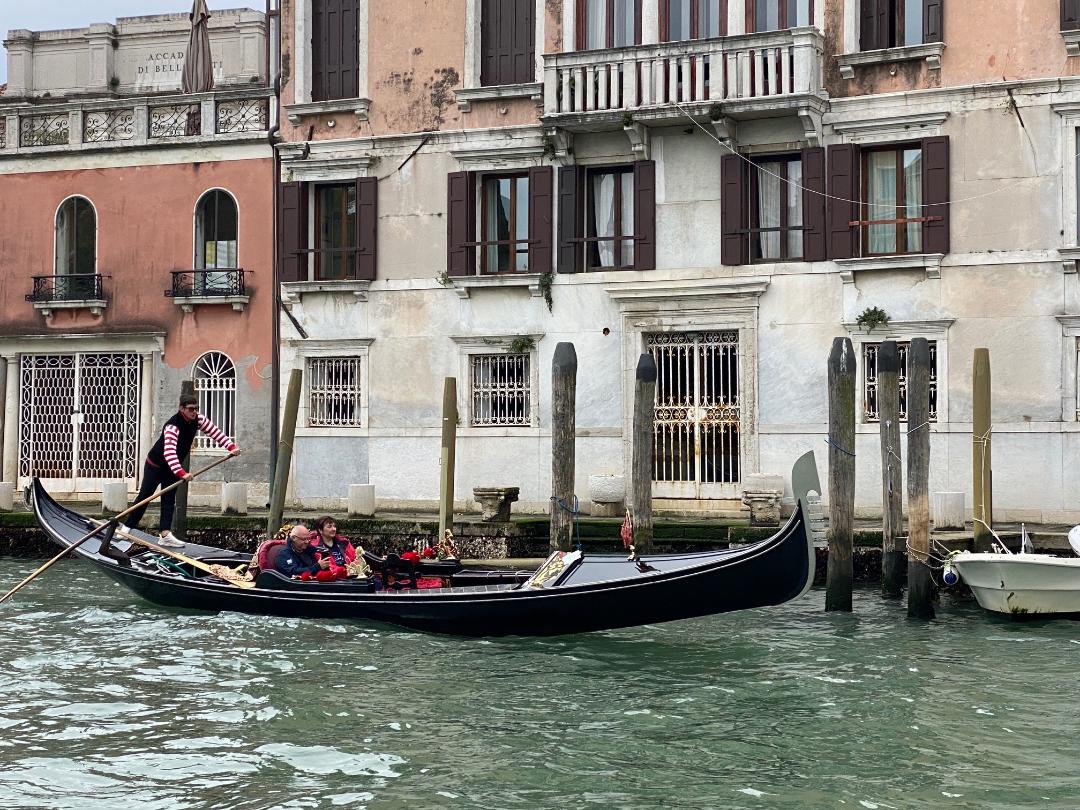
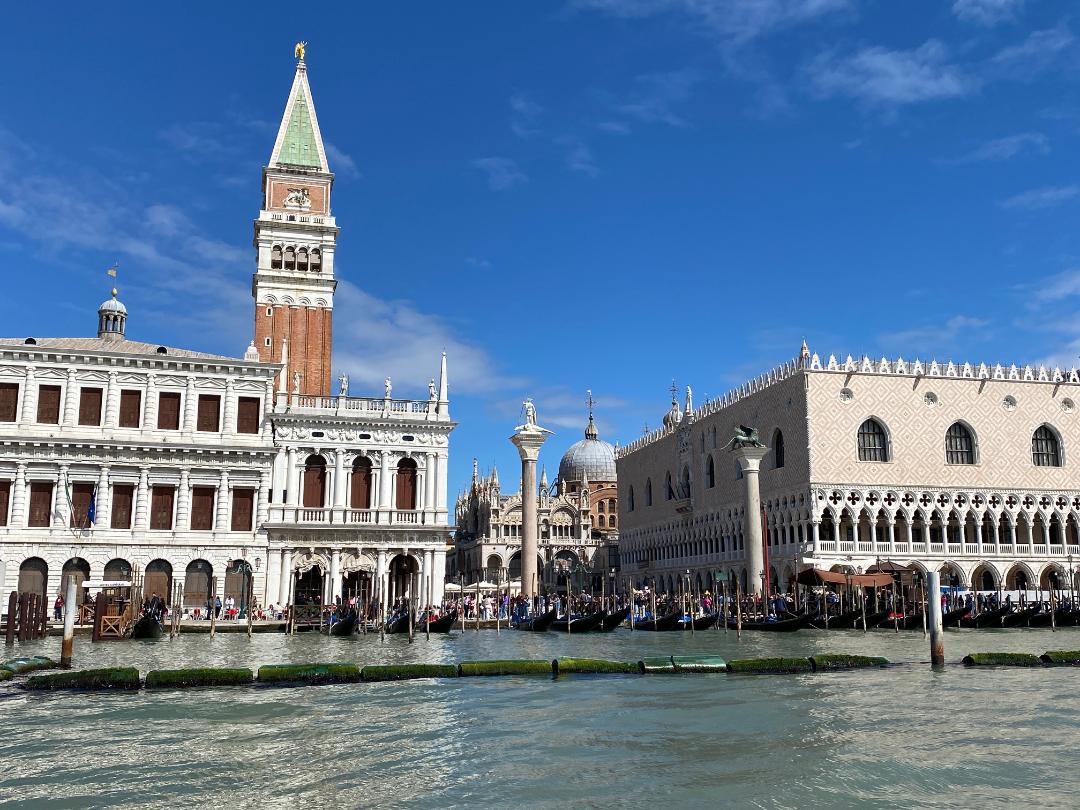
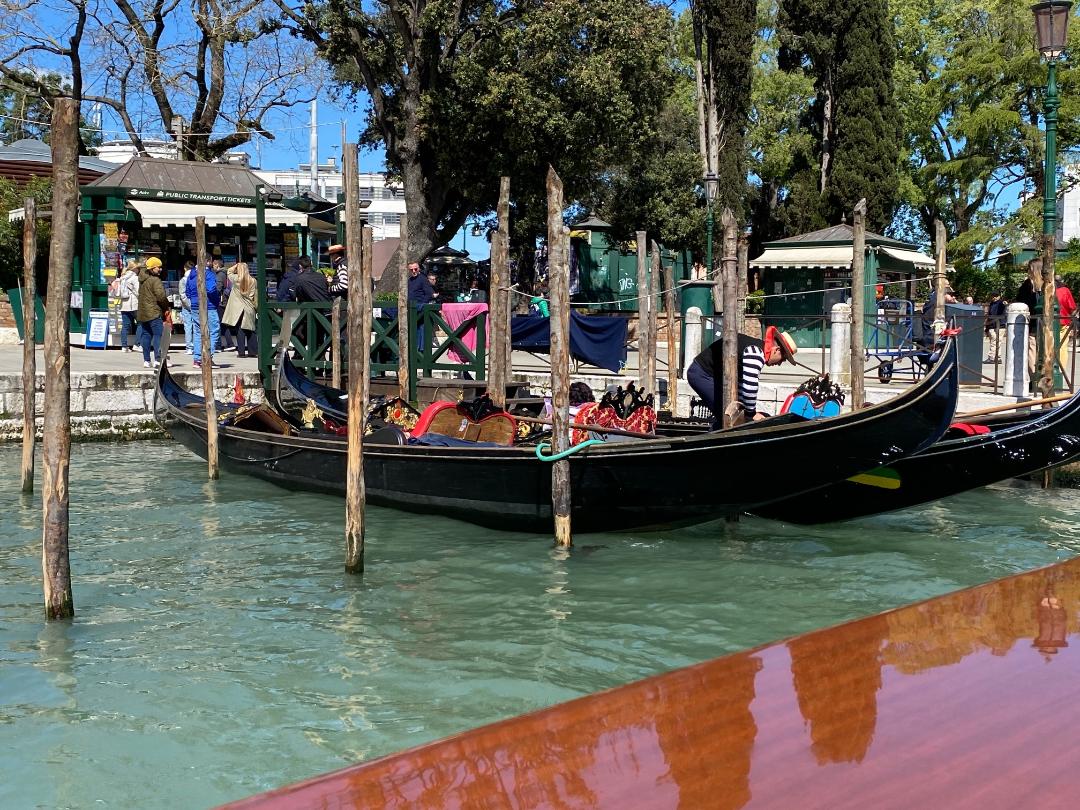
Next was Venice, where our hotel was near the Piazza San Marco. Also, nearby was Church of the Pietà – Saint Mary of the Visitation. It’s known as “Antonio Vivaldi’s Church” because he became a priest there so that he could compose, teach and perform music. He was there, with several interruptions, between 1703 and 1740. He produced over 500 compositions. On 22 April, we attended an evening concert by the renowned ensemble, I Virtuosi Italiani (The Italian Virtuosos)—superb entertainment!
“Things Remembered” is the name of one of my favorite one-hour trumpet shows. But that show is not the remembrance that still bothers me. Instead, it’s the memory of those five days, 16 to 20 December just before Christmas. On the 16th, I performed two bugle calls at the Wreaths Across America ceremony in Seattle, which I wrote about in my previous post here. And on the 20th, I performed my trumpet show, “Things Remembered,” at The Bellettini,” in downtown Bellevue. I struggled to play my horns on both days, and afterwards, I did not touch them again for the first four and a half months this year. What happened? Let me tell you.
Suddenly, a few days before the 16th, my buzz into the mouthpiece went bad. My lips would not respond to the air flow unless I blew quite hard. But you can’t play every note of every bugle call or song at “FF” volume. I’d blow, and at first, only air would hiss through the horn before a note would suddenly burst out. It was sort of like stammering or stuttering, when the words just won’t come out of a person’s throat for a few seconds, followed by a shout. I’d lost the ability to fade out down to “pp” and softer. I’d lost some control of dynamics and the ability to express certain emotions through the horn.
At first, I thought it was simply stiff lips that had lost their flexibility from not enough practicing. I thought I could overcome it if I warmed up for at least 20 minutes. But no amount of warming up would eliminate it. On the 16th, my “Assembly” didn’t sound normal. I struggled a bit with “Echo Taps,” too. It didn’t help that I had to stand and play without my cane, hunched over from lower back pain.
So, should I cancel my show at The Bellettini? I love The Bellettini, the staff, and the residents. They had invited me back for the fifth time to present a new show which they had not yet heard.
I couldn’t bear the thought of canceling, even if I wouldn’t sound normal. I had three more practice days to improve. If I didn’t sound better, would they forgive me? Or would they walk out and never invite me back again?
Yamaha Allen Vizzutti, Bach 1.5C, 3C, 8C, and Getzen 3C, 7C trumpet mouthpieces
No amount of practicing changed things. I reached a certain level, and nothing improved beyond that. Then I hit on another idea: what about changing mouthpieces? Up to now, I’d been using only my favorite, the Allen Vizzutti mouthpiece by Yamaha. So, I broke out my entire (but small) collection of six trumpet mouthpieces and tried each one. I got the best results with my Bach 1.5C. Eureka!
I arrived quite early, set up, and went into a side room to warm up for a half hour. Then I came out and did the show—not normal. But no one walked out. They were very tolerant and forgiving, and besides, they were enjoying themselves. After all, we’re all in the same age group–we could be classmates!
Afterwards, numerous residents came up to thank me and say how much they enjoyed the two dozen songs from our era–such great songs with which they could sing along!
And then, a tall man came up, thanked me, and said in a kind voice, “It’s hard to play when the buzz won’t work right, isn’t it?” He said he used to play saxophone and luckily, with a reed mouthpiece, that problem can’t happen.
“Yes,” I said. “But they liked the music and had a good time.”
He agreed sympathetically and complimented me for doing my best on an off day. Was that really all it was—just an off day? I worried that my playing days might be over entirely. I might never play again in public. I simply knew that I would never let myself play like that again.
But the experience of those five days begged the question: what caused this problem? It had never happened to me since I began playing in fifth grade.
I thought, “It must be my two front teeth”—my central incisors in the upper jaw. You see, for those readers who are young, your teeth can start to migrate in old age. Mine had been slowing creeping toward the middle of my mouth for several years, so much so that the left front tooth had actually slid outside and over the right one. It was overlapping and pushing itself outward against my upper lip, and it was probably also pushing the right tooth backwards toward my tongue.
Is this TMI–“Too Much Information?” Well, how else will you know what to do when this happens to you? Keep reading…
I developed a new theory. The crooked front teeth were diverting the air flow, ruining my buzz. So, last January, I went to see my orthodontist, Dr. Zachton Lowe in Shoreline. He advised plastic aligners by Invisalign instead of metal braces. He said it would take about sixteen months to straighten all my teeth.
“Can I play ‘Taps’ on Memorial Day?” I asked.
“Yes, I think so.”
And so, I did! The Bellettini taught me a huge lesson. Please read all about my Memorial Day performances in two blog posts which are soon to be posted in a few days–but first, I’ll post next about the music on our spring trip to Italy and Paris.
Glenn Ledbetter warms up his bugle while using practice mute to muffle sound
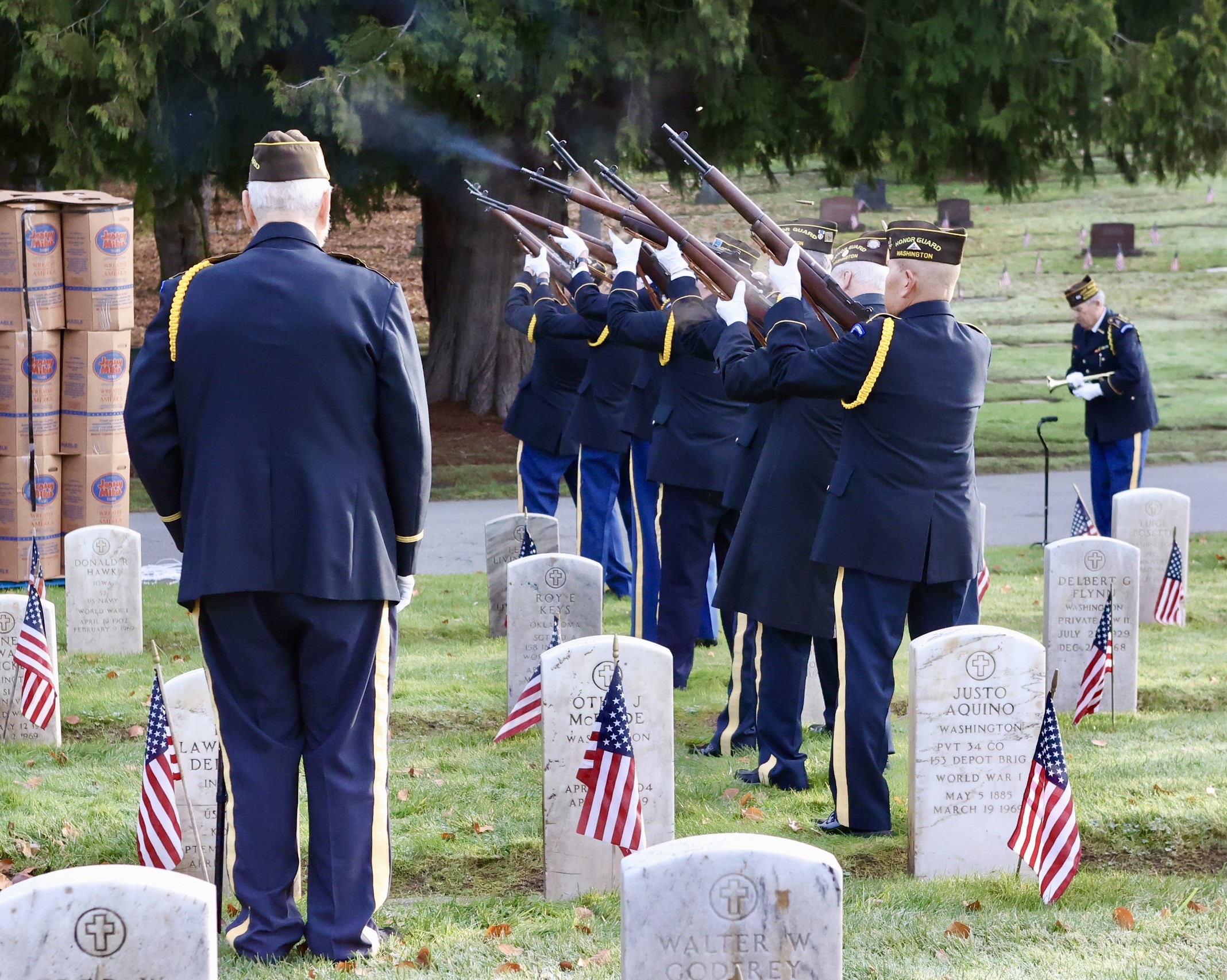
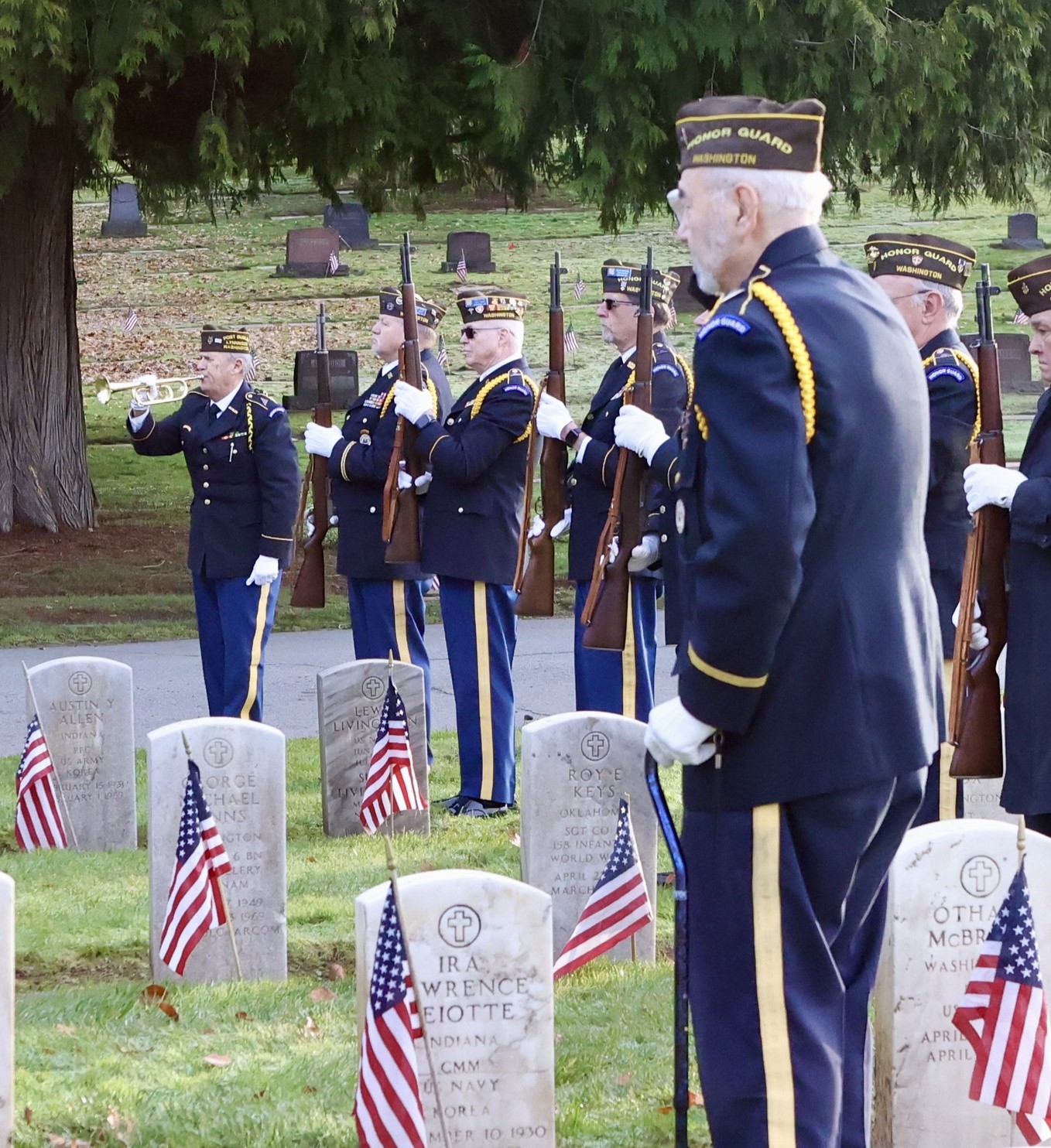
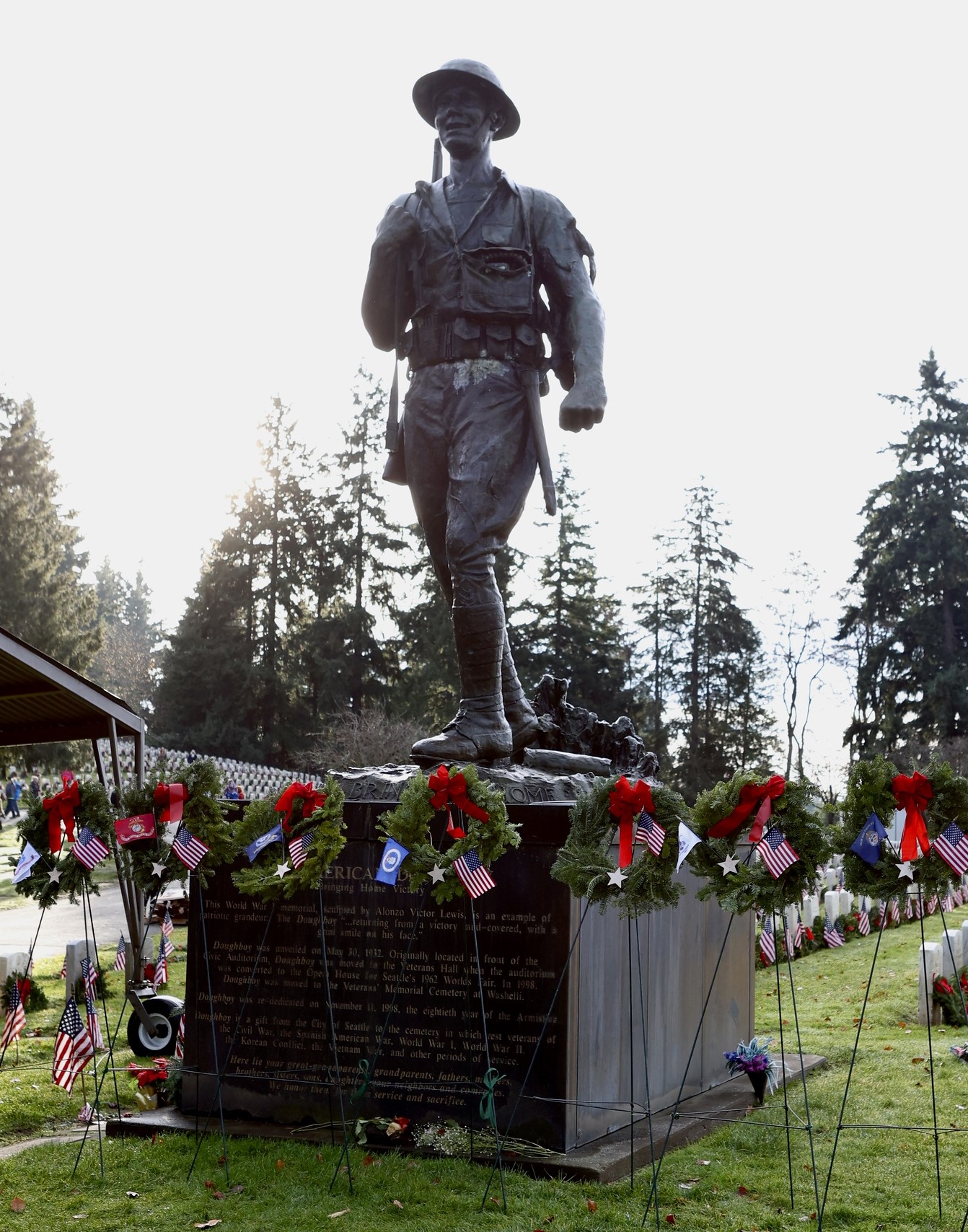
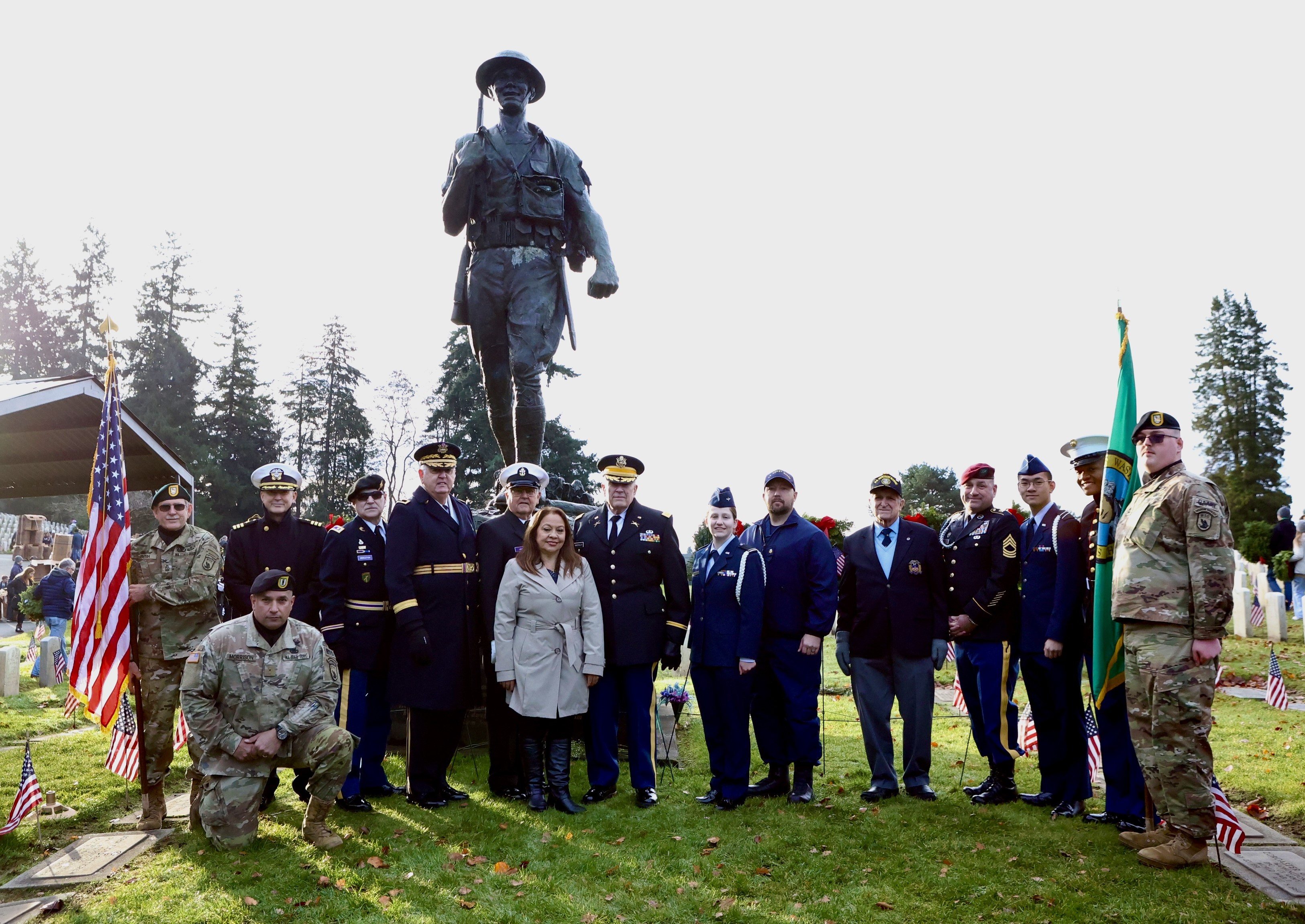
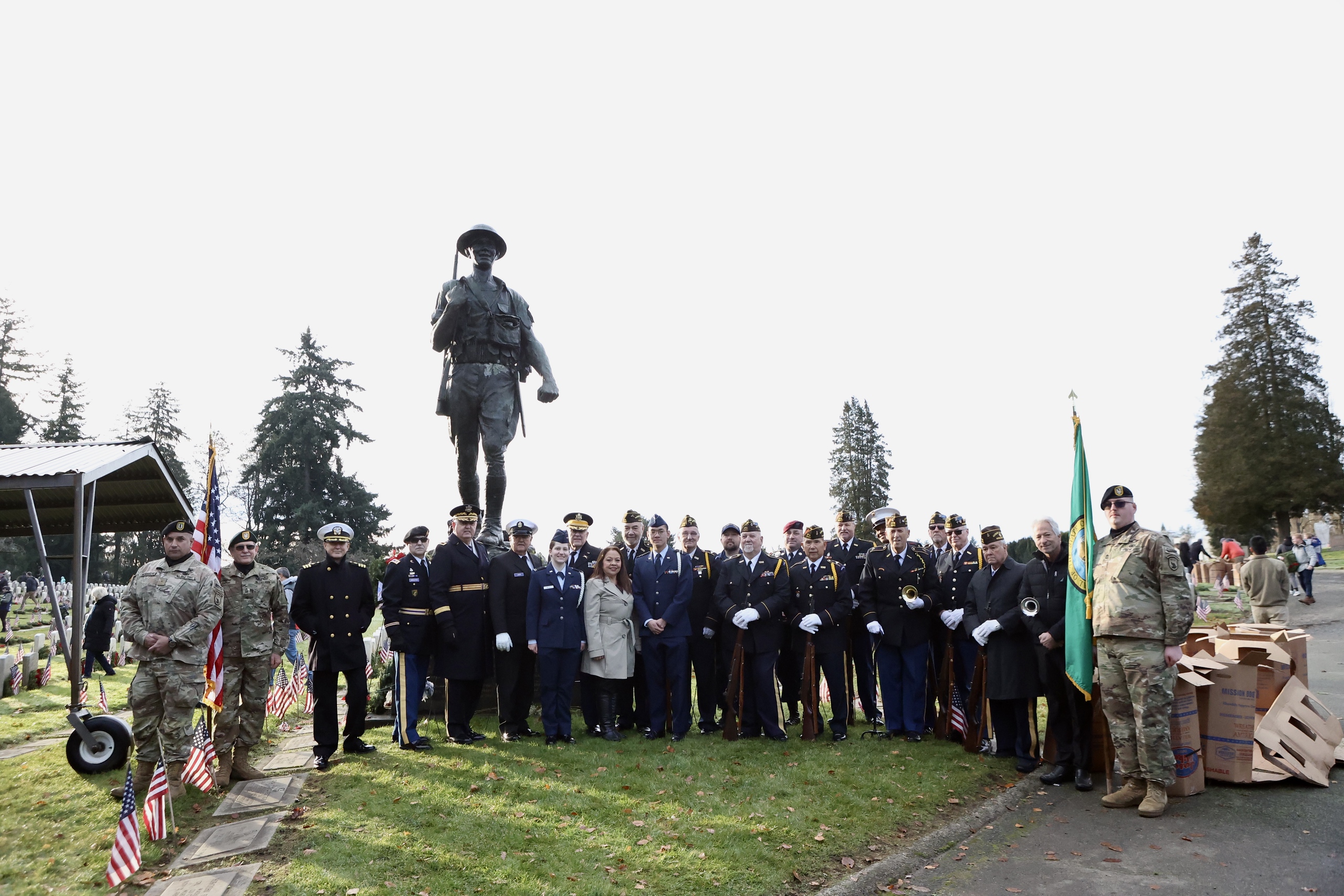
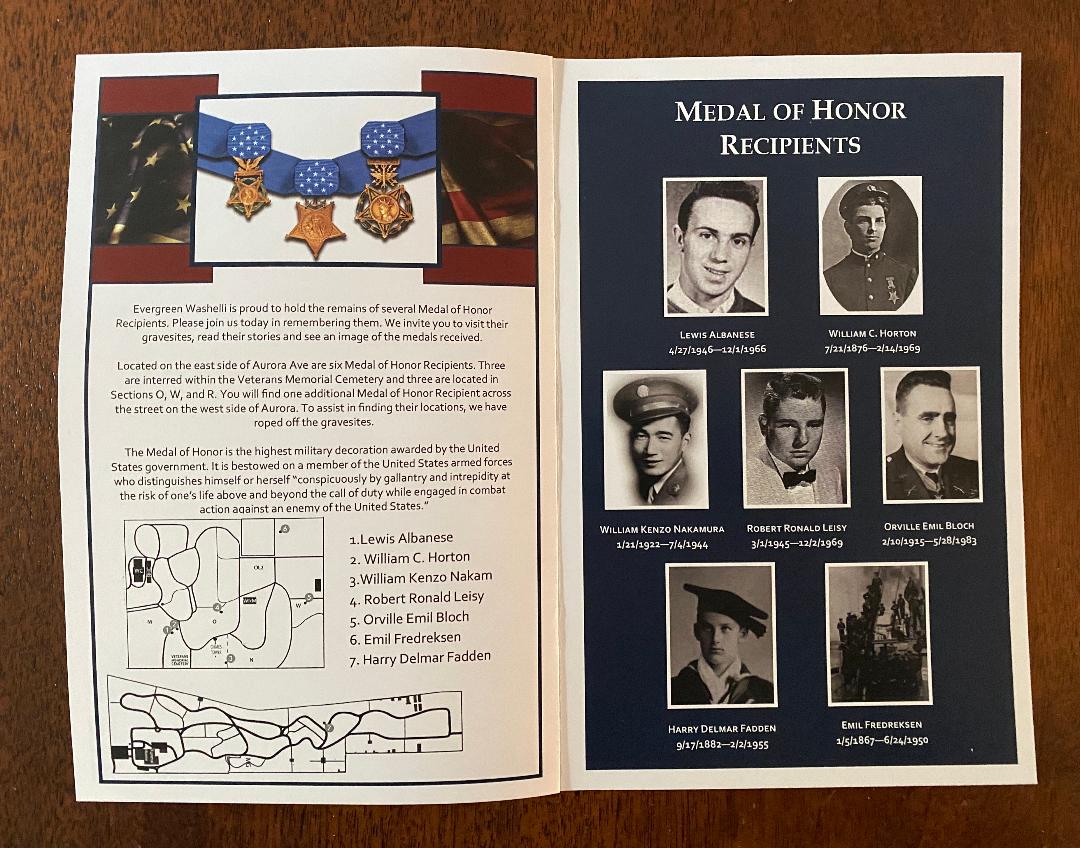
For the first time, I used a cane to walk to my position for sounding “Assembly” and “Echo Taps” once more on my Getzen bugle at this, the 15th Annual Ceremony called Wreaths Across America (WAA). “Assembly” silences the crowd and opens the event. “Echo Taps” signals its conclusion. Just like two years ago, Laurence Stusser played the “echo” part on his trumpet with me (please see my blog article of 31 December 2021).
The cane was necessary, of course, because of my continuing sciatica nerve pain in my lower back and down my leg. But that was not my only trouble at this performance.
Photo by Glenn Ledbetter
I noticed that I was suddenly having some trouble with articulation, slotting, and tone control. It puzzled me. Nothing like this had ever happened since I originally began playing my cornet in fifth grade! At this writing, however, in hindsight, I now know what was causing the problems. More in subsequent blog articles.
For more information about WAA and past ceremonies, simply use the Search box in the upper right column. Search keywords “Wreaths” and “Wreath-Laying” for different results. Also, check out https://www.wreathsacrossamerica.org and https://www.vfw1040.org.
All photos except two (as marked) are by Phil Onishi Photography. Please click on any photo to enlarge it.










































 Glenn's Trumpet Notes