Glenn’s Trumpet Notes

News & Tips for Trumpet & Cornet Students

  • January 2026
    S M T W T F S
     123
    45678910
    11121314151617
    18192021222324
    25262728293031
  • Enter your email address to subscribe to this blog and receive notifications of new posts by email.

    Join 89 other subscribers
  • Subscribe

Archive for the ‘Church Music’ Category

Church Orchestra and Choir End Season with “Glory”

Posted by glennled on June 9, 2012

‘Twas the last Sunday of the season for the church orchestra and choir, 3 June. Now comes the summer break. Lucky me, I got to play 3rd trumpet when one of the regular players had a conflict. This church conducts three services every Sunday morning, and we played four songs—three at each service. It’s easy to see why our conductor favors the arranger, Dan Galbraith—he’s superb!  He arranged three of the pieces below. And B.J. Davis did a super job, too, arranging Nichole Nordeman’s beautiful song, “Glory.” She is a Dove Award-winning songwriter (see http://www.doveawards.com/).

If you want to look over the scores and hear samples of the orchestration and arrangements, please see the following:

Posted in Church Music | Tagged: , , , , , , , , , , , , , , | Leave a Comment »

“A Baby Changes Everything” as Christmas Nears

Posted by glennled on December 18, 2011

Today, I got to play 2nd trumpet in the church orchestra that I like so much. At the 7:20 a.m. rehearsal before the first of three Sunday church services, the Worship Director called out the next song—“A Baby Changes Everything.” Quietly, the lead trumpeter quipped, “We don’t do baby changes,” and a French horn player added, “No more baby changes, never again!”

And then we rehearsed one of the loveliest songs ever written about the coming of the Christ child. The arrangement we played was by David T. Clydesdale and is available through Word Music (see http://www.wordmusic.com/item/080689886270). The concluding lines are “My whole life has turned around, I was lost but now I’m found. A baby changes everything, yeah, This baby changes everything.”

It was written and composed by Tim Nichols, Kim Wiseman, and Craig Wiseman. Faith Hill made it a #1 hit in 2008. To see and hear her sing it, please see:

Think about this special baby—can you name any other man who has ever had a more profound, widespread, long-lasting impact on humanity and human history?

We also played several hymns and Christmas carols. The jazz arrangement of “God Rest Ye Merry Gentlemen” by Tom Payne was especially good (see http://www.praisecharts.com/detail/arrangement/2132).

For my four other posts about playing in this church orchestra, simply click on Church Music at the beginning of the paragraph below this post.

Posted in Church Music | Tagged: , , , , , , , , , , | Leave a Comment »

Six Sharps (Key of F#)—Who Cares in this Great Church Orchestra? Not me!

Posted by glennled on December 17, 2011

F-Sharp Major

Last Sunday, I played trumpet in the church orchestra again, and this time our music was in the key signatures of F# (six sharps), B (five sharps), E (four sharps), and B-flat (two flats). So what, who cares? I did last spring when I facetiously complained about it in my post of 28 March (see also, 11 April) 2011. But no more. As the Worship Director commented with a wide smile, she chooses the key signature of the music for the benefit of the congregation. It’s all about worship by everyone, not about the musicians or the orchestra. Right on!

Posted in Church Music | Tagged: , , , , , , , , | Leave a Comment »

That’s better—Three Sharps is Plenty for Church Music!

Posted by glennled on April 11, 2011

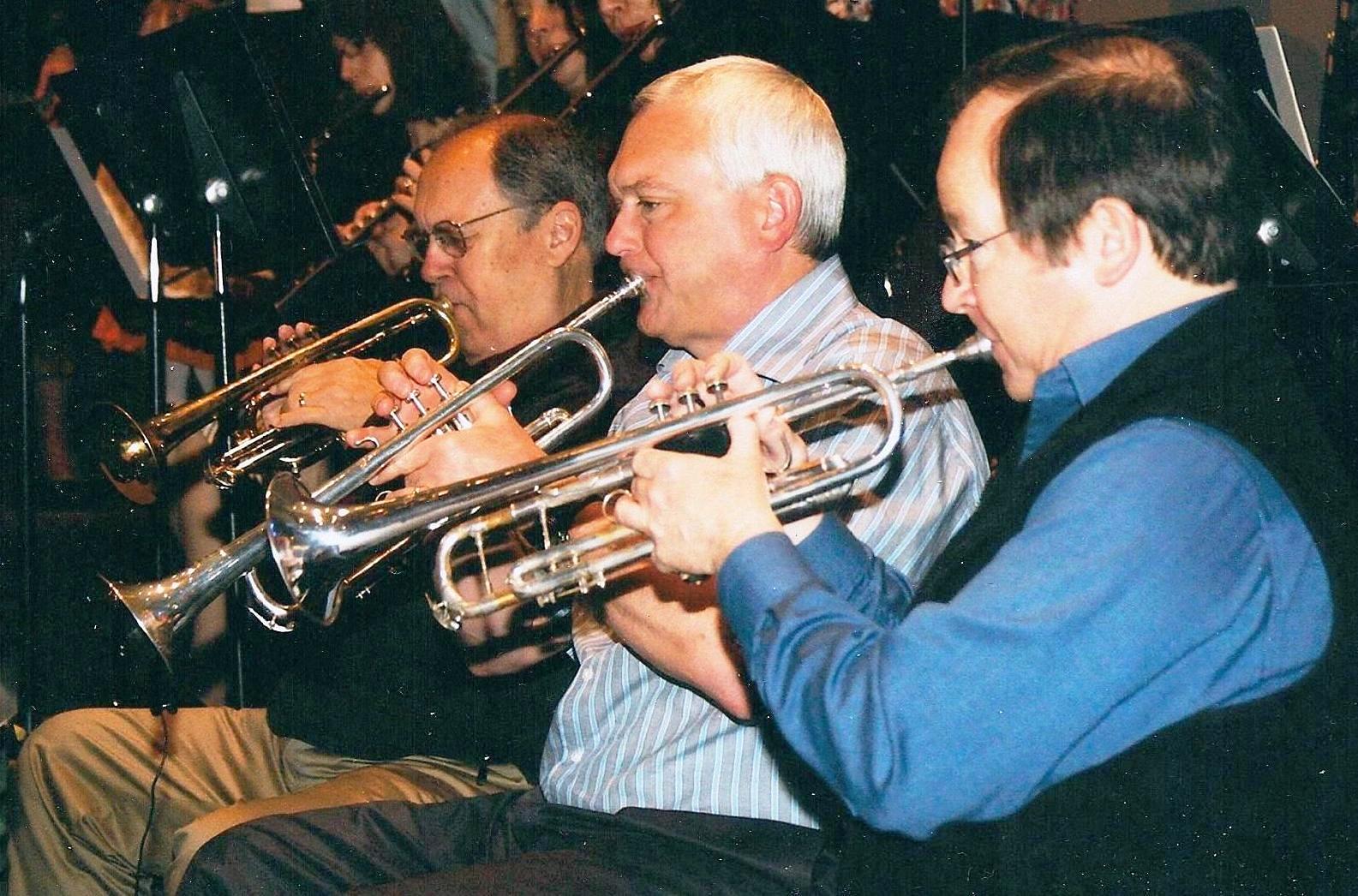
Glenn, Rex, and Les

Last Sunday, I again played trumpet in the church orchestra—dum-de-dum-dum! This time, however, the music was written in some of the easiest key signatures: C, F, B-flat, G, and A—whew, no problem! Begone to that diabolical stuff like the key of F-sharp, which has a whopping six sharps (see my post of two weeks ago, 28 March 2011). Hmmm (or Hymnnn)… it was a lovely day.  🙂

Posted in Church Music | Tagged: , , , , | 2 Comments »

Why on Earth Write in the Key Signature of F-Sharp (Six Sharps)?!

Posted by glennled on March 28, 2011

I’ve decided there is something wicked about any composer or arranger who writes music in the key of F-sharp major! Why in the world would you choose to do that, when right next door, a mere half-step up or down the scale, are either the key of F (with one little flat, B-flat) or G (with one little sharp, F-sharp)? When I was young, I might have played in the key of F-sharp, but at my age, why should I want to or have to? Holy cow, come on!  😉

Last Sunday, I played trumpet again in that wonderful church orchestra about which I wrote in my post of 25 December 2010. During the two services, we played a total of 8 pieces. Wonderful worship services! Loved the music selection and most of the arrangements…except the one for “Let the Church Rise.” Great piece, but tell me—why six sharps for B-flat instruments including the trumpet? For C instruments such as the piano and flute, that is the key of Concert E, which has four sharps and is bad enough in itself. Mercy!

My theory is that Mr. Arranger must be bored or demonic or both. Must have played a string instrument or piano, I’ll bet. Hates brass. Must be on a crusade to force musicians to practice. Mean guy. The devil himself must be behind this…sneaking the key of F-sharp into church music for laughs. Spoiler…saboteur. Yes, Mr. Arranger is possessed.

Now listen, students, if you’re still reading this—this is called “venting” or “blowing off steam.” It’s also called “whining,” “avoidance,” and “blaming” others for your troubles. It’s refusing to take responsibility for yourself. Another name for it is “stinkin’ thinkin’.” Consider this: is the horn designed and built to play in six and even seven sharps or flats? Answer: yes. Then the question is, “Can we, can you, can I do it?”

The truth is that if you want to master the horn, you must practice enough to play well in any of the 12 key signatures. That’s just how it is. No shortcuts, no excuses. Come on, Glenn, get to work. Watch your self-talk. “For as a man thinketh in his heart, so is he” (Proverbs 23:7). 

“Just do it,” says Nike. “The Lord rewards those who help themselves,” they say. “If you pray to God to move a mountain, be prepared to wake up next to a shovel,” someone said. Go practice the scale, arpeggios, and etudes in the key of F-sharp, Glenn, and be better prepared the next time you’re called to play in this church orchestra. It’s what they do, and so can you. The fact is that they like certain arrangers who like certain key signatures with lotsa sharps. It is what it is. Get on board the train. 🙂

Posted in Church Music | Tagged: , , , , , , , , , , , , , , | 8 Comments »

And the Trumpet Shall Sound in the Church Orchestra

Posted by glennled on December 25, 2010

This past Sunday was different from any other in my long life. I’ve played in marching bands, drum and bugle corps, concert bands, orchestras, ensembles, operas, and musicals. As a teen, I led congregational singing, but until 19 December 2010, I had never played trumpet in a church orchestra.

Archangel Gabriel Wall Relief, Church of San Michele, Florence, Italy, 1359 A.D.

My wife and I have heard and joined in congregational singing with this orchestra at a local community church several times this year. It is the best of its kind that I’ve ever heard in the Greater Seattle Area. The compositions and arrangements are sophisticated and even challenging at times.

One Sunday in the church bulletin, there was an offer to consider new members in the orchestra. I auditioned and was accepted as a substitute trumpeter. There are three regular trumpeters and several subs like me. The lead trumpeter has been there well over 20 years and plays at least a dozen instruments. Another regular also has been there more than 20, and the other more than 15.   

The day I played, there were about 18 musicians in the orchestra; sometimes there are as many as 25-30. The choir numbered about 50. On this occasion, we were not playing “And the Trumpet Shall Sound” from Handel’s Messiah. Instead, this was the music:

  • “Festival of Carols” (a medley of four)
  • “Angels We Have Heard on High”
  • “The First Noel,”
  • “Come, Emmanuel,”
  • “I Heard the Bells on Christmas Day.”

Bass Performance Hall, Ft. Worth, TX, by Tony Gutierriz/AP, 14 June 2002

I had not known that “I Heard the Bells on Christmas Day” was written as a poem by Henry Wadsworth Longfellow after he had lost two wives and one of his sons had been severely wounded in the Civil War. He wrote the words on 25 December 1864. About four months later, the Civil War ended and peaced reigned over the land once more. Later, the poem was modified and became a carol. Its last two stanzas read as follows:

“And in despair I bowed my head;
‘There is no peace on earth,’ I said;
‘For hate is strong,
And mocks the song
Of peace on earth, good-will to men!’

“Then pealed the bells more loud and deep:
‘God is not dead; nor doth he sleep!
The Wrong shall fail,
The Right prevail,
With peace on earth, good-will to men!'”

Can you worship with a horn? Until last Sunday I was not sure—maybe concentrating on playing the music correctly would displace worship. No, to my pleasant surprise, it did not. It was a moving experience. You can worship with your horn just as surely as you do with your voice in song. And it’s especially poignant when you’re accompanying an excellent church choir like this one.  Volunteer and try it someday—you’ll like it.

Posted in Church Music | Tagged: , , , , , , , , , , , , , , , , , , , , , , , , , , , | 2 Comments »