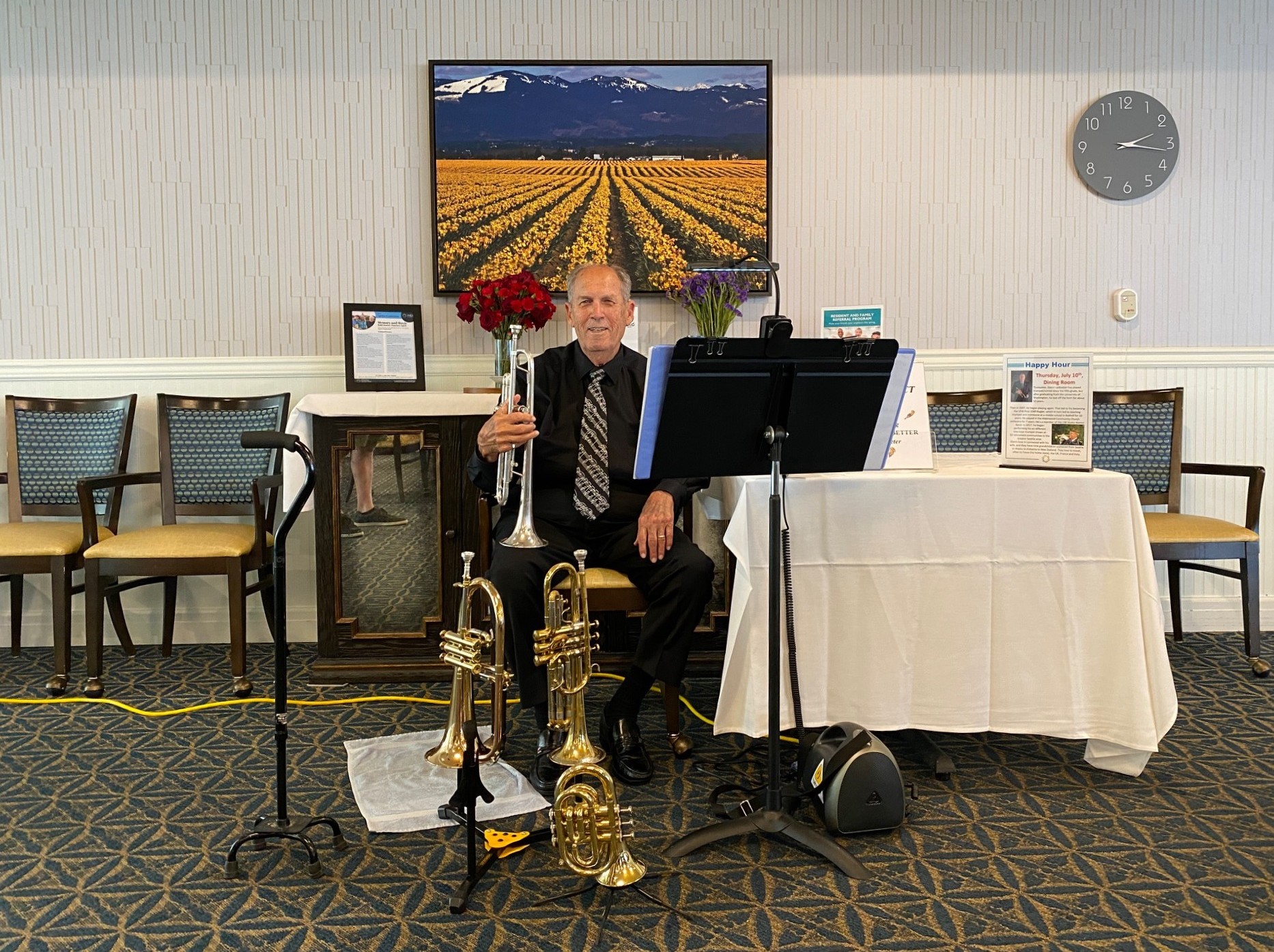
Glenn Ledbetter with four horns for “In Retrospect” trumpet show at 2:30 p.m., 10 July 2025. Photo by David G. Ledbetter
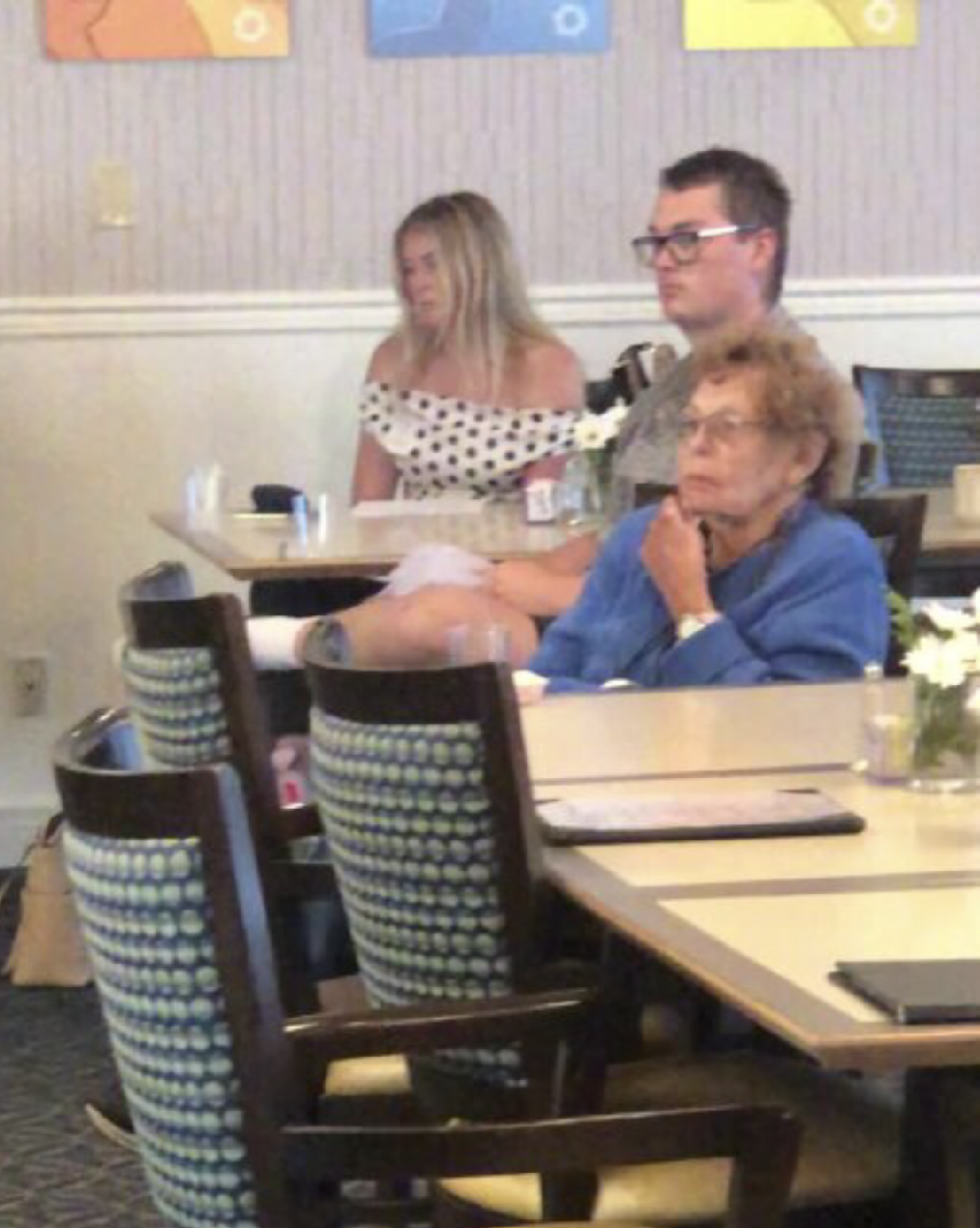
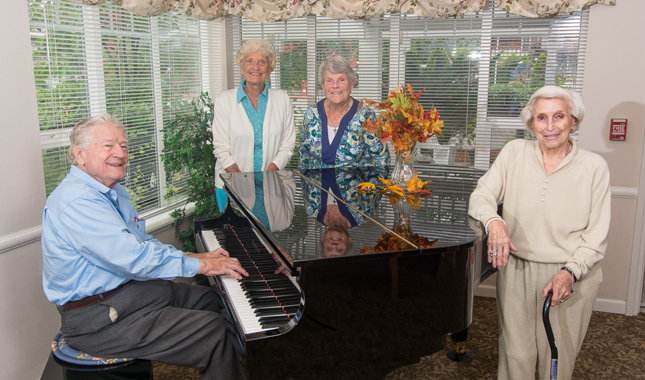
This was a very special day, 10 July 2025, because I got to return to Mountlake Terrace Plaza and perform another one of my six trumpet shows for the residents. In August 2021, I performed “Showtune Favorites,” and this time, I presented “In Retrospect,” where we look back, through great songs from the residents’ era, at common experiences that we all share in living life.
It was extra special, also, because my son and his family were visiting from New Zealand, and this is the first time they ever attended one of my shows. My two grandchildren helped me by distributing a handout to the residents. It contained 25 jokes, so that they could have some fun and laughs with their friends and relatives. And afterwards, the whole family helped me load my gear into the car.
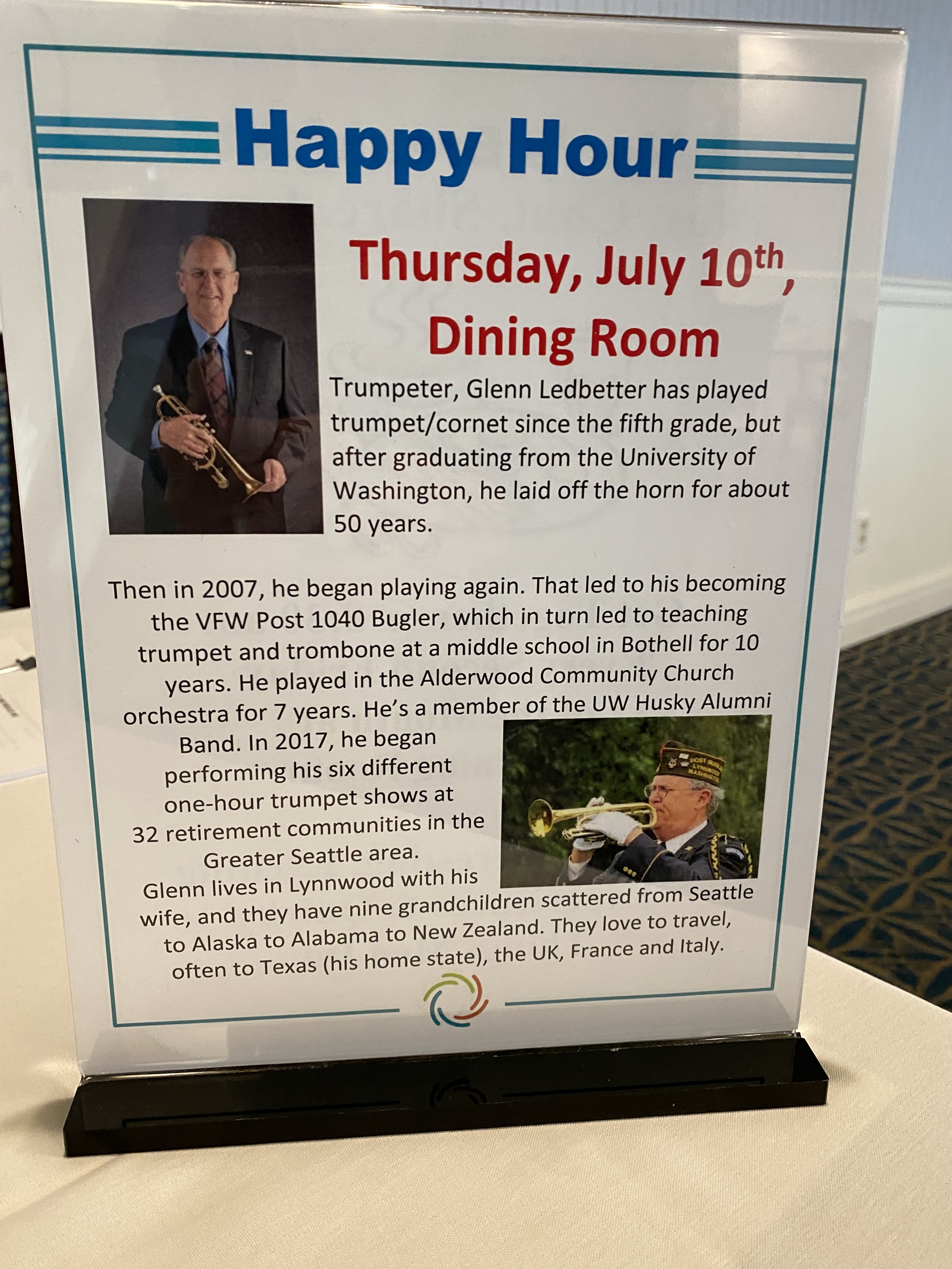
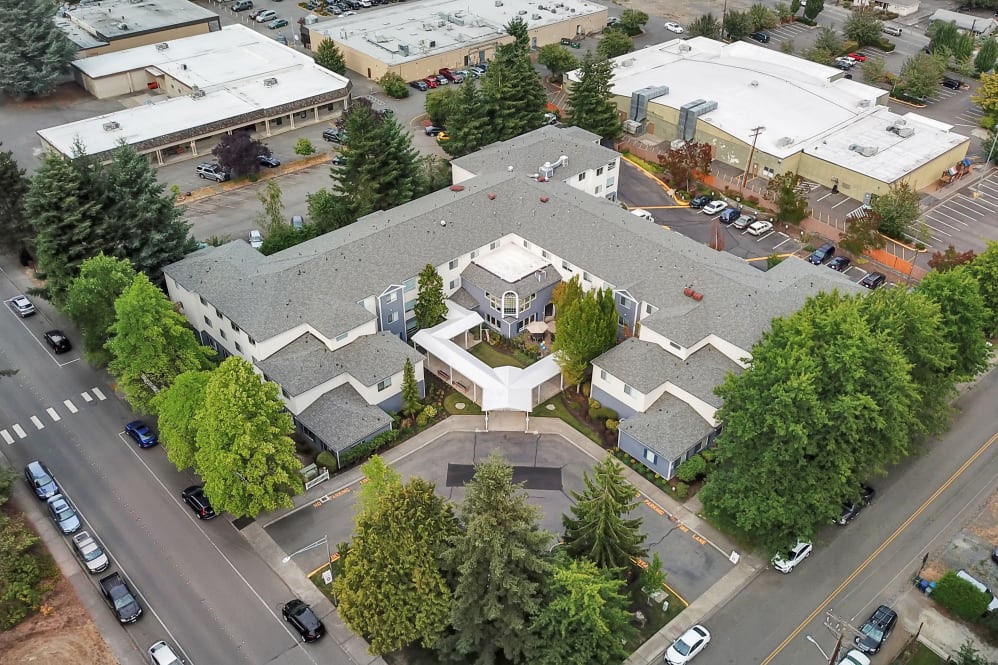
Moreover, energetic, friendly Anne Paine, Director of Wellness Programming, also made it special. She printed and displayed a brief bio of me (see photo). That was a first, too—that’s never happened at any other of the 35 retirement communities in the Greater Seattle area where I have performed since 2017. In other ways, too, her support was exceptional. Mountlake Terrace Plaza offers assisted living and is a member of MBK Senior Living Company.
“In Retrospect” is comprised of two dozen hit songs during the 84-period, 1892-1976. The oldest is “Bicycle Built for Two,” and the most recent is “Money, Money, Money,” by ABBA. All these songs stir deep memories, and people sing along or hum. Each song has a unique message, so I choose the horn with the most appropriate sound—trumpet, cornet, flugelhorn, or pocket trumpet.
L to R: Bugle, Pocket Trumpet, Flugelhorn, Trumpet, and Cornet
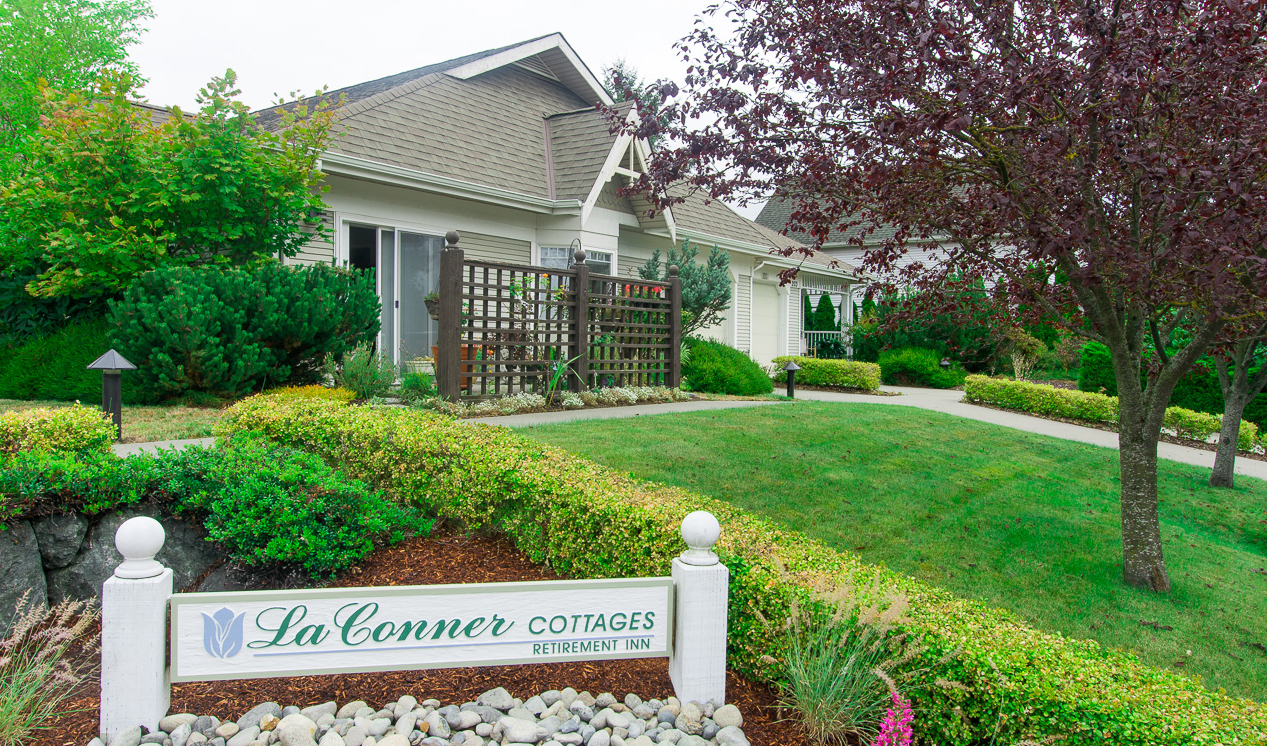
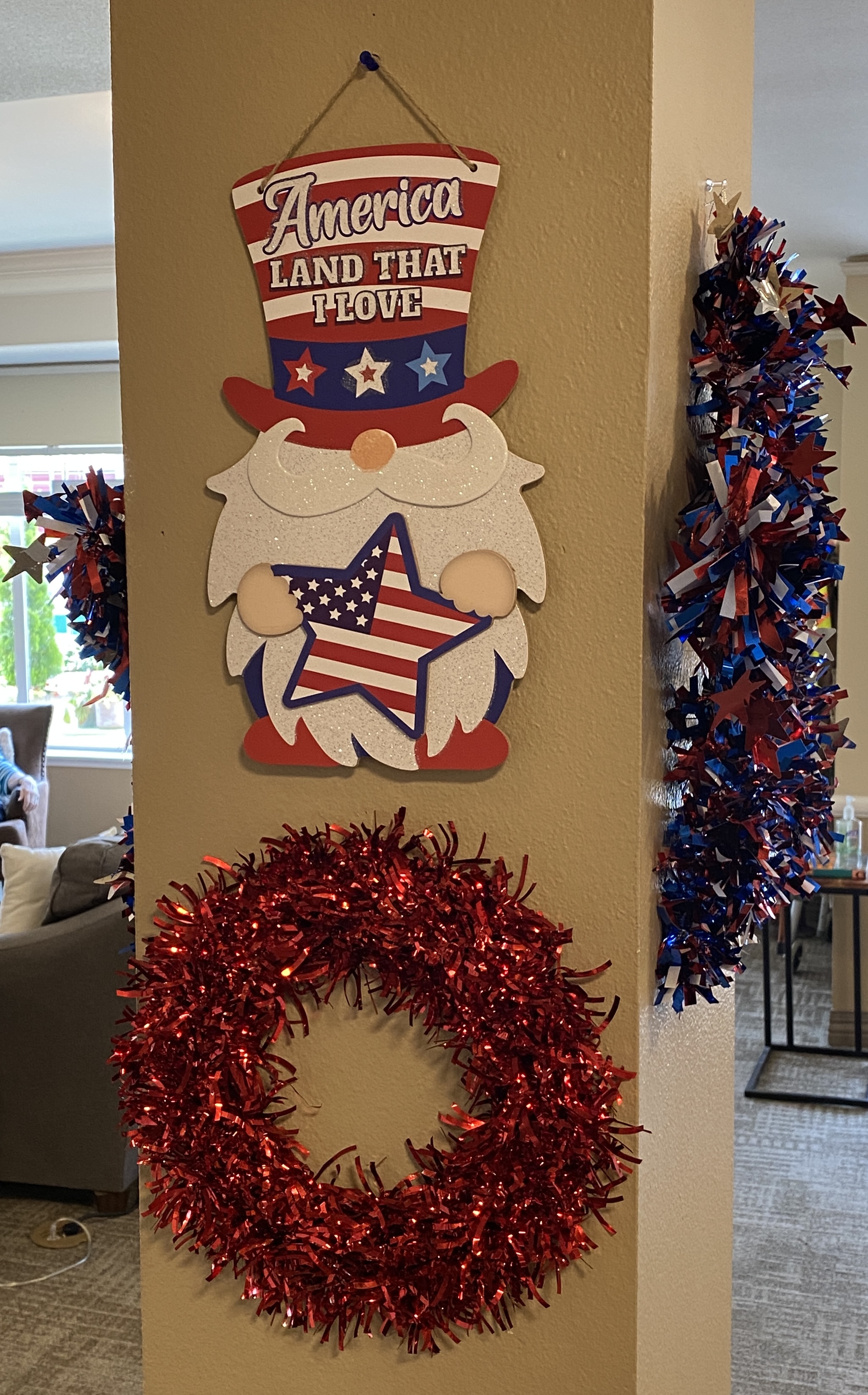
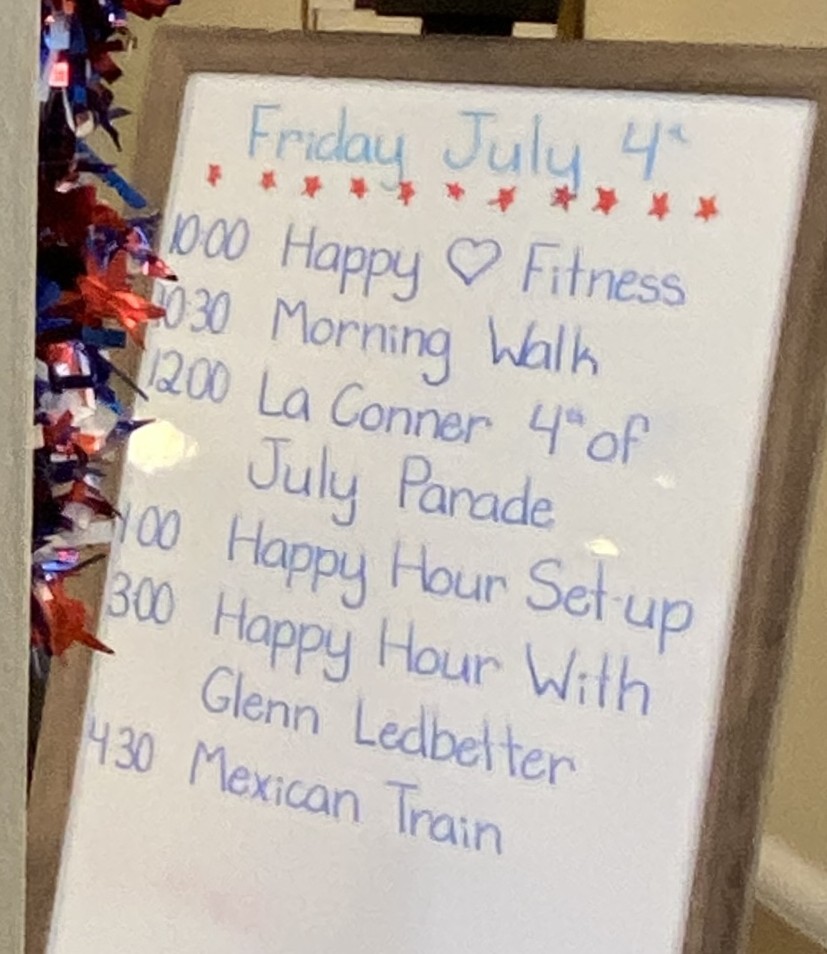
On this Independence Day, I finally got to perform one of my six trumpet shows at La Conner Retirement Inn. In 2022, I was scheduled to perform “I Stand for the Flag,” on Flag Day in June, but Covid struck in March, and we cancelled that show. Then the Activities Director, Allie Kester, booked me for a Christmas show, and we had to cancel that one, too. This year, we hit paydirt. On 4 July, I performed “I Stand for the Flag” for the residents during their Friday afternoon Happy Hour.
The Inn offers both Independent and Assisted Living accommodations and services. Allie proudly told me that they have three residents who are 100 or more years. The oldest one to attend my show is 98, and I dedicated “You’re a Grand Old Flag” to her. She and others liked to sing along to some of my patriotic songs and marches. The audience voluntarily stood while they sang “God Bless America,” and stayed standing while we said the “Pledge of Allegiance” and closed with “The Star-Spangled Banner.” It was an extra-special performance for me because my youngest son from Las Vegas happened to be visiting in nearby Oak Harbor and came to hear me play for the first time. He helped with the handouts and reloading my car. We shared dinner afterwards.
I used all five instruments and used my flugelhorn mute once. The bugle and trumpet are Getzens, the pocket trumpet is a Jupiter, the flugelhorn is by ACB (Austin Custom Brass), and the cornet is a Super Olds, given to me by my parents when I became a freshman in high school in 1954. This show features about two dozen patriotic marches, songs, and bugle calls.
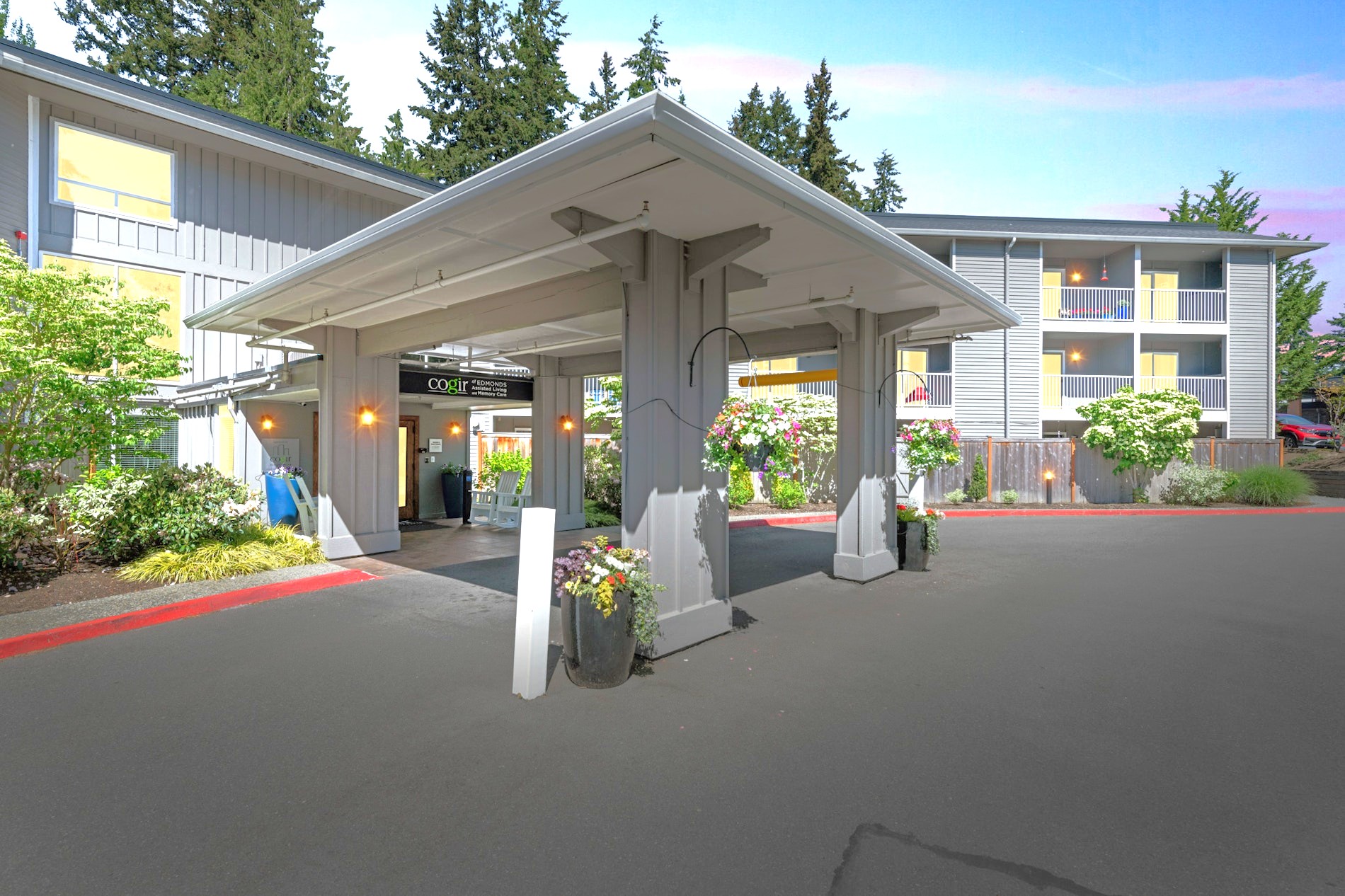
After sounding bugle calls in the morning at the Memorial Day ceremony, 26 May 2025, at Veterans Park in Lynnwood, I drove to (formerly) Edmonds Landing Retirement Community in Edmonds in the afternoon to perform my one-hour trumpet show, “I Stand for the Flag.” It consists of about two dozen patriotic marches, songs, and bugle calls. The residents sing along with me.
I have six one-hour trumpet shows. During this one, I use all five of my horns: Getzen trumpet and bugle, Jupiter pocket trumpet, ACB (Austin Custom Brass) flugelhorn, and Olds Super cornet (71 years old, given to me by my parents when I became a freshman in high school).
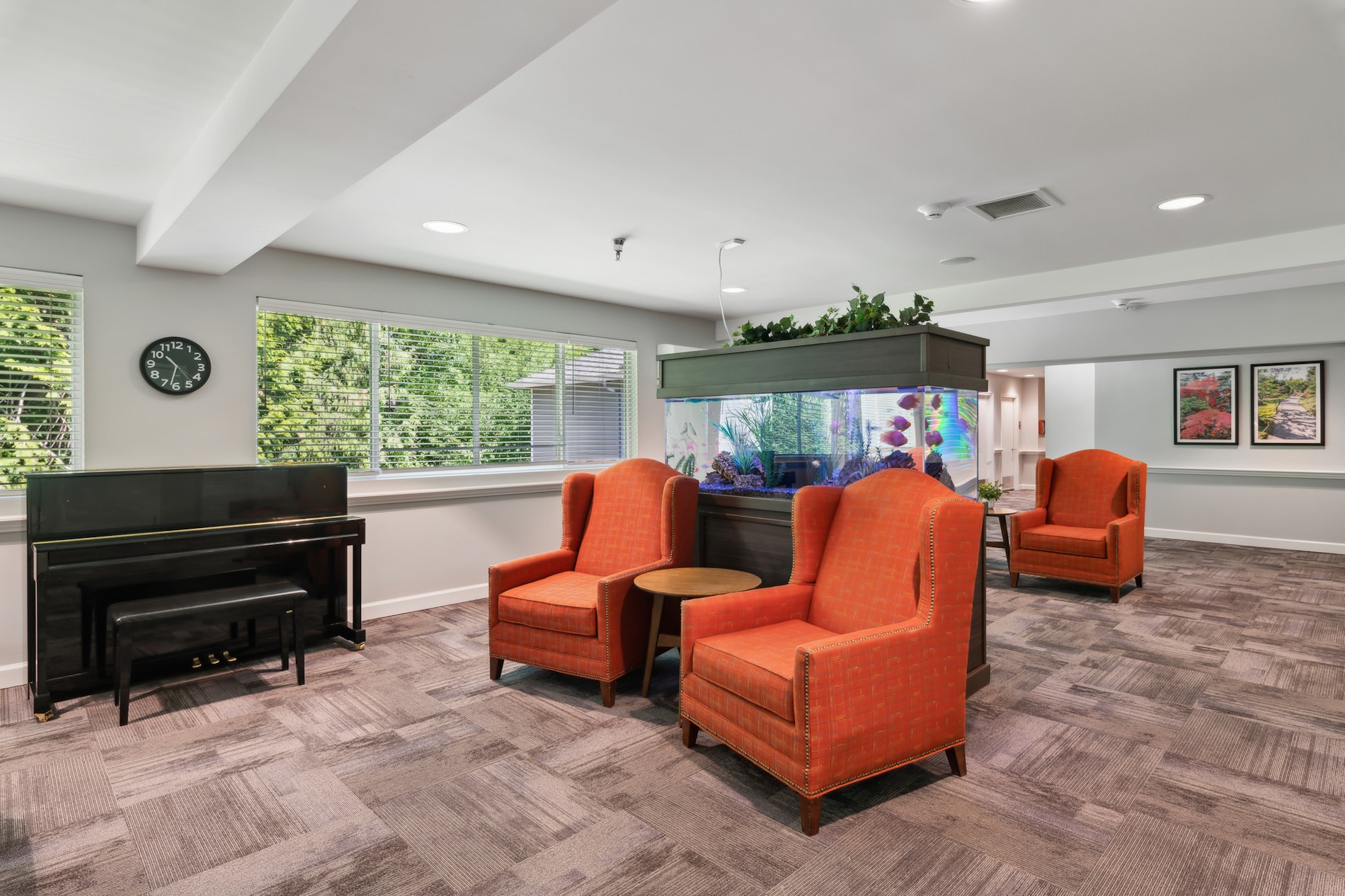
Photos courtesy of Edmonds Landing by Cogir. Please click on any photo to enlarge it.
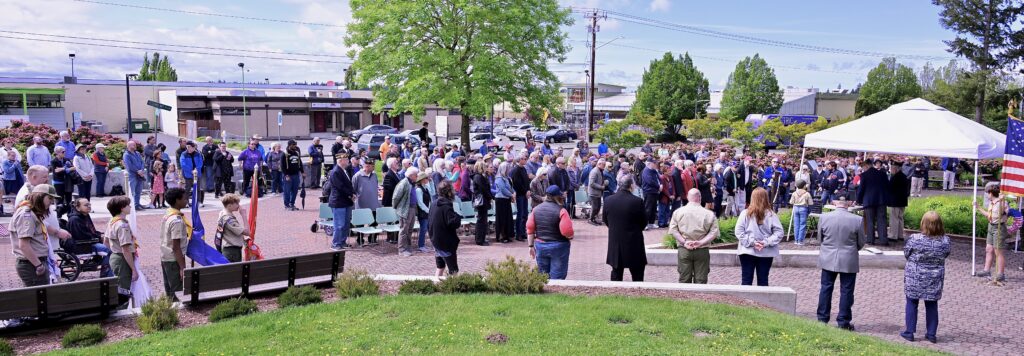
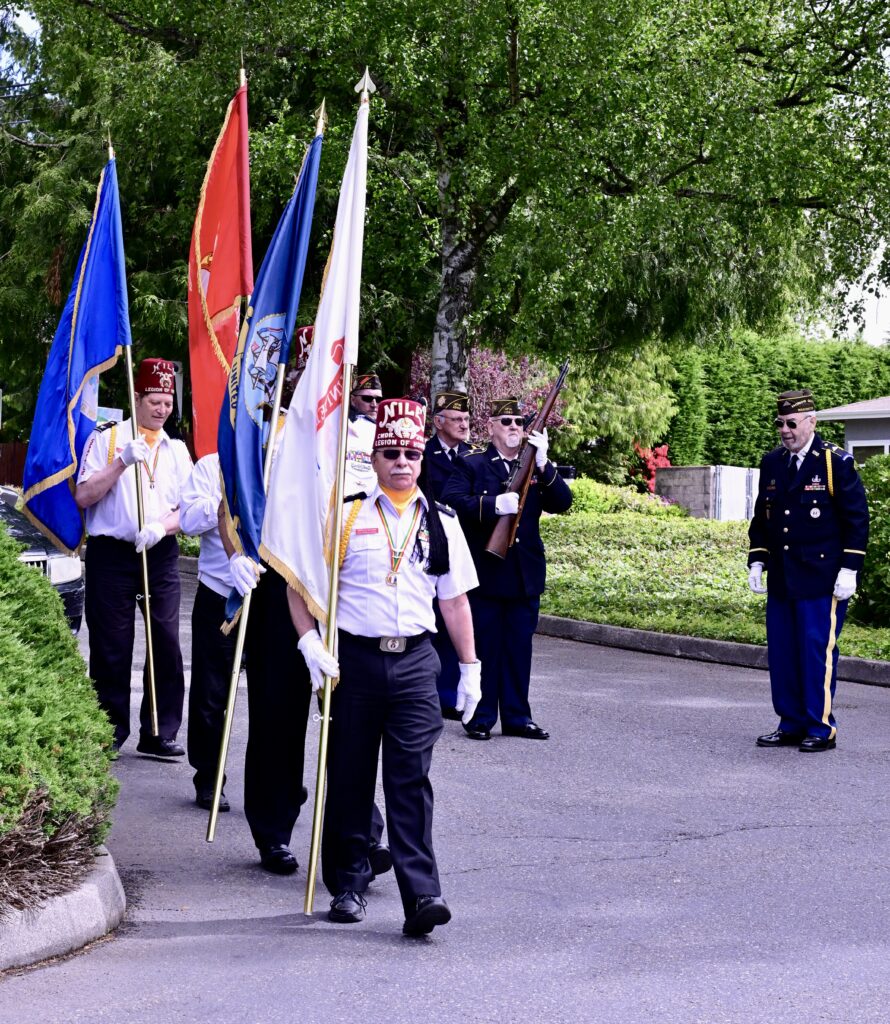
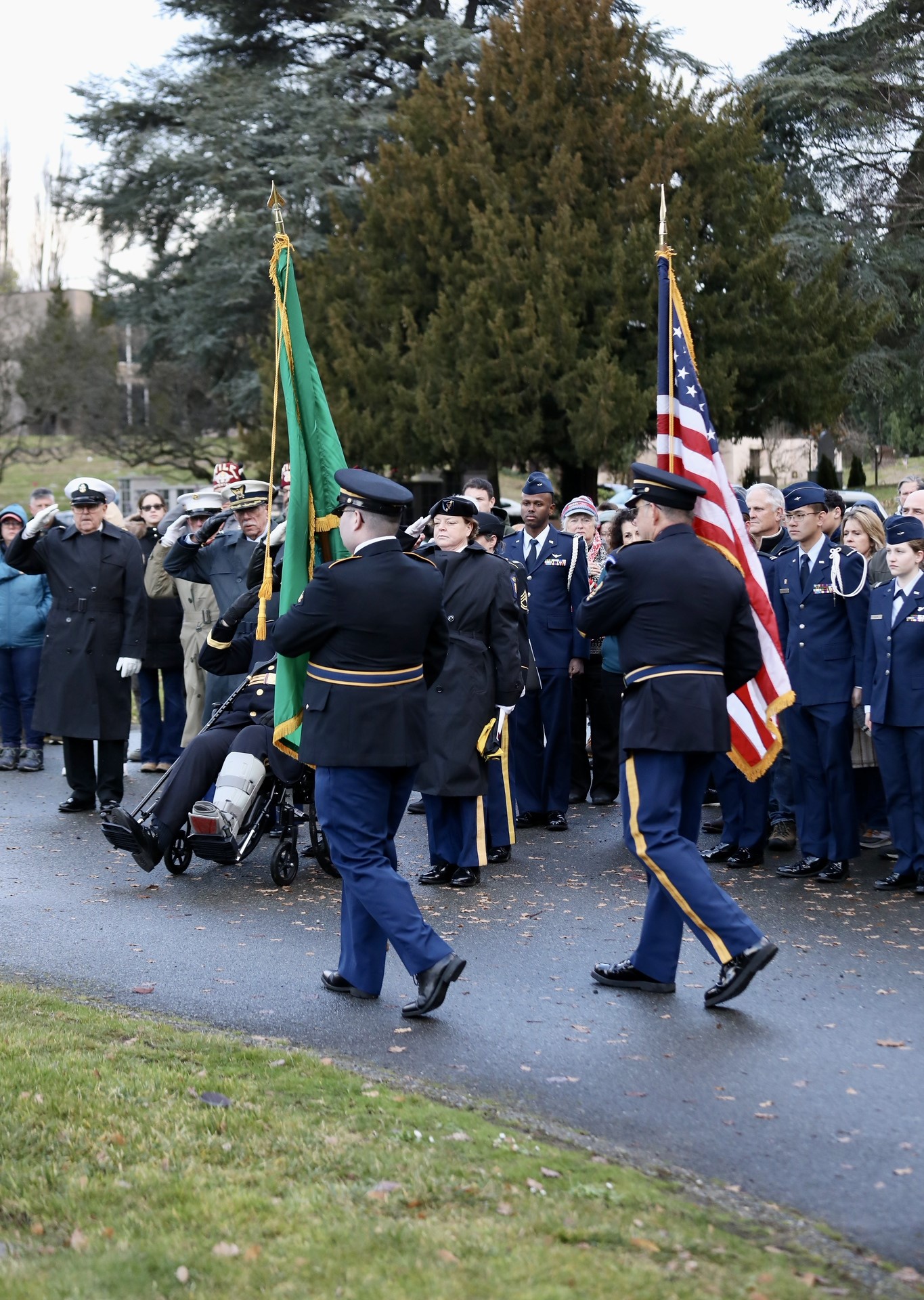
Large crowd stands for the Invocation at Veterans Park, Lynnwood
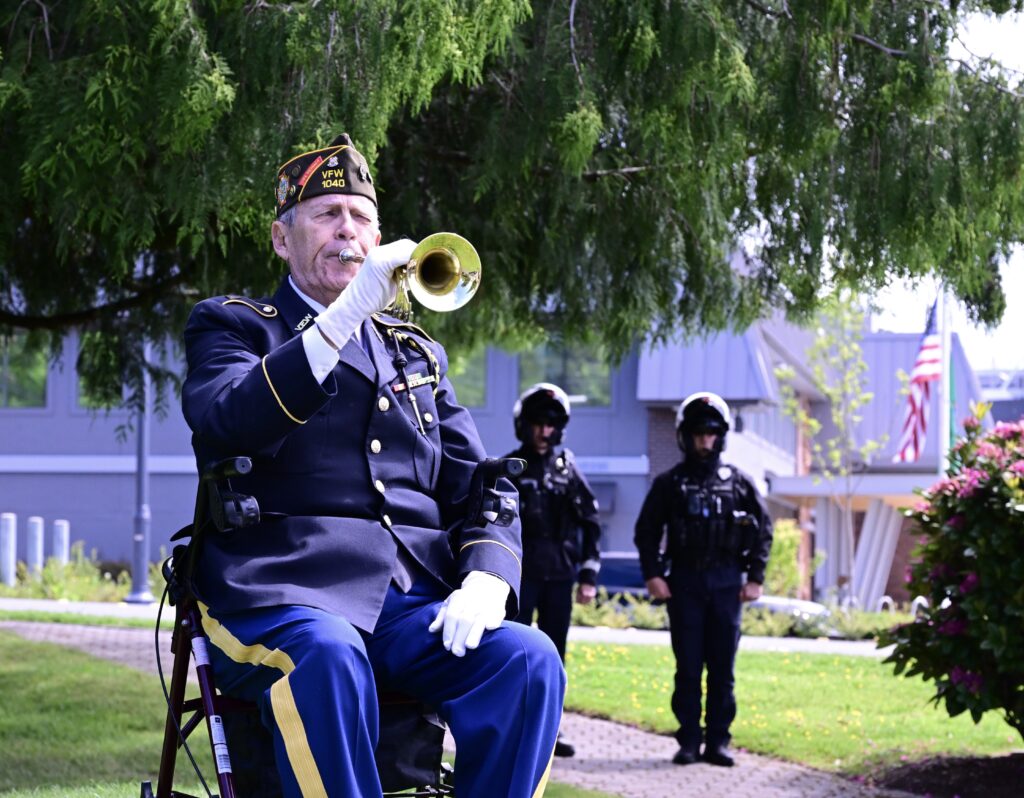
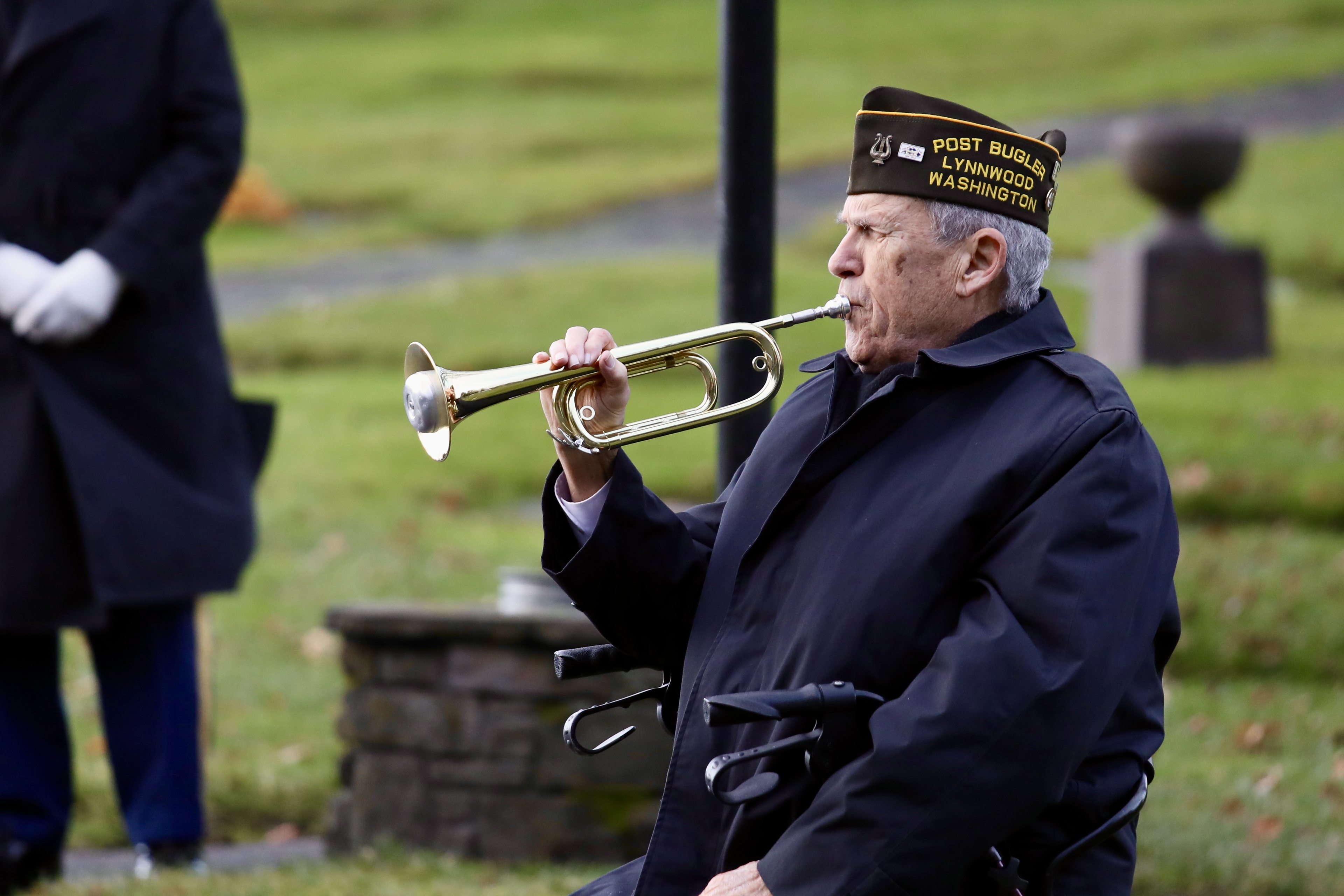
To me, Memorial Day is always special, apart from its main purpose–to remember those veterans who gave their lives in service to our country. I’m one of the lucky ones who get to perform at this special memorial ceremony! And not only that, I get to sound bugle calls. And more than that, one of them is “Echo Taps”. And on top of that, the other two are “Assembly” at 11 a.m. to call the meeting to order and “To the Color” as the flag is raised at noon from half-staff to full staff. And such it was this Memorial Day, celebrated on Monday, 26 May 2025.
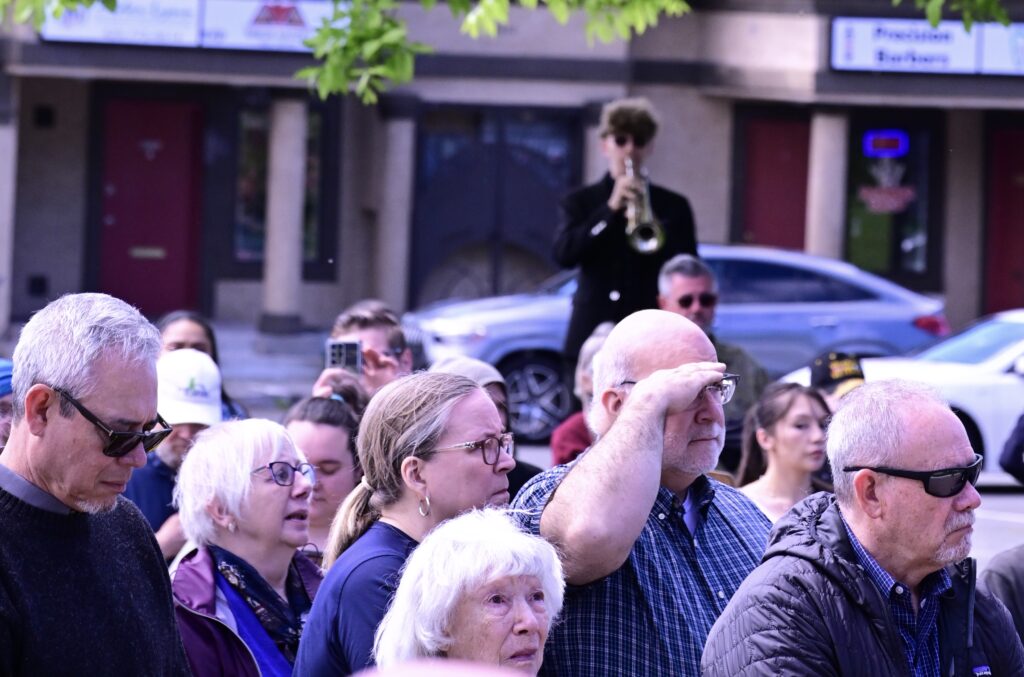
Joining me to sound the “Echo” part was Jasper Stutes, a senior trumpeter at Lynnwood High School. Among the other participants were the VFW Post 1040 Honor Guard, the Nile Shrine Legion of Honor, and Boy Scout Troop 49. I’m sure those participants felt as lucky, proud, and honored as I did.
I used by Getzen bugle–love that horn!
Photos by Julia Wiese, Lynnwood Today. Please click on any photo to enlarge it.
Glenn LedbetterBoy Scout Troop 49Jasper Stutes (background)Nile Shrine & VFW Post 1040Navy Veteran & Navy FlagVFW Post 1040 Honor Guard
On Saturday, 24 May 2025, I traveled to Renton to perform my one-hour trumpet show, “I Stand for the Flag,” for the first time at Solstice Senior Living (please see https://solsticeseniorlivingrenton.com/). It is a Provincial Senior Living Community, headquartered in Arlington, Texas. They operate about 70 retirement communities across the country. Others in Washington state include Bellingham, Normandy Park, Point Defiance (Tacoma), and Kennewick. At Renton, Independent Living is offered, with the support of health care professionals, when needed.
I entertained the residents with about a dozen patriotic marches, songs, and bugle calls. They sang along with me and laughed at my jokes. I used all five of my horns: trumpet, pocket trumpet, cornet, bugle, and flugelhorn.
For awhile now, I’ve been wanting to perform one of my six trumpet shows at Mirabella, Seattle. My chance came this spring, thanks to Diana Rawls, Activities Director. On 11 April, I performed “Showtune Favorites”–about two dozen songs from popular musicals and movies familiar to the residents.
Why did I especially want to play there? Because it’s operated by a non-profit organization, occupies a whole city block in downtown Seattle, and is still quite new, opening for business only 15 years ago. I’m impressed!
I used four of my five horns–Getzen trumpet, Super Olds cornet, ACB flugelhorn, and Jupiter pocket trumpet (but not my Getzen bugle). I’ve owned the flugelhorn for only two and a half years, but the cornet for 71 years—Holy Cow! My parents gave it to me when I was a freshman in high school, and it took me to the Texas All-State Band when I was a senior. Love that horn! (Thanks again, Mother and Daddy, may they rest in peace.)
Besides At-Home Care, Mirabella, Seattle offers Independent Living, Assisted Living, Memory Care, and Skilled Nursing and Rehabilitation. Residents from all levels came to my performance. One couple among the audience has lived there since it originally opened!
Photos are courtesy of Mirabella, Seattle. Please click on any photo to enlarge it.
It’s always nice to be invited back, especially when you get to perform a different show (I have six). Seven months ago, I played “I Stand for the Flag,” a patriotic show, here at Cogir of Kirkland Senior Living (https://glennstrumpetnotes.com/?s=cogir). This time, on 13 March, it was a personal history show, “Where Were You, Back Then?” Here’s how it goes.
I’ve chosen 18 years between 1947 and 2008. Then I tell some significant events and situations that happened in each of those years. They remember those things, and I ask them to remember also what was going on in their own lives during that year. Sometimes, I sprinkle in some tales of my own, like when in 1967, I was single and an officer in the Navy, stationed near San Francisco, and I bought my yellow Camaro convertible–oh, boy! I hope these things trigger memories in their minds, too.
Next, I’ve chosen a song that was popular that year—perhaps from a musical or a movie or a hit that won a Grammy Award or Academy Award Oscar. I invite them to sing or hum along with me, as I play one of four horns: Getzen trumpet, Super Olds Cornet, ACB (Austin Custom Brass) flugelhorn, and Jupiter pocket trumpet. Sometimes, I use one of my mutes. For example, I especially enjoyed playing “That’s Amore” (1953) on my trumpet, “Dream a Little Dream of Me” (1968) on my cornet, “Some Days Are Diamonds” (1981) on my flugelhorn, and “Money, Money, Money” (2008) on my pocket trumpet.
As often happens, we started out with a crowd of size “X,” and as I played, more people came, and we ended up with all the chairs filled, including one up in the balcony! I recognized several people from my first performance there last August. And now I’m ready anytime to return for a third show!
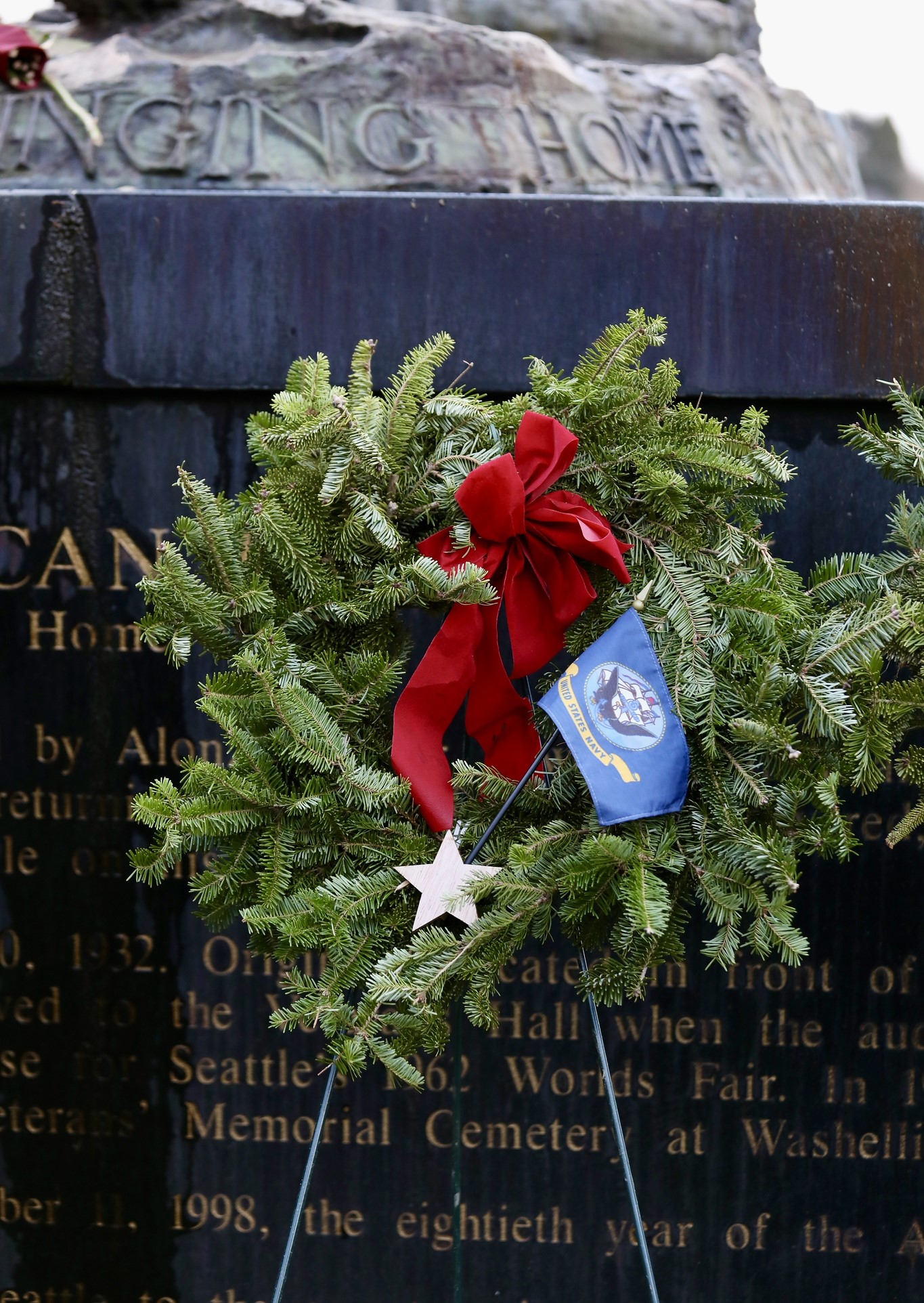
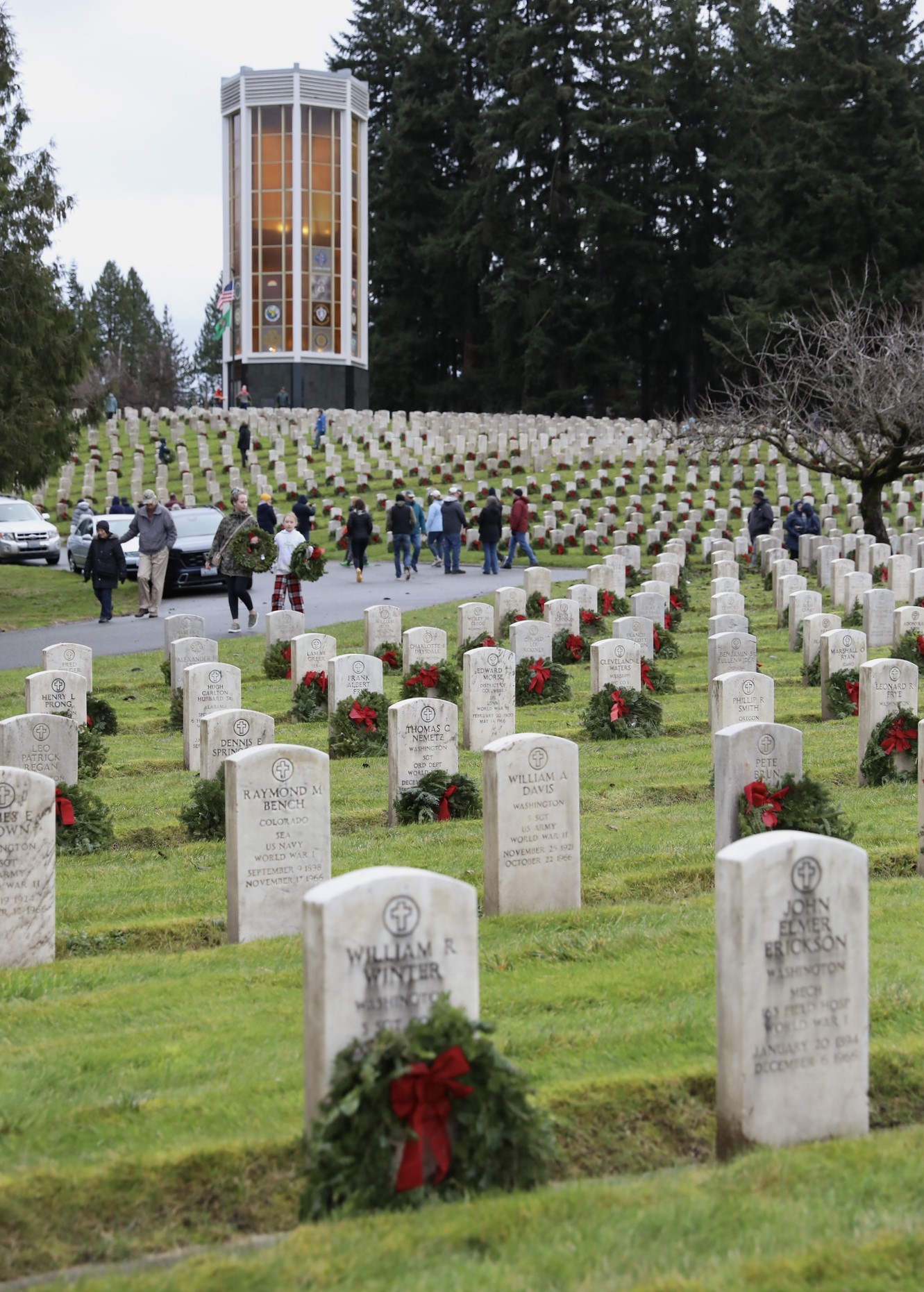
U.S. Navy Wreath (photo by Phil Onishi)Photo by Glenn LedbetterPeople voluntarily lay the wreaths (photo by Phil Onishi)
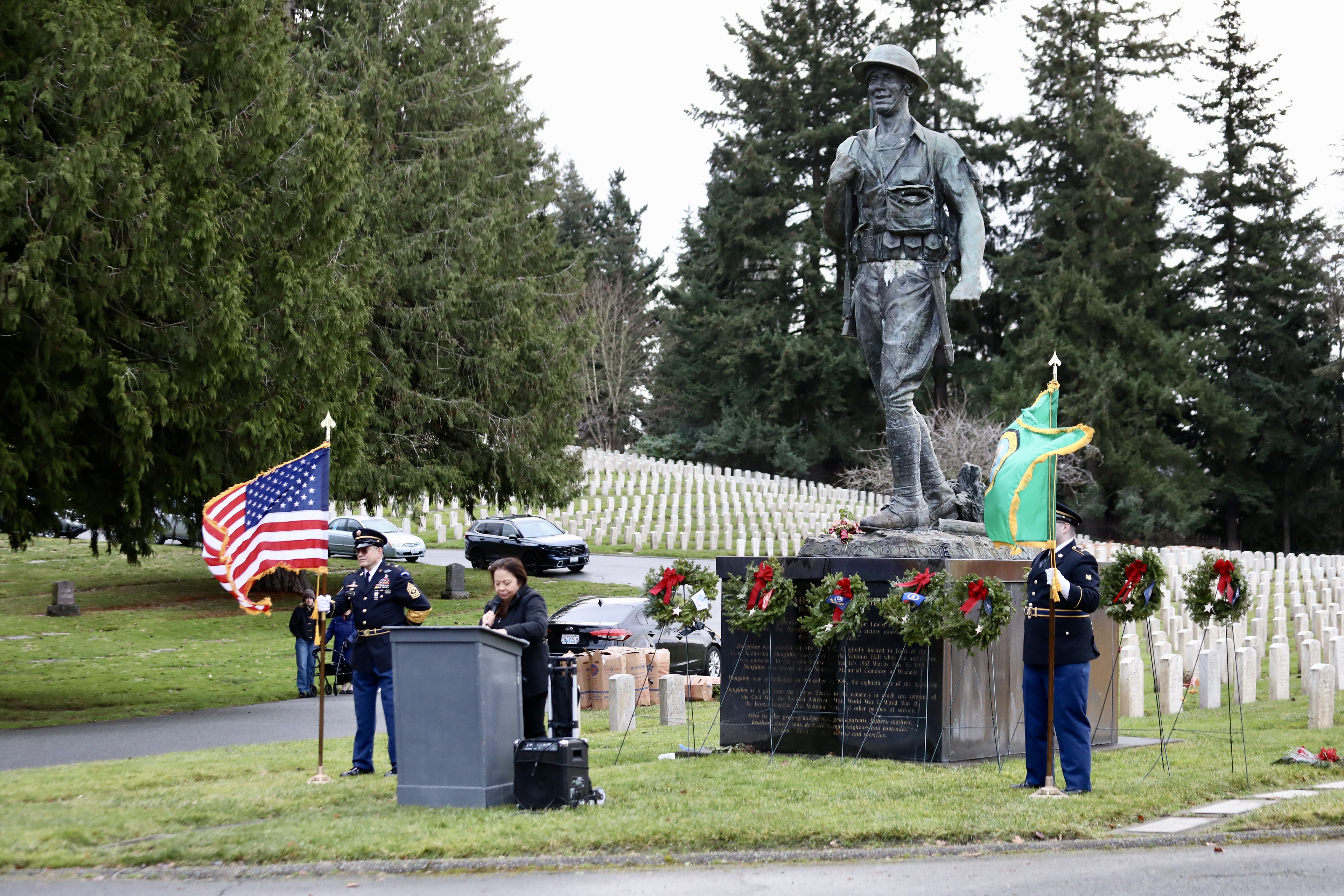
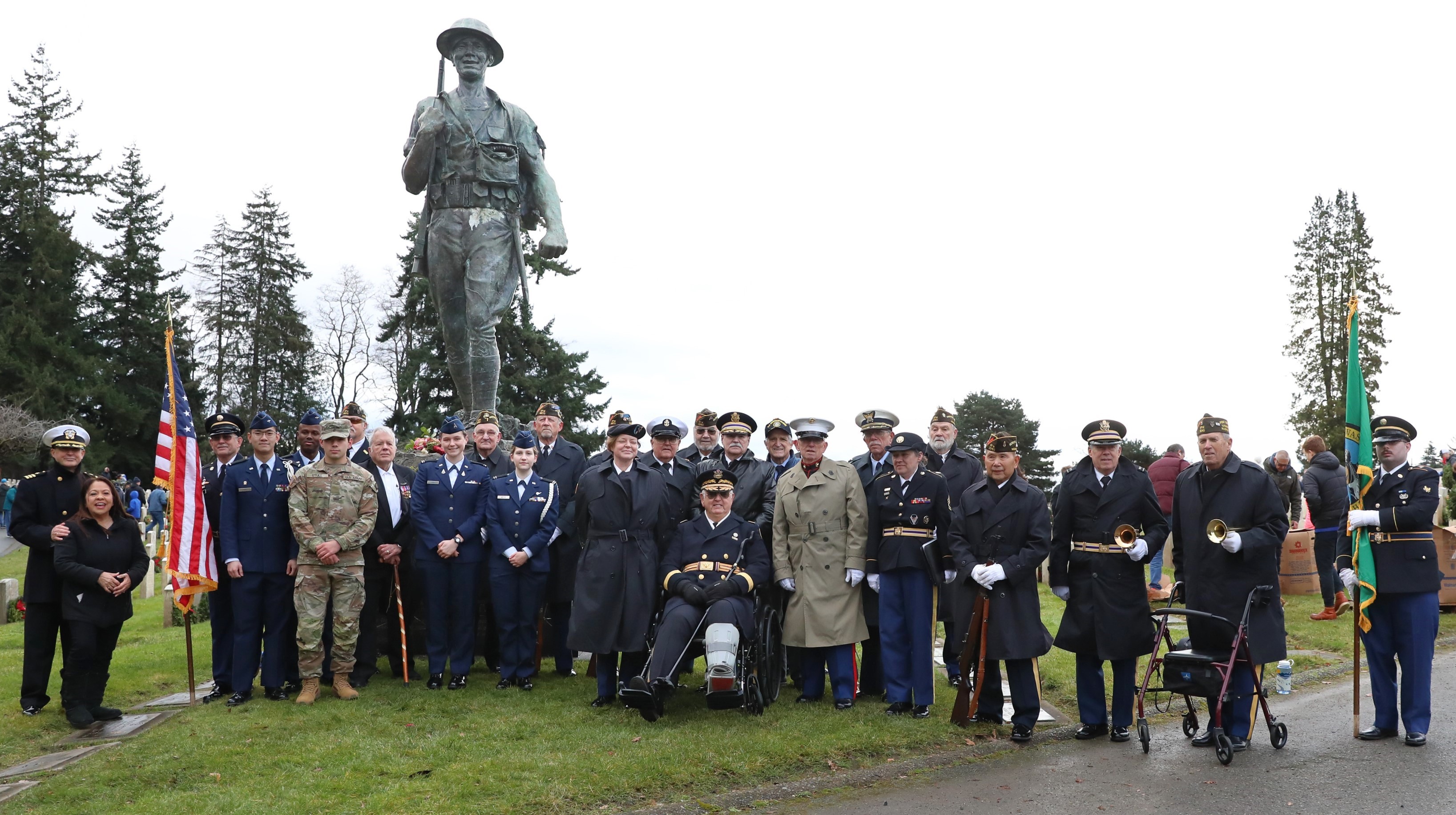
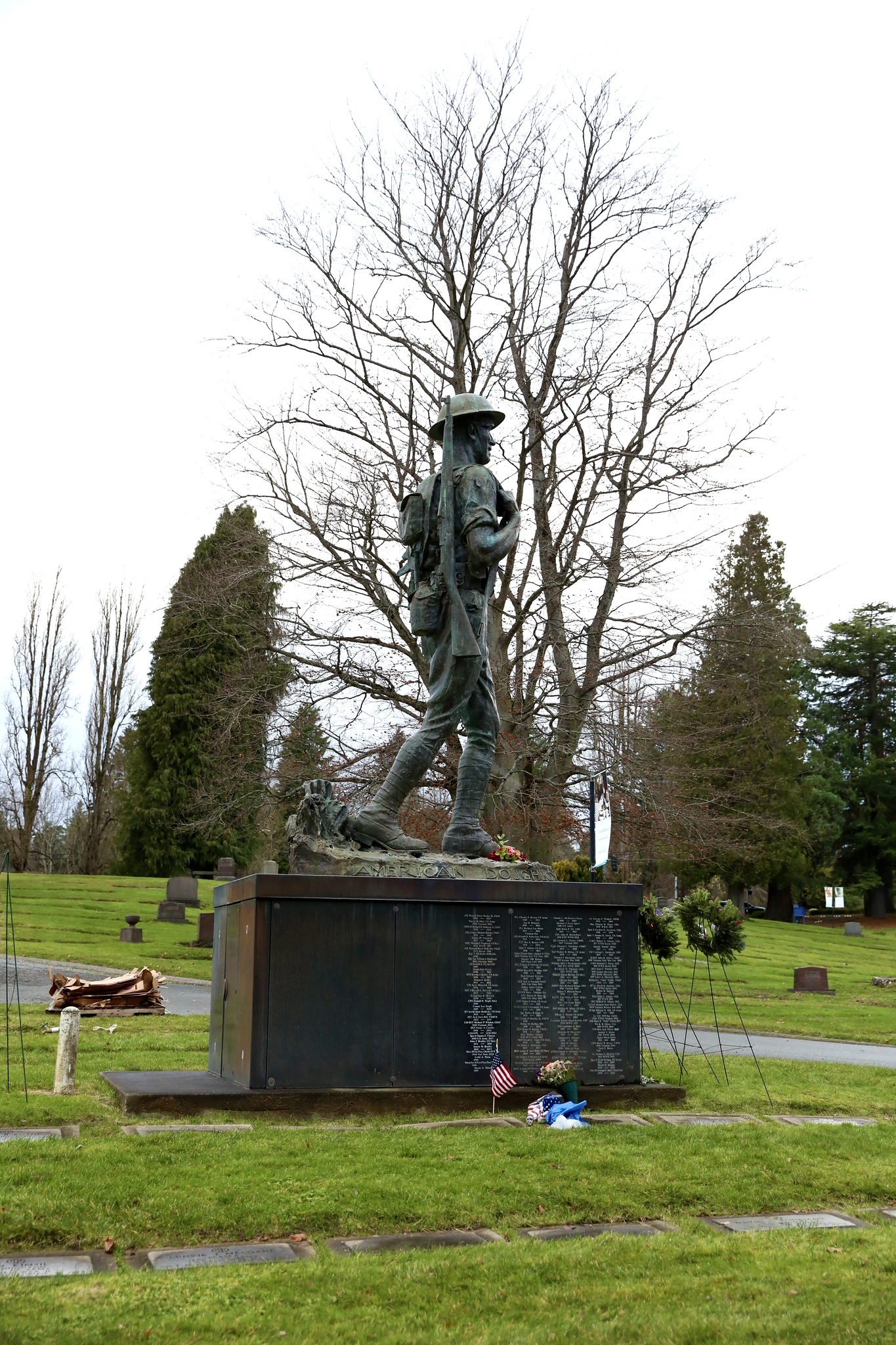
Despite the high, cold wind at 9 a.m. on Saturday, 14 December 2024, the participants and crowd gathered at the Doughboy statue in Veterans Memorial Cemetery at Evergreen-Washelli in north Seattle for the 16th annual Wreaths Across America (WAA) ceremony. The wind chill was so bad that the emcee, Lorraine Zimmerman, cut her own speech from the program. She is President and Executive Director of the Veterans Memorial Wreaths Foundation (WMWF—please see http://www.vmwf.org).
The croud gathers
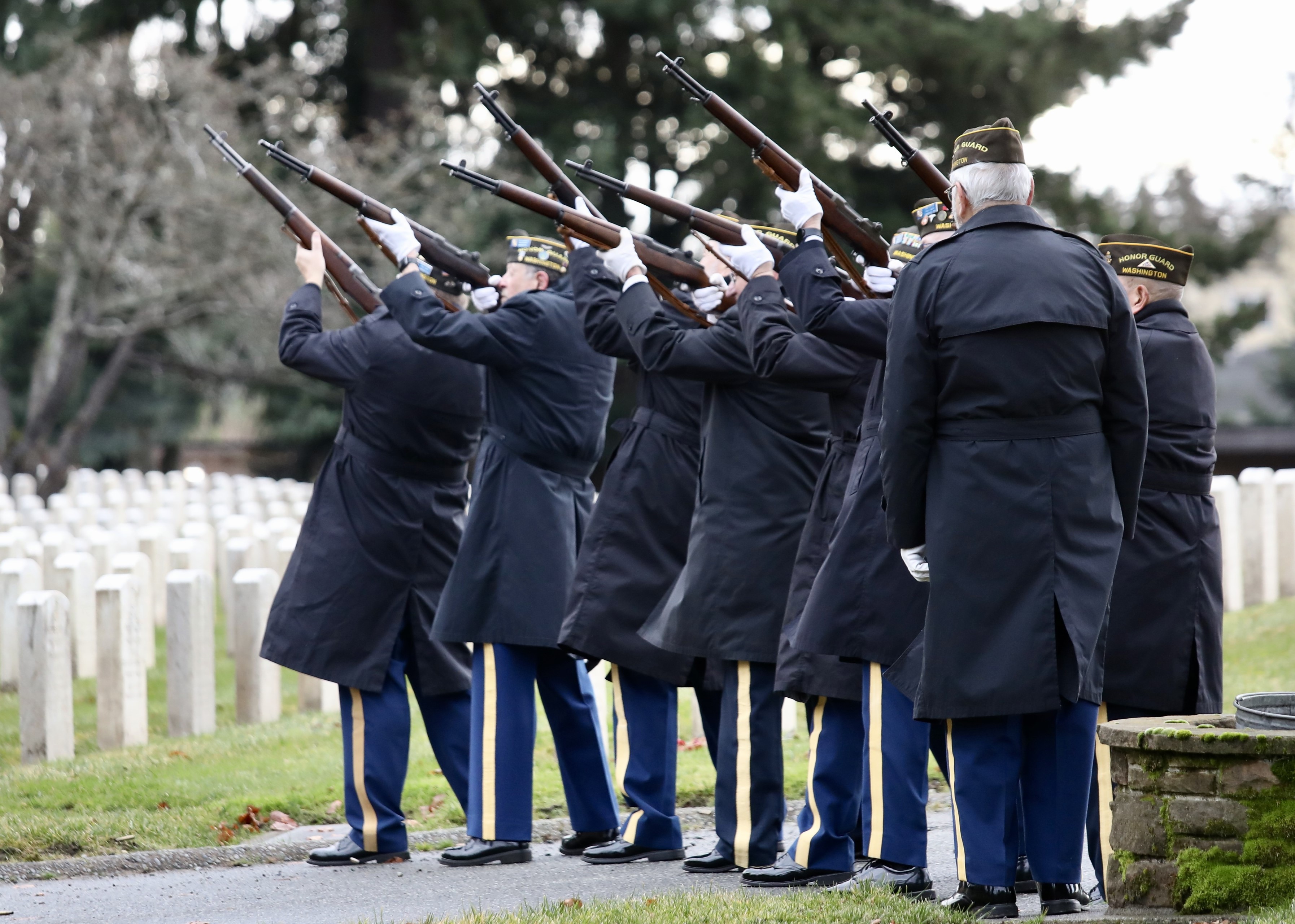
My bugle call, “Assembly,” called the ceremony to order. The first major event, as always, was the placement of flags upon the 8 ceremonial wreaths by representatives of the Army, Marine Corps, Navy, Air Force, Space Force, Coast Guard, Merchant Marines and POWs/MIAs. (Read more about the POW/MIA representative below.) Then the Honor Guard of VFW Post 1040 of Lynnwood fired a 21-gun salute (3 volleys).
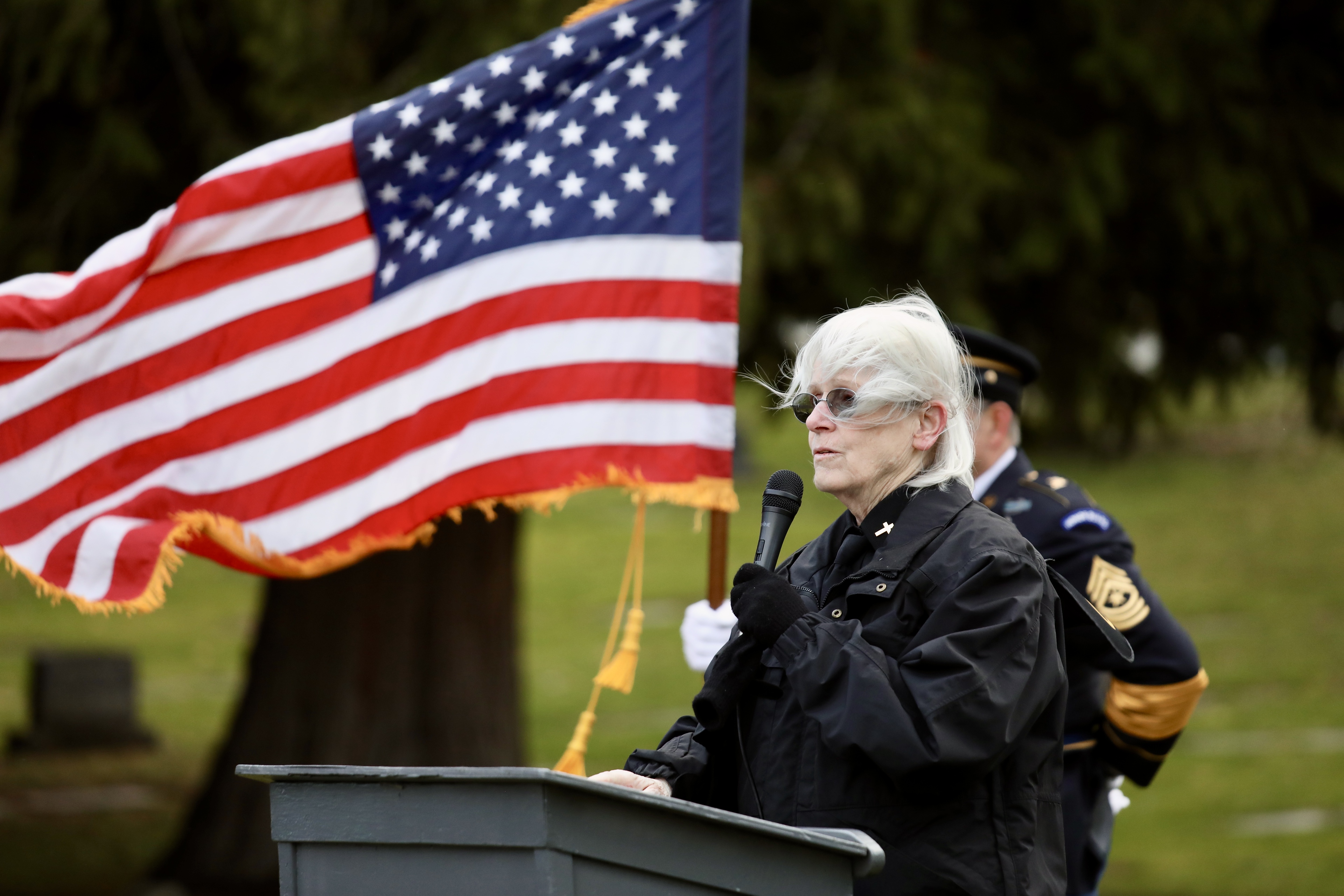
Lorraine Zimmerman presides as emcee
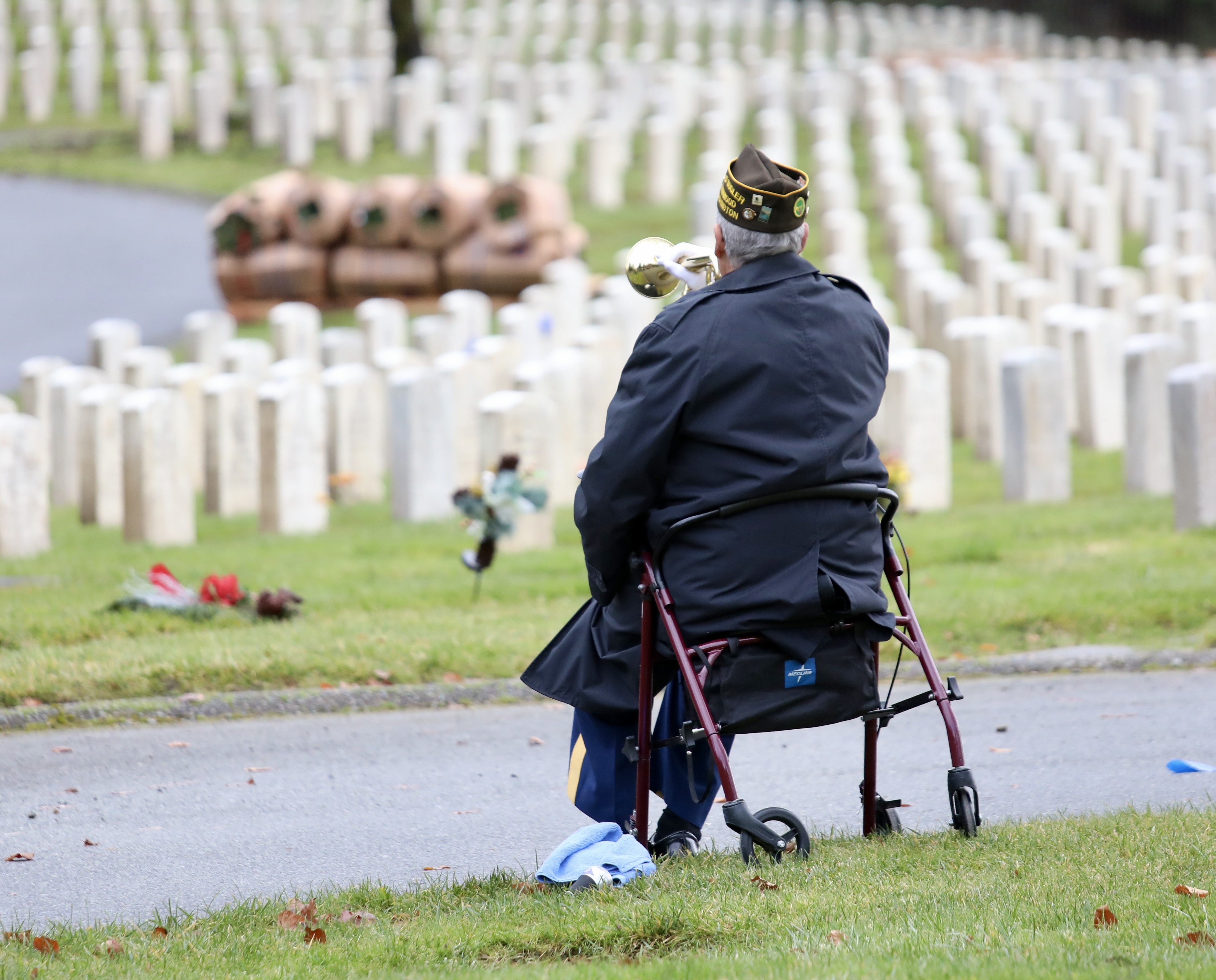
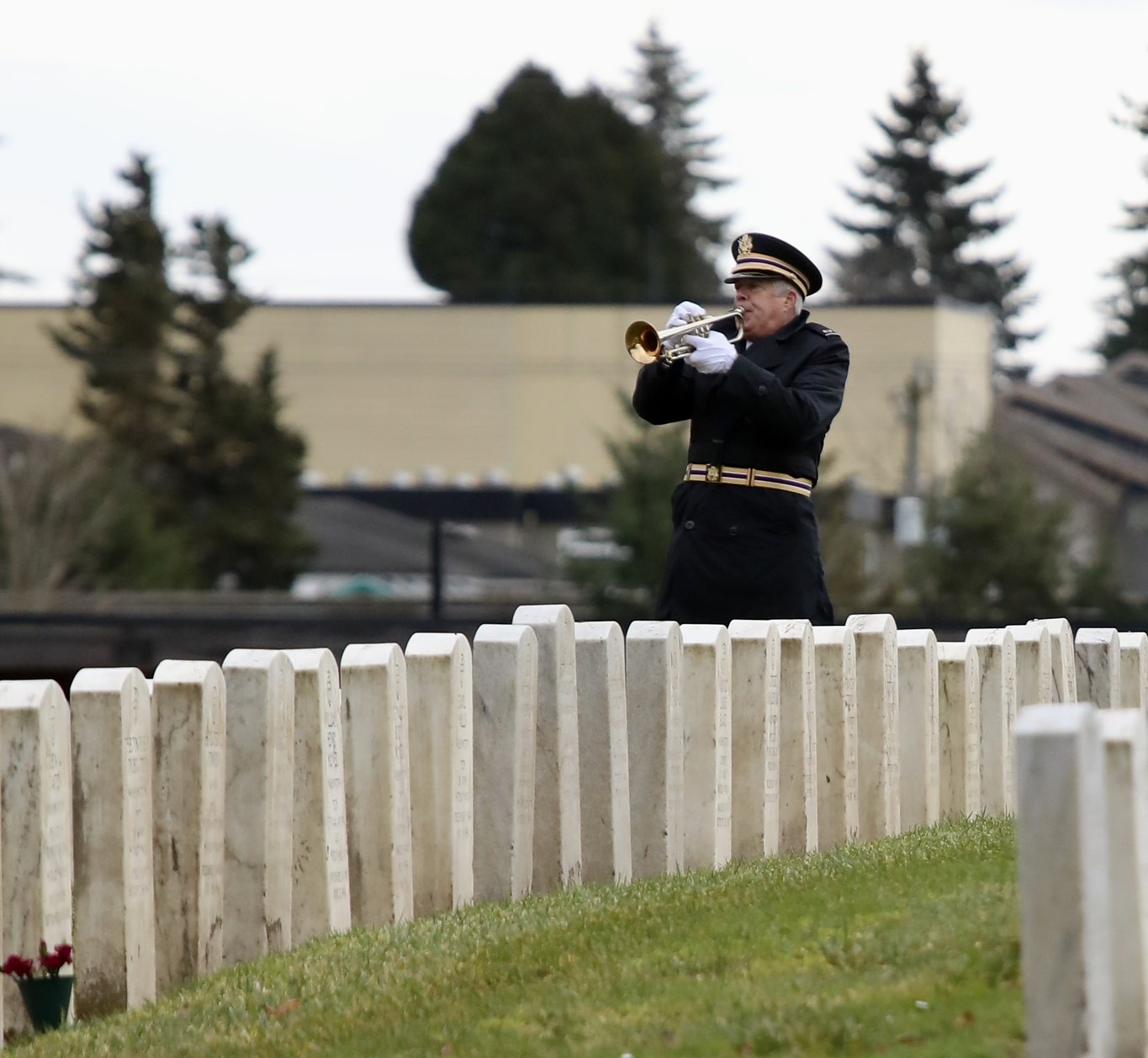
The ceremony concluded with “Echo Taps.” I sounded the lead part and James D. (Jim) Kellett, Army Musician CWO2, did the “echo.” I used my Getzen field trumpet (bugle), and he used his Super Olds trumpet. [Recall that I own a Super Olds cornet.] He is a member of the VFW 1040 Honor Guard and regularly sounds “Taps” with the Rifle Team at funeral services for veterans at numerous cemeteries throughout the area.
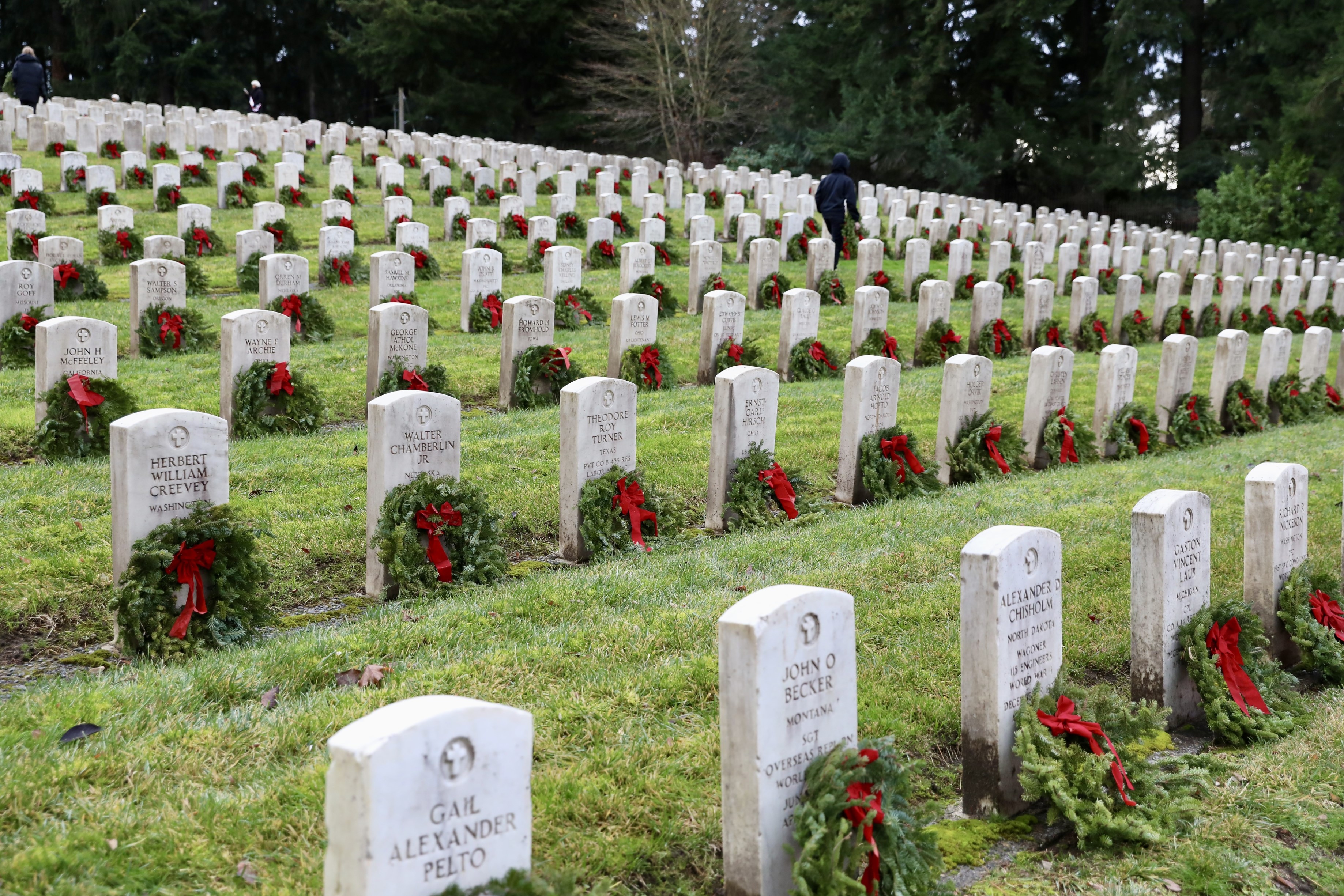
The second main event is the placement of wreaths against selected headstones among the more than 5,000 graves of veterans within Evergreen-Washelli. Seven Medal of Honor recipients are buried there. Zimmerman asked the wreath-laying volunteers to read aloud the names on the headstones as they placed the wreaths and thank them for their service—they are not forgotten.
Similar ceremonies are being held this year at the same local time in more than 4,500 participating locations in all 50 states, at sea, and abroad. More than two million volunteers and supporters are involved (please see http://www.wreathsacrossamerica.org).
Flag placement on POW/MIA Wreath
Capt. Wilson, Cadet Mugo, and Lorraine Zimmerman
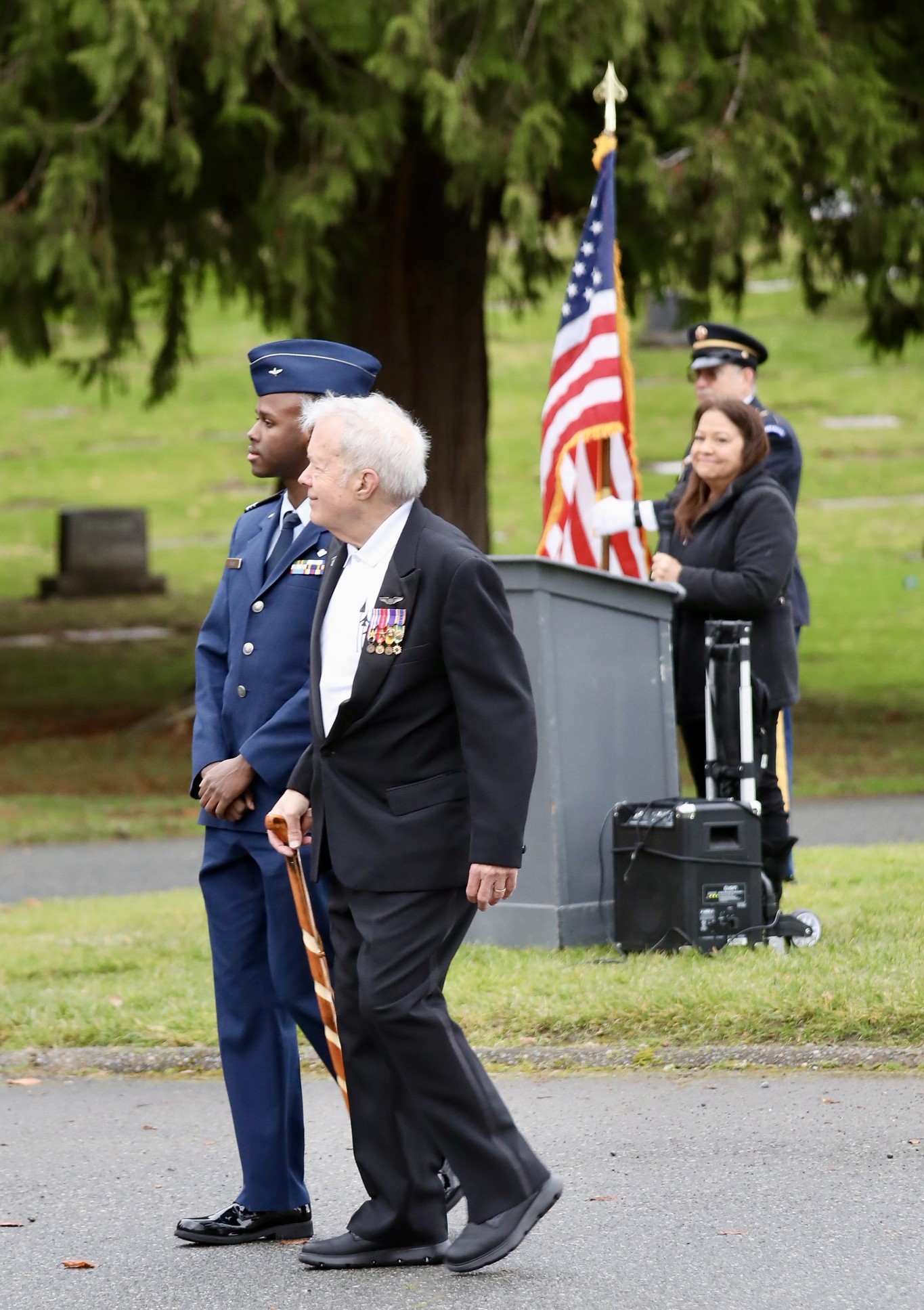
When the time came, Zimmerman called the POW/MIA representative to the podium to receive the flag that he would place on the POW/MIA wreath. As he stood before her, she read a brief description of his POW experience.
““Captain William W. Wilson, U.S. Air Force, is assisted by Cadet Martin Mugo, UW USAF ROTC.
“Captain Wilson, former prisoner during the Vietnam War, made 33 missions over North Vietnam and Laos, flying an F-111 Aardvark before being shot down while bombing the Red River docks in downtown Hanoi on 22 December 1972. He evaded capture for a week, was nearly rescued by a Super Jolly Green helicopter, and then was captured by the North Vietnamese on 29 December. He spent a month in the ‘Heartbreak’ section of the ‘Hanoi Hilton’ [Hoa Lo Prison, loosely meaning ‘hell’s hole’ or ‘fiery furnace’] before being moved to the ‘Zoo’ [facility near the village of Cu Loc].
“He returned to U.S. control on the last C-141A Starlifter out of Hanoi on 29 March 1973 during Operation Homecoming.
“Bill will now place a flag in honor of the more than 83,000 United States servicemen and women from all branches of the service whose last known status was either Prisoner of War or Missing in Action. These individuals have never returned to their families and homes. We will not forget you.”
After he placed the flag and rendered a slow hand salute, he turned and walked slowly back across the grass toward the crowd. From a distance, I rendered a hand salute to him, and as he stepped onto the paved road, the crowd broke into warm applause. Zimmerman later told me, “I was so proud when the crowd honored him so spontaneously.” Indeed, it was the highlight of this year’s ceremony. Please see the photos (below, by Phil Onishi) of Captain Wilson and Cadet Mugo.
Embouchure Troubles Are Subsiding Nicely
Glenn Ledbetter warms up his bugle by sounding “Assembly” with a practice mute that deadens the sound
It was one year ago that I developed severe embouchure troubles for the first time in my life. Old age brought crooked teeth, to the point that my left front tooth had crossed over the right one just enough to disrupt the air flow into the mouthpiece of my horns. The problem flared up suddenly, right before last year’s WAA ceremony. I first alluded to it in my blog post of 10 June 2024, about the previous WAA ceremony. Then I wrote about it in more detail in my post of 12 June about my performance at The Bellettini retirement community in Bellevue. (Please use the Archives in the left column to find these articles, if you wish).
I had to go to the orthodontist for the solution: not braces, but Invisaligners (see http://www.invisalign.com). I wear them constantly, daily, except when eating. They have been gradually straightening my teeth since last February. Next spring, my teeth should be completely straight with the proper overbite—Oh, Happy Day!
But last May, after only four months, my teeth had straightened sufficiently that I was able to start performing again. My first public appearances were on Memorial Day when I performed at the ceremonies at Veterans Park in Lynnwood and in T-Mobile Park at the Seattle Mariners baseball game before a crowd of 24,000. Since then, on a reduced schedule, I have performed my one-hour trumpet shows at several retirement communities in the Greater Seattle area (scroll down this page). I’ll resume normal scheduling in 2025.
Photos Credits and Donations, Likes and Comments
Please click on any photo to enlarge it. All photos (except the one by me) are by Phil Onishi (please see https://philonishiphotography.smugmug.com). Mr. Onishi, long-time Band Director at Lynnwood High School, sang the National Anthem.
Donations are welcomed by both WAA and WMWF. I invite you to “Like” and “Comment” by clicking on the links below.
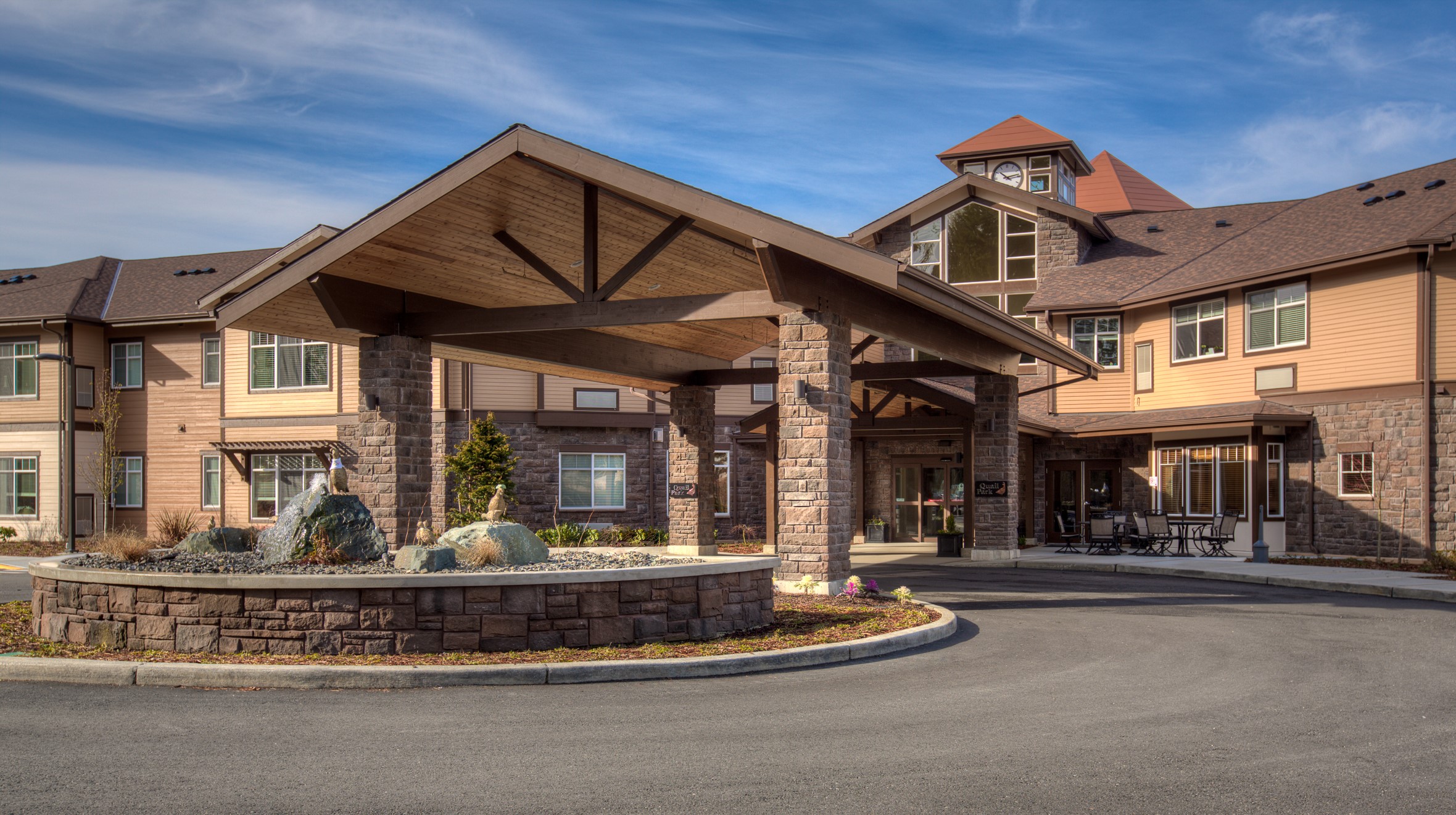
I’ve performed at 32 different retirement communities in the Greater Seattle area, and Quail Park is unique in a good way. Of course, every community is unique, but I’m thinking of Quail Park’s private, hilltop location and its eight different floor plans:
2 bedroom/2 bath cottage with garage (1,616 s.f.)
2 bedroom/2 bath apartment (787-1,072 s.f.)
1 bedroom/1 bath apartment (592-794 s.f.)
Studio bed/1 bath apartment (411-603 s.f.)
Private Studio Suite – Studio bed/1 bath (377-399 s.f.)
Tribute Studio Suite – Studio bed/1 bath (374-469 s.f.)
Tribute Adjoining Studios – Studio bed /1bath (374 s.f.)
Adjoining Studios-Lynnwood – Studio bed/1 bath (352-420 s.f.)
For diagrams of the different layouts and to match each floor plan with the four lifestyles (assisted living, enhanced assisted living, independent living, and memory care), please see the website, http://www.livingcarelifestyles.com/quail-park-lynnwood.
So, it was a privilege to perform for the residents in their beautiful auditorium on 12 November, one day after Veterans Day. In my VFW uniform, I performed my one-hour trumpet show, “I Stand for the Flag.” As usual, I used my five horns to play about two dozen patriotic marches, songs, and bugle calls. I love to match each instrument—trumpet, cornet, flugelhorn, bugle, and pocket trumpet—to the character and mood of each different piece.
This is my second performance at Quail Park. The first was on 22 December 2019, before the Covid pandemic. I presented my Christmas show, entitled “Things Remembered.” In addition to these two, I have four other different shows. I look forward to returning in 2025, God willing. Merry Christmas and Happy New Year!
Veterans Day, 11 November 2024, found me in Bellevue for my third performance at The Gardens at Town Square retirement community. That afternoon, I presented my one-hour trumpet show, “I Stand for the Flag” to a large, generous audience.
Actually, I have two versions of this show. In 2021, after the Covid Pandemic peaked, I performed the “talk version.” In this show, I not only play patriotic marches, songs, and bugle calls, but also, I talk about veterans’ current well-being, concerns, and activities. But this year, I performed the “standard version”–about two dozen pieces of music with a bit of talk to introduce each piece. The audience sings along as I play my five horns: Getzen Eterna Severinsen trumpet, Super Olds cornet, Austin Custom Brass (ACB) flugelhorn, Getzen bugle, and Jupiter pocket trumpet.
We had such a great time that I look forward to returning sometime in 2025, God willing. I have six different trumpet shows, so there’s plenty to choose from. Merry Christmas and Happy New Year!