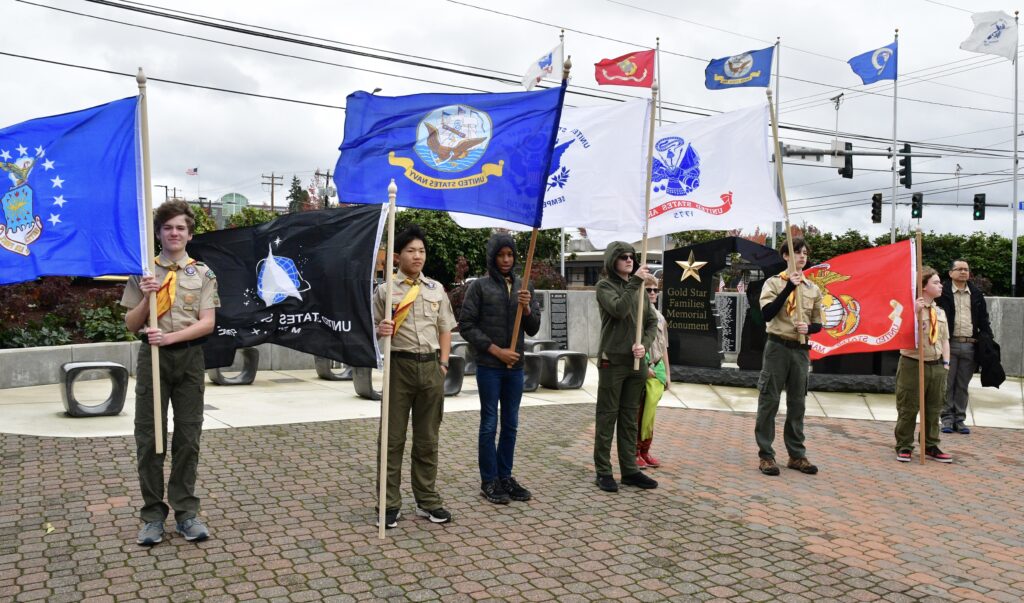
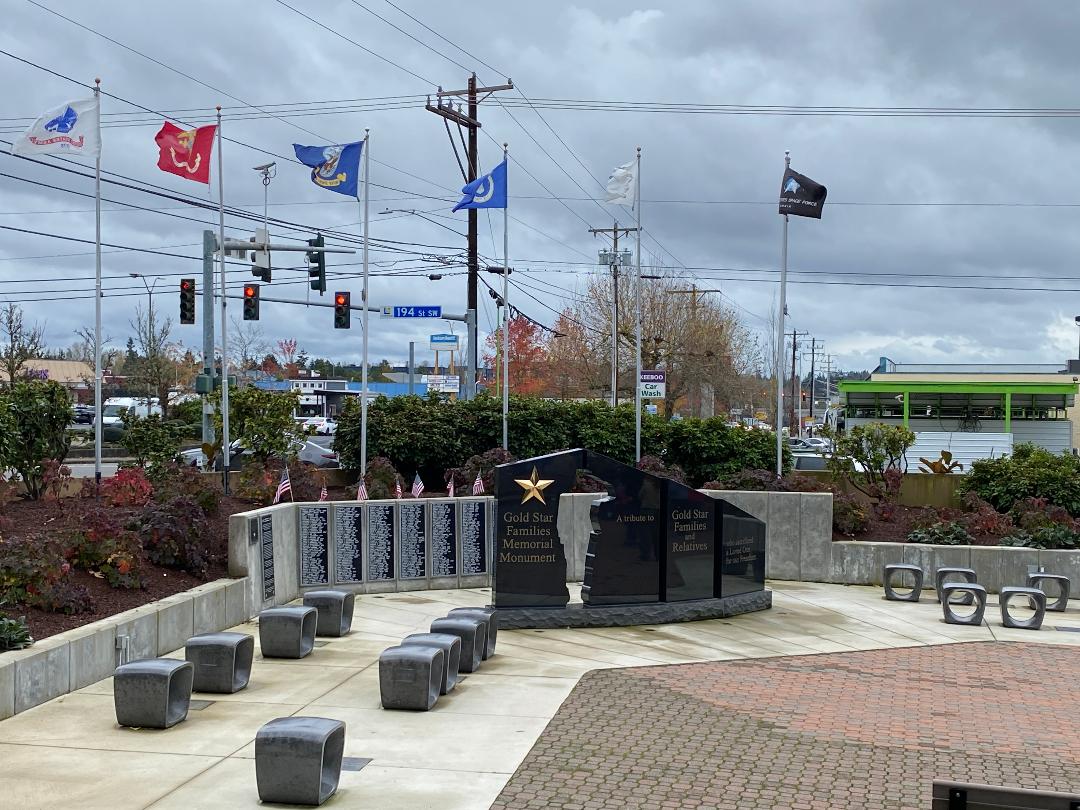
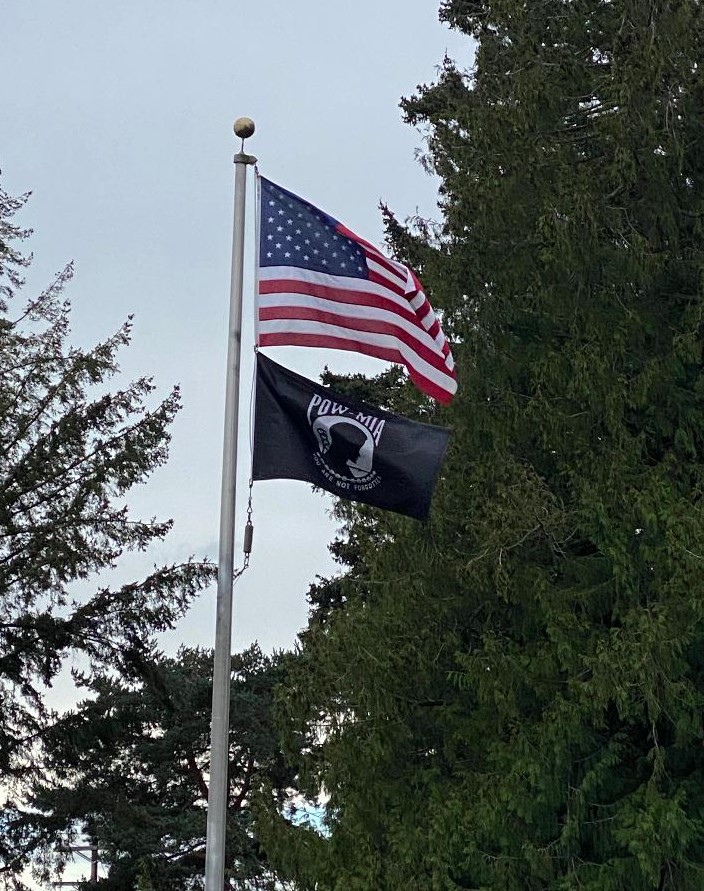
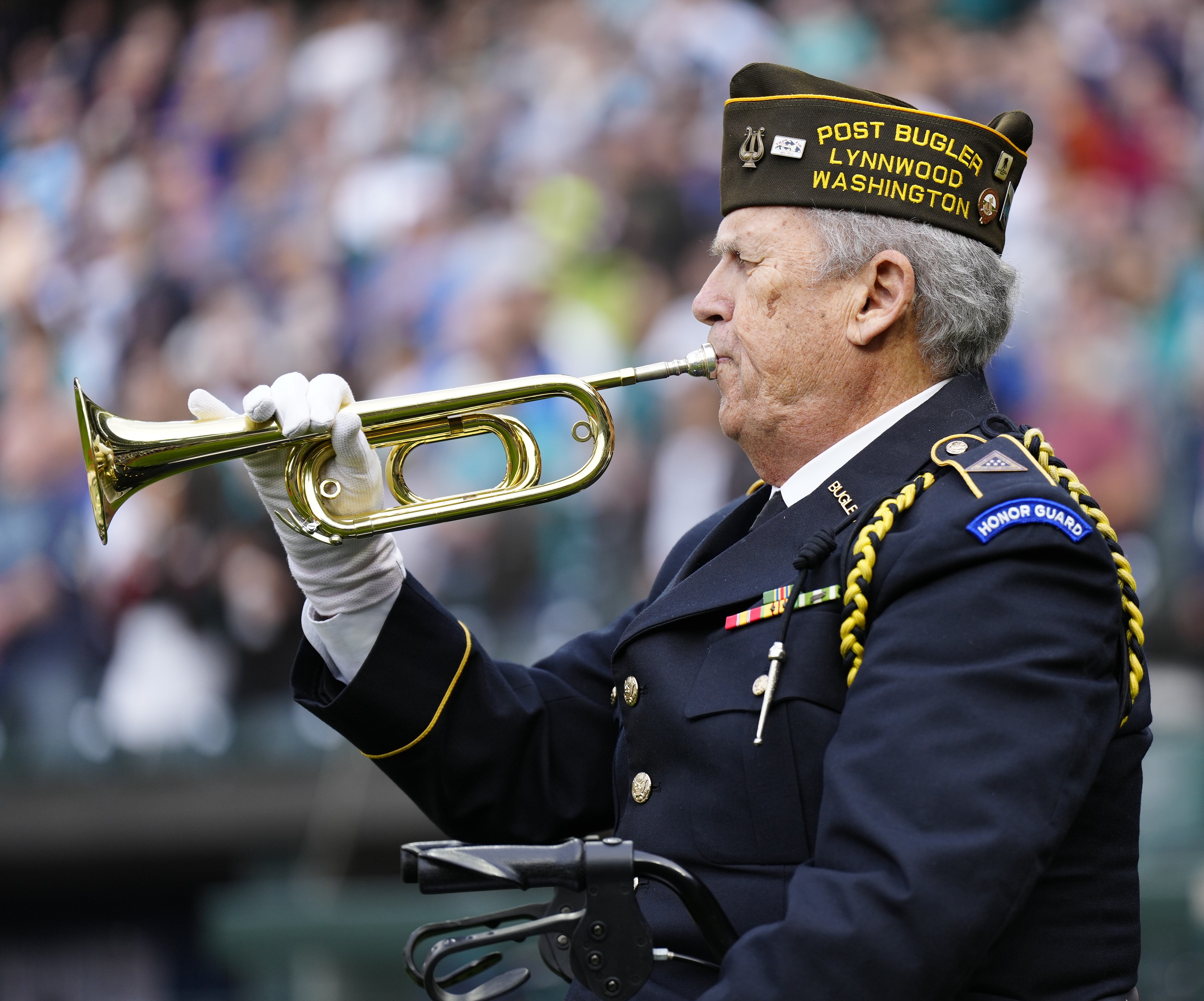
The national tradition is to conduct the Veterans Day ceremony at 11 a.m. local time, worldwide, on the 11th day of the 11th month—formerly known as Armistice Day, WWI. Never forget, as succeeding generations were charged by Canadian Lieutenant-Colonel John McCrae in his elegant poem, “In Flanders Field.” And so this is done annually at Veterans Park in downtown Lynnwood.
This is the second time that I’ve sat in my walker at this location for sounding the two bugle calls, ‘”Assembly” and “Echo Taps.” My lower back hurts, and when I stand to play, I’m a bit shaky. Also, I am challenged by the aligners that are in my mouth to straighten my teeth. (They should be removed by next Memorial Day.) Old age does its thing. So, when I sit, it sounds better. Judah Deuman sounded the “echo” part. He graduated from Lynnwood High School last spring. I used my Getzen field trumpet, and he used his trumpet.
Please click on any photo to enlarge it.
Photos by Julia Wiese, Lynnwood Today:
Boy Scouts Troop 49Glenn Ledbetter, VFW 1040 BuglerVFW Post 1040 Honor Guard (L) and Legion of Honor, Nile Shrine Center (R)
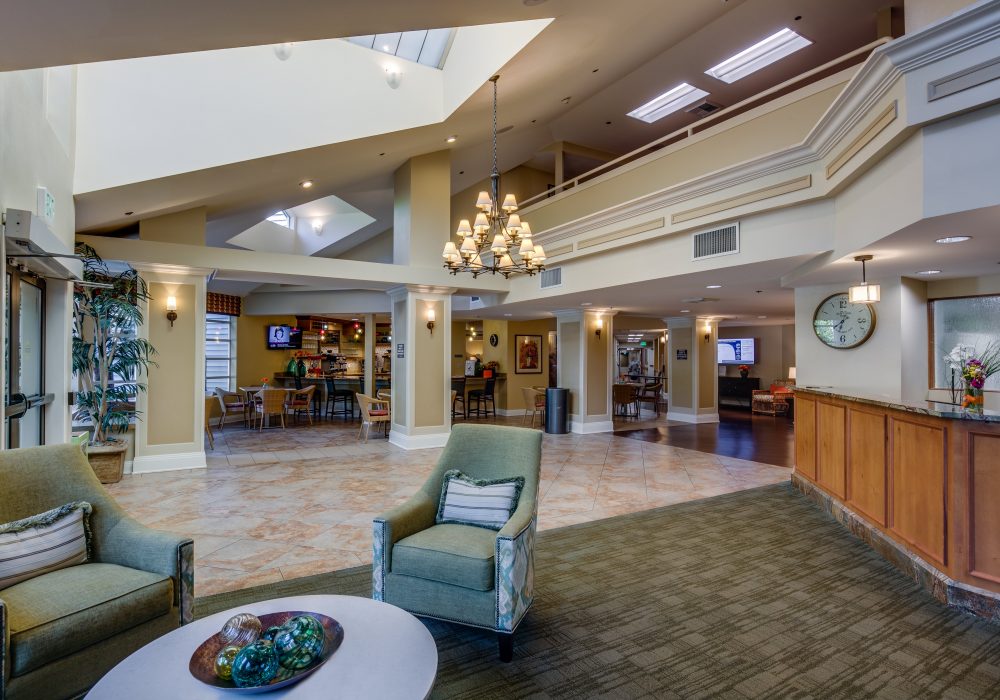
Lobby, courtesy of Fairwinds, Brighton Court, Lynnwood
Veterans Day generated three gigs for me, and the first one was at Fairwinds, Brighton Court in Lynnwood on Saturday, 9 November 2024—two days before the actual Veterans Day (11 November). The other two performances will be covered in forthcoming blog posts.
I’ve now performed at 32 retirement communities, including many repeat appearances, throughout the Greater Seattle area. Fairwinds, Brighton Court is now the leader with six performances. My first trumpet show there was in 2018.
On this occasion, I appeared in my VFW uniform and presented my one-hour show, “I Stand for the Flag.” The audience was large and quite responsive. I used five horns: trumpet, cornet, flugelhorn, bugle, and pocket trumpet. The show consists of about two dozen patriotic marches, songs, and bugle calls. The audience sings along.
I look forward to returning for a seventh time in 2025, God willing. I offer six different shows, so next time could be entirely a different experience for the residents. Merry Christmas and Happy New Year!
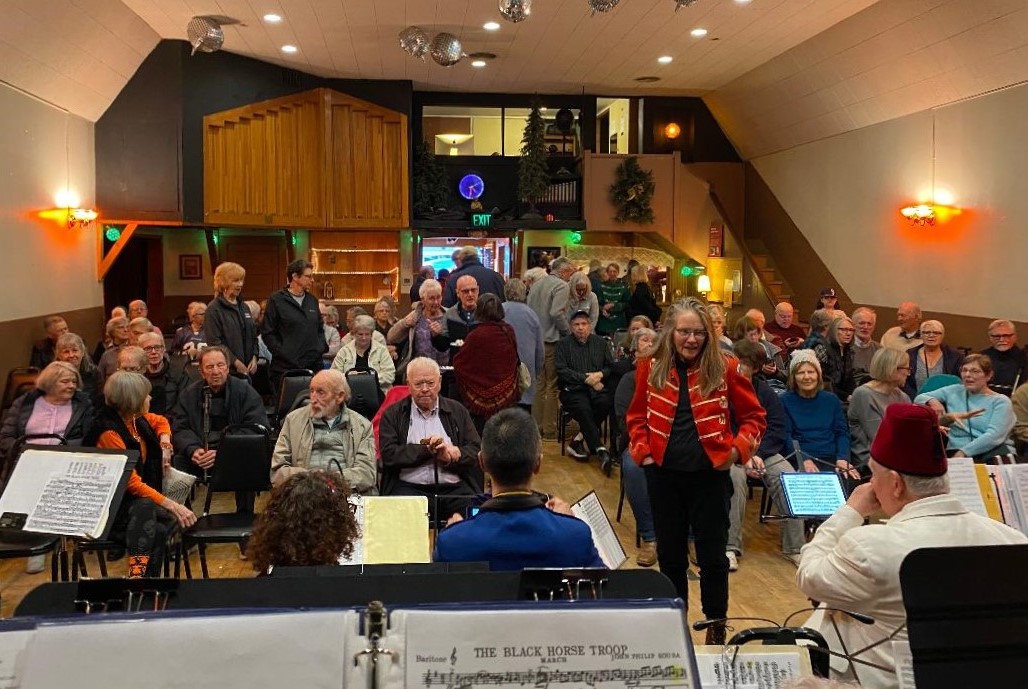
Audience heads for the concession stand (right background) during Intermission. Liz Dreisbach, band creator and director, stands in foreground.
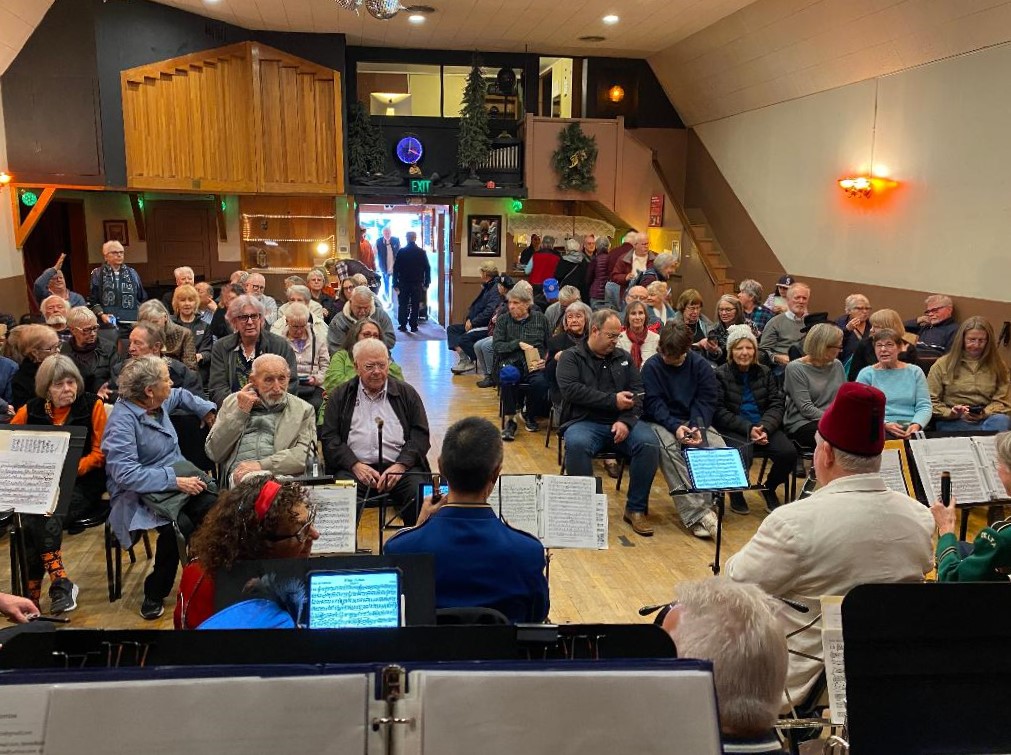
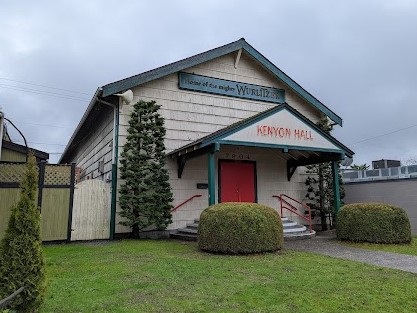
On Sunday, 3 November (three days before John Philip Sousa’s 170th birthday), the Ballard Sedentary Sousa Band (BSSB) performed again in his honor at Kenyon Hall in West Seattle. As usual at this annual event, informally called the “Sousa Bash,” the hall was full of Sousa fans. Revered as “The March King,” Sousa composed 136 marches between 1873 and 1932, when he died.
The band performed 13 pieces, including a “Happy Birthday” song written especially for Sousa by Gary Pedersen. Nine of the marches were written by Sousa, and two others were by Henry Fillmore and Alex F. Lithgow. Sousa wrote the march, “El Captain,” in 1895 for an operetta of the same name. So, Ms. Dreisbach passed out the lyrics, written by Charles Klein, and the band and audience sang them together. One line is particularly fun to sing up-tempo—“Behold El Capitan–Gaze on his misanthropic stare, Notice his penetrating glare.”
Everyone recognizes Sousa’s “Semper Fidelis,” “Washington Post” and “Stars and Stripes Forever,” which the band performed. But the band also played his “King Cotton,” “Fairest of the Fair,” “The Belle of Chicago,” “The Thunderer,” and “Black Horse Troop.”
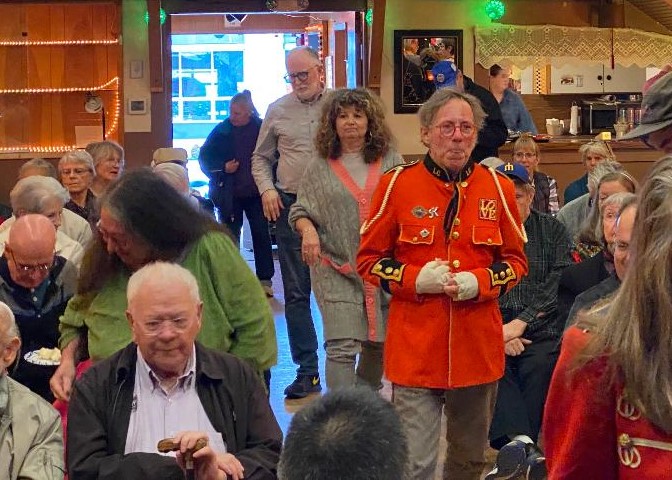
As I did last year, I played with the baritone section, using my Austin Custom Brass (ACB) flugelhorn (please see my post of 9 November 2023, using the Archives column on the left). For fun, each band member wears his/her own unique uniform.
For more information about the “Sousa Bash” and Kenyon Hall, see my post of 11 November 2023. Please click on any photo to enlarge it. I invite you to “Like” and “Comment” on this post by clicking on the links below.
Returning to seats after Intermission.Find the man eating popcorn and the man waving.Returning to seats after Intermission.Two beautiful baritones
On Wednesday, 24 July, I heard Bria Skonberg and her band at Jazz Alley in Seattle. Nobody plays trumpet like Bria. And she also composes, arranges, and sings.
For about three years, I’ve watched her videos and followed her on Facebook, and as she posted about playing everywhere else but here, mostly on the East Coast and New Orleans, I would comment, “When are you coming to Jazz Alley in Seattle?”
She always replied, “We’re working on it,” until one time she said, “Check the July 2024 schedule.”
Sure enough, she was booked for 23-24 July! So, on the last night, I went and sat in the balcony at table 430. Had a nice side view. After the show, I spoke with her briefly. She wants to come back.
Later, I also spoke to the general manager. “I’ve come here to see Pancho Sanchez, Arturo Sandoval, and Chris Botti. I like her best of all.”
“She belongs with them,” he said.
“She’s so versatile and expressive!” I said. “She talks through the horn. She may not have the range and power of some other trumpeters, but she beats them all in expression. I hope you’ll bring her back.”
“We will!” he said, and we shook hands.
The New York Times wrote, “Ms. Skonberg has become the shining hope of hot jazz, on the strength of a clarion trumpet style indebted to Louis Armstrong, a smooth purr of a singing voice inspired by Anita O’Day.” Coming from British Columbia and now living in New York, she was described in The Wall Street Journal as “one of the most versatile and imposing musicians of her generation.” Her signature composition is “So Is the Day,” with which she closed the show.
Jazz Alley wrote, “Bria has recorded on over 25 albums, has garnered over 13 million streams online and over 85,000 social media followers…She tours constantly, bringing her own signature sounds of fiery trumpet playing, smoky vocals and storytelling together with adventurous concoctions of classic and new.” She’s a Juno Award winner (2017), among other awards. Her 2024 release, What It Means, “tells stories of life lessons that range from upbeat to down-to-earth to emotionally deep, all the while exhibiting both her mastery of the trumpet and her soulful and undeniably connective voice.”
Her parents were in the crowd on that last night. They know—nobody plays the horn like Bria.
It was Independence Day, and I was returning to Mercer Island, where I lived for 30 years (1973-2003), to perform my one-hour trumpet show, “I Stand for the Flag,” at Island House MBK Senior Living, a retirement community. Moreover, I was returning to Island House itself, where I had sounded “Taps” six years ago in a ceremony on Memorial Day, 28 May 2018. It was good to be back!
It was a bright, warm day, so the staff, led by Jacqueline Lilly, Director of Wellness Programming, set things up in the courtyard, where I and many of the audience sat under large, dark green umbrellas. I wore my VFW Honor Guard uniform, and as usual, played five horns–Getzen trumpet and field trumpet (bugle), Olds Super Cornet, ACB flugelhorn, and Jupiter pocket trumpet. The show consists of two dozen patriotic marches, songs, and bugle calls.
For more information about Island House, please see https://www.mbkseniorliving.com/senior-living/wa/mercer-island/island-house/. It is located downtown and offers assisted living and short-term stays in studio, one-bedroom, and two-bedroom apartments. Photos courtesy of Island House, Mercer Island.
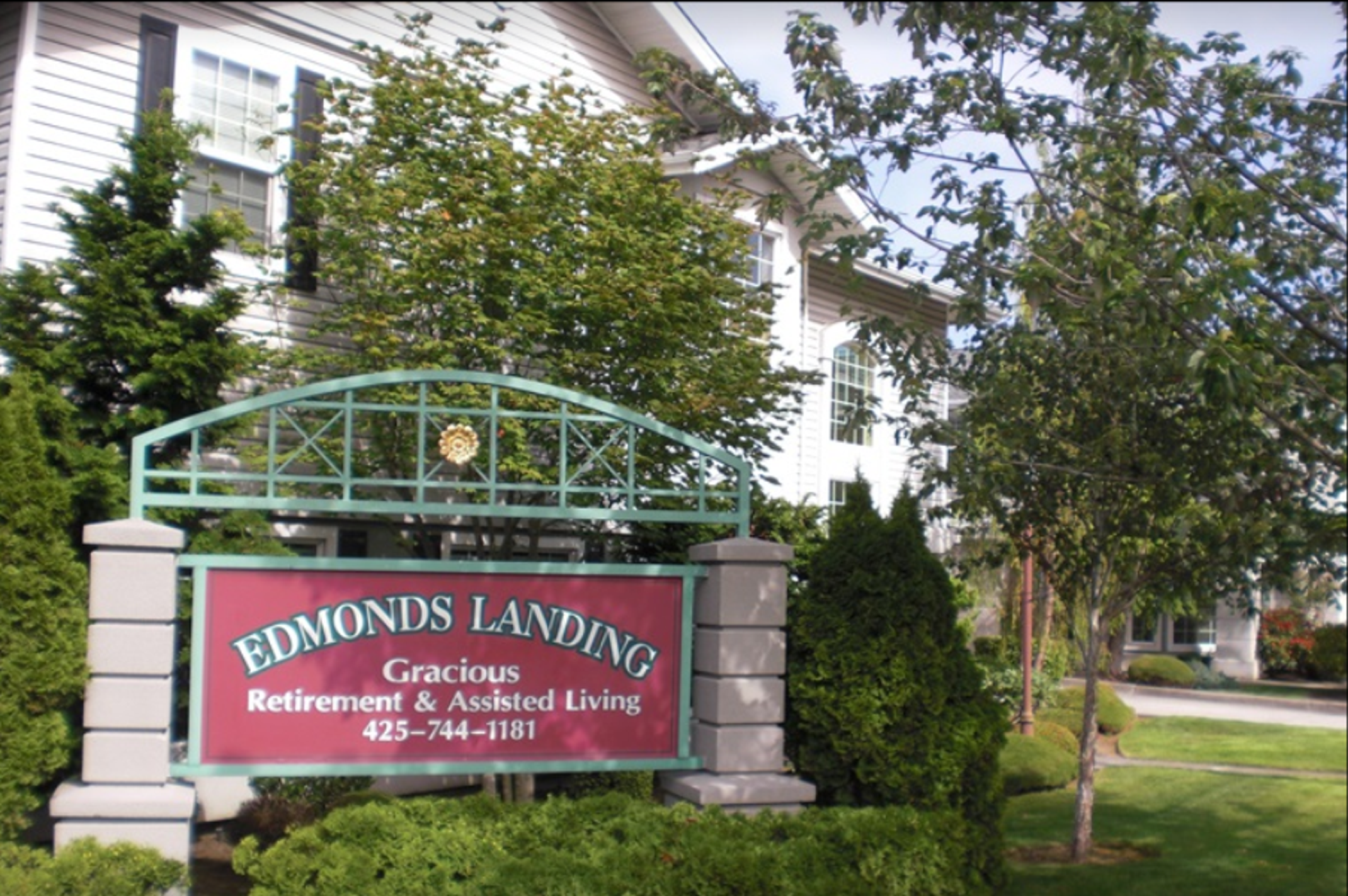
If it’s your birthday, where do you go? You go perform a one-hour trumpet show, “In Retrospect,” at Edmonds Landing in Edmonds, WA, because they invited you to do so! And that’s exactly what I did at 2 p.m. on 24 June. It was my second performance for the residents there, courtesy of Lifestyle Director, Sonia Pace.
For this show, I use four horns: Getzen trumpet, Olds Super cornet, ACB flugelhorn, and Jupiter pocket trumpet. I play about two dozen popular songs from the residents’ era. They were composed during the 84-year period from 1892 to 1976. As I play each song, I comment on it and relate it to something that we all experience at some time in our lives, including courtship, marriage, family, death, and national pride and loyalty. It’s a favorite of mine among my six different trumpet shows.
Edmonds Landing offers Independent Living and Assisted Living in 83 apartments on two floors in the “Edmonds Bowl.” It is part of the family of retirement communities operated by Frontier Senior Living (please see https:/www.frontiermgmt.com).
Photos courtesy of Edmonds Landing (except for poster).
Almost every Flag Day (14 June), I get to perform my one-hour trumpet show, “I Stand for the Flag.” This year, I did so at a brand-new community, Cogir of Kirkland, located near Carillon Point. It opened last February, offering assisted living services.
Among the residents who attended was a couple celebrating their 55th wedding anniversary. He used to play trumpet, and she used to play the French horn.
My show consists of about two dozen patriotic marches, songs, and bugle calls. I use four horns: Getzen trumpet, Olds Super cornet, Getzen field trumpet (bugle), and Jupiter pocket trumpet. Residents sing-a-long with me on certain songs.
Cogir Senior Living operates nearly 70 facilities in 11 states. In Washington, it has 18, ranging from Spokane to Walla Walla to Vancouver to Everett to Bellevue. Collectively, Cogir’s services include independent living, assisted living, connections care, memory care, and respite care, but most facilities offer one or two of these five levels of care. Together, these communities are staffed with more than 3,700 skilled, compassionate team members (please see https//:cogirusa.com).
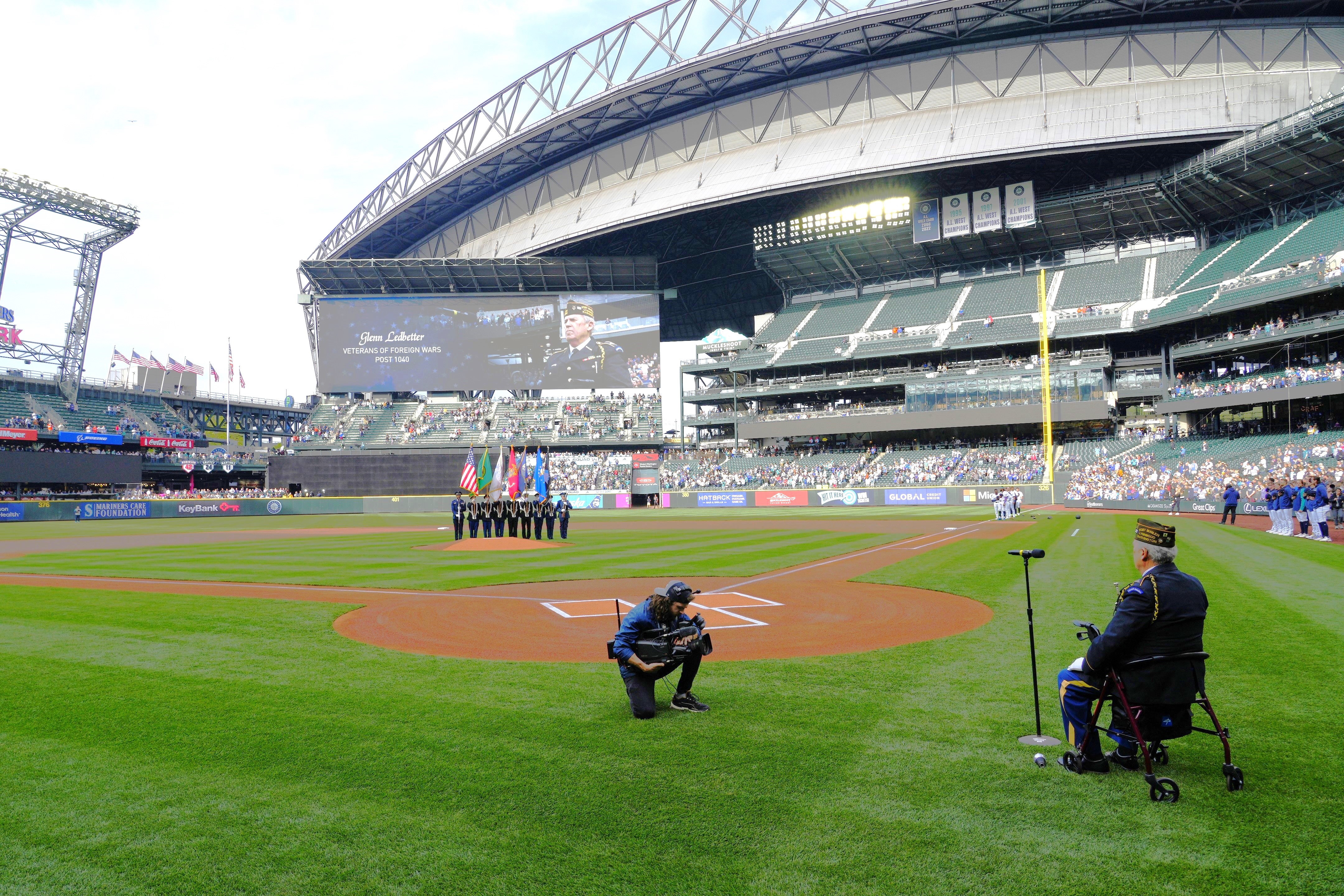
Awaiting cue to sound “Taps”—click to enlarge and read Jumbotron screen. Photo by Ben Van Houten, Seattle Mariners photographer
Glenn Ledbetter, VFW Post 1040 Bugler, Lynnwood, sounds “Taps.” Photo by Ben Van Houten, Seattle Mariners photographer.
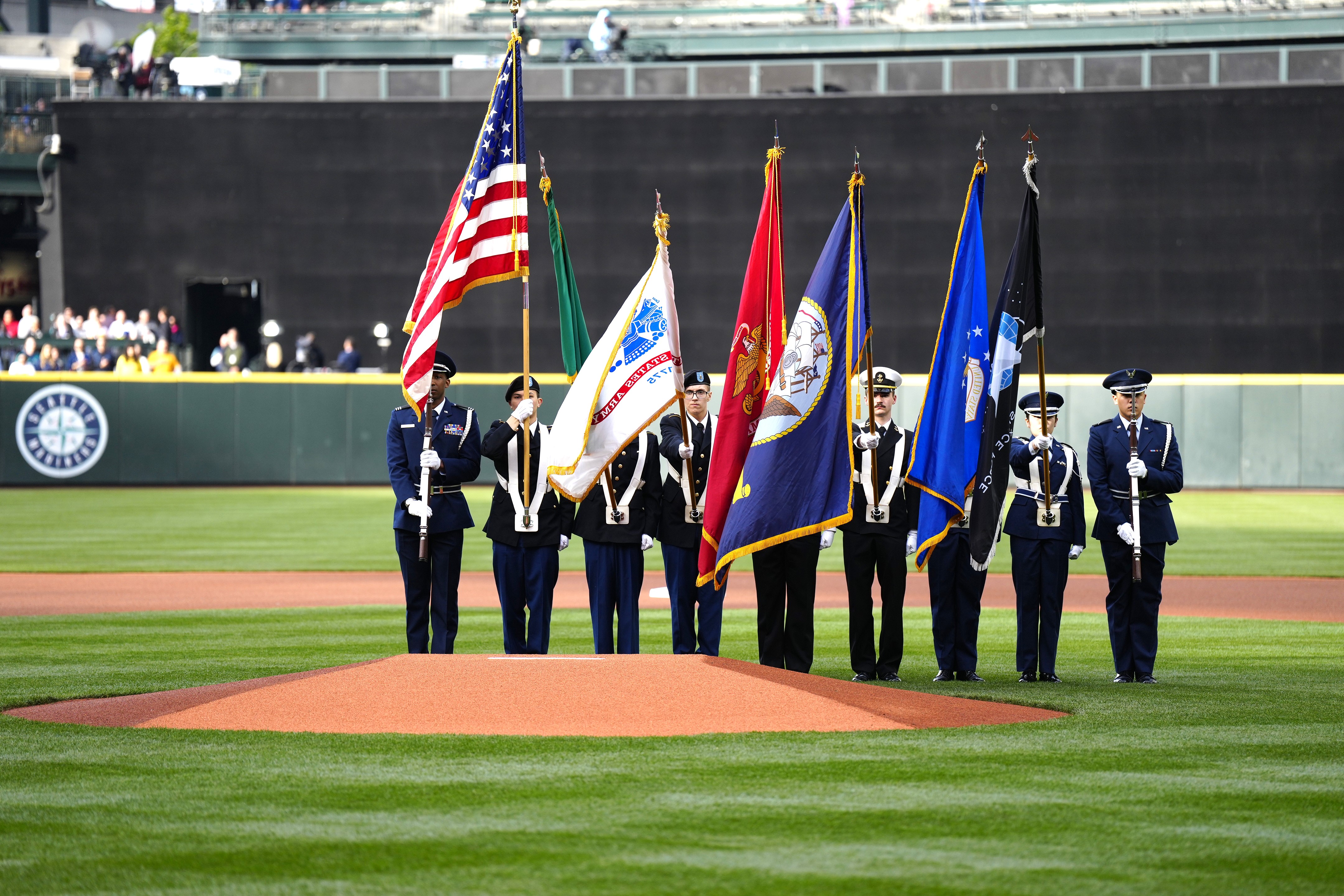
UW Joint Navy and Air Force ROTC Color Guard. Photo by Ben Van Houten, Seattle Mariners photographer.
The Seattle Mariners beat the Houston Astros, 3-2, at T-Mobile Park in downtown Seattle on Monday, 27 May. That was Memorial Day, and the Mariners’ pre-game activity was to “Remember and Honor” those military personnel who died in service to our country. The Joint Color Guard was comprised of University of Washington students who are in the Navy and Air Force ROTC programs. And one bugler was assigned to sound “Taps” after a moment of silence—me!
It was a dream come true! On 17 August 2014, I had sounded “To the Color” at a Mariners’ minor-league Aquasox game at the ballpark in Everett. And that inspired me to want to sound a bugle call at a Mariners game in Seattle. Ten years later, it happened, thanks to someone else. Unbeknownst to me, Monica McNeal, Gold Star Families of Washington, had referred me to the Mariners. Gold Star Mothers were also honored between certain innings of the game. Please see https://www.goldstarmoms.com. and my blog article of 2 November 2023.
I’ll be 84 next week. You’re never too old to have dreams and set goals—and if you need to, straighten your teeth!
Thus ends the “Lost Buzz Saga.” To read the whole story, please see my posts of 10, 12, and 21 June, plus this one, which is the climax. I invite your “Likes” and “Comments;” simply click on the links below this post.
The Mariners kindly recorded the pre-game activities. Here are the links for viewing the videos:
On Memorial Day this year, I sounded four bugle calls:
MorningStar Senior Living at Silver Lake, Everett
“Assembly” and “Echo Taps” at the ceremony hosted by VFW Post 1040 at Veterans Park in Lynnwood.
“Taps” at the retirement community, MorningStar Senior Living at Silver Lake, in Everett.
“Taps” at the Seattle Mariners baseball game at T-Mobile Park in Seattle.
Judah Deuman, a senior trumpeter at Lynnwood High School, played the “echo” part of “Echo Taps” with me.
Veterans Park, Lynnwood
These were very significant, “comeback” performances for me. I had not played in public for the past five months.
In my previous blog article, I divulged that during last December, I was having trouble playing my horns. My orthodontist predicted that I should be able to play my horns again by Memorial Day. Sure enough, it happened!
Now, what else could happen? Sciatica, that’s what. While sounding “Assembly” during the morning ceremony in Lynnwood, I discovered I could not hold a steady tone while standing, due to my lower back pain. So, for the rest of the day, I sounded “Taps” while seated on my walker and did just fine.
Who said that old age is just a number? Well, if that’s true, then jail is just a room.
The privilege of sounding “Taps” at the Mariners game that evening is presented in my next blog article.
In Paris, there’s a music museum. A friend told me about it several years ago, and finally, I found it and went to see it on 7 May—the Musee de la Musique in the 19th arrondissement, northeast of the Louvre and Eiffel Tower.
A docent on the second floor, who plays trumpet, told me about a special trumpet on display on the fourth floor. She said it was used at the premier of Verdi’s Aida in Cairo, Egypt in 1871, over the objections of Verdi himself. She could not leave her post and come upstairs to show it to me.
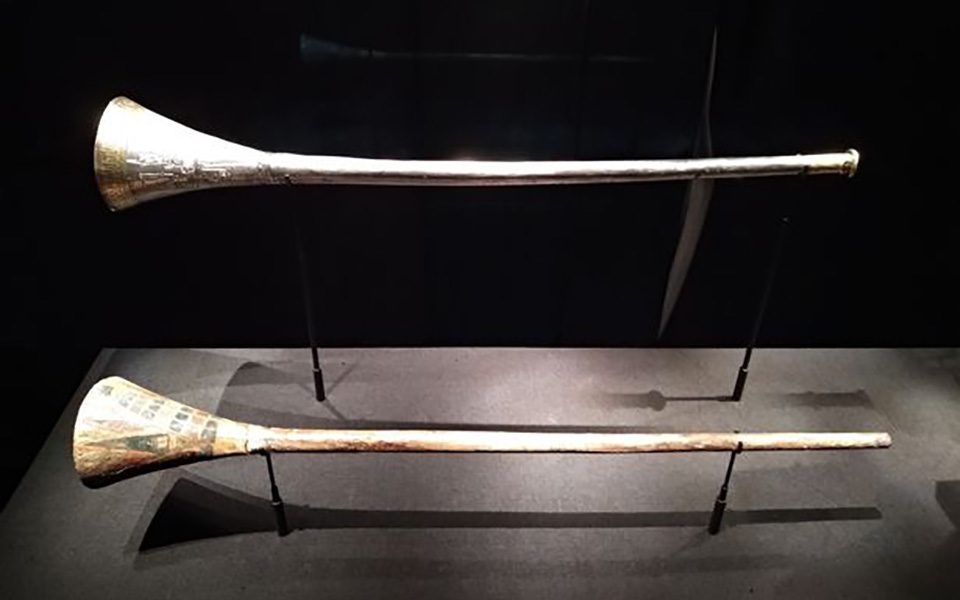
Egyptian trumpets found in King Tutankhamun’s tomb
But before I repeat what else the docent said, let me say something about the opera itself. The orchestral instrumentation calls for 6 Egyptian trumpets. They play the melody of the now-famous “Triumphal March,” when the victorious Egyptian troops parade into the city of Thebes after defeating the Ethiopian army.
The docent’s story was that Verdi insisted that the orchestra use authentic period trumpets which had no valves. The lead trumpeter, however, did not want to use them. So, in rehearsals the trumpeters used the Egyptian instruments, but at the premier, they brought trumpets with one valve. Verdi was furious, but there was nothing he could do. These trumpets became known as “Egyptian trumpets” or “Aida trumpets.”
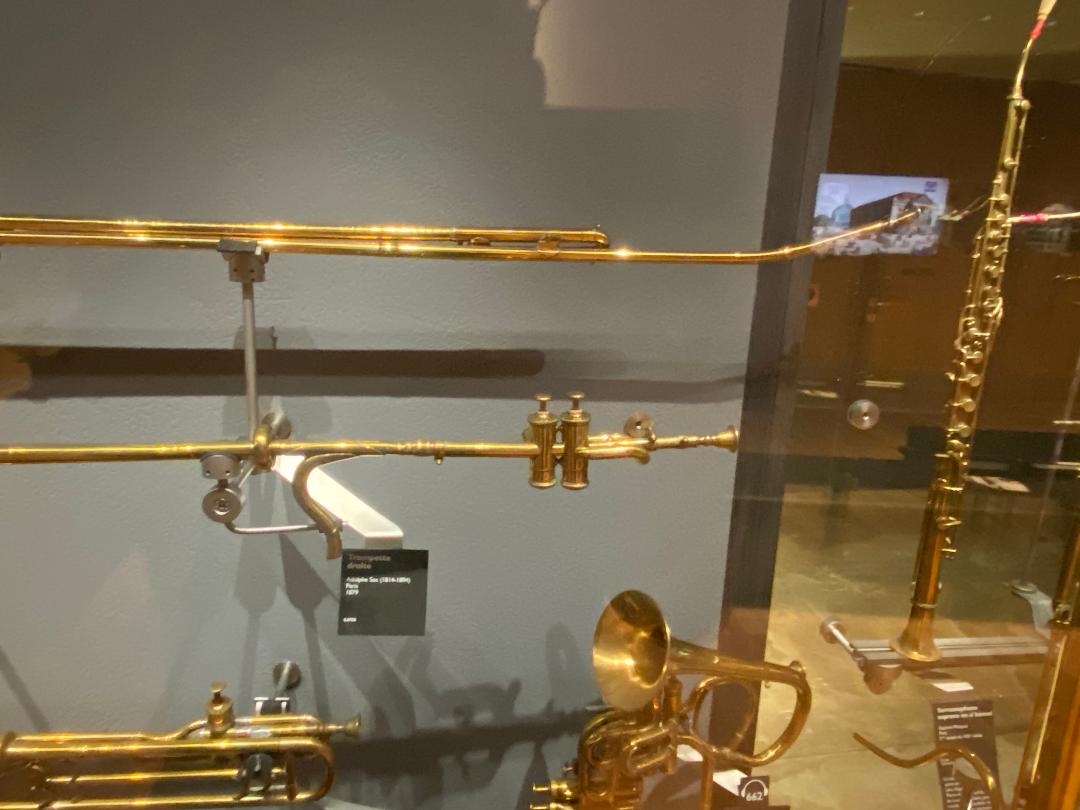
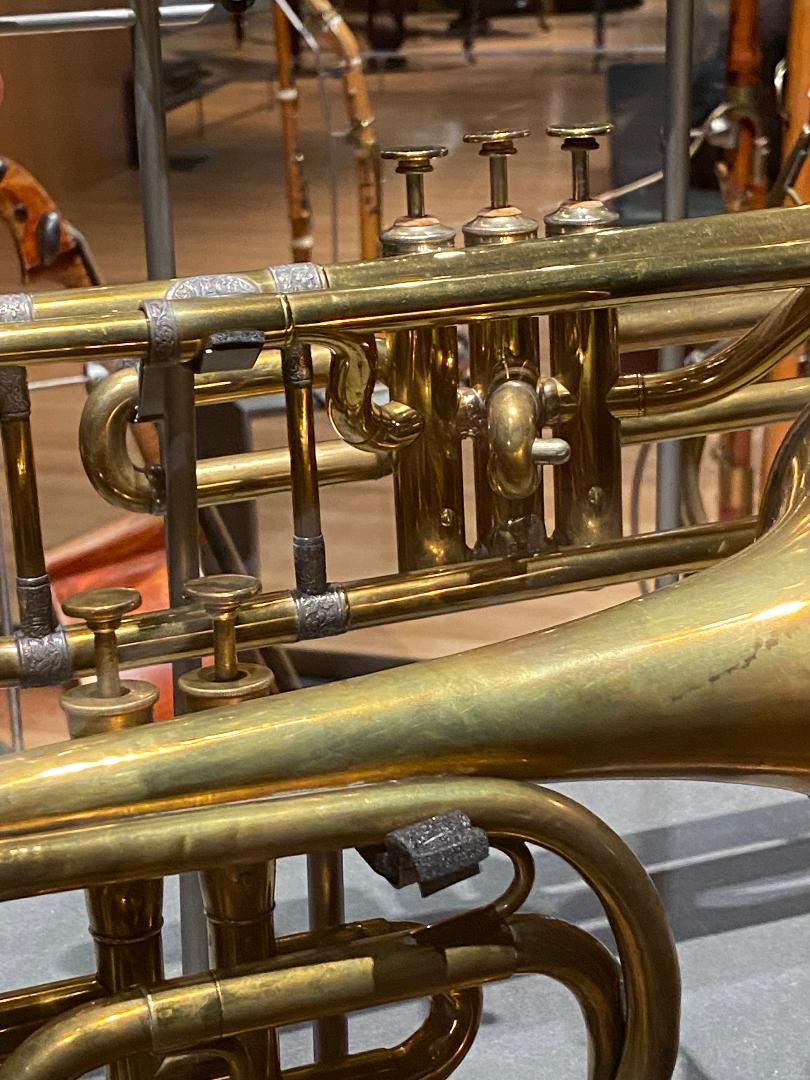
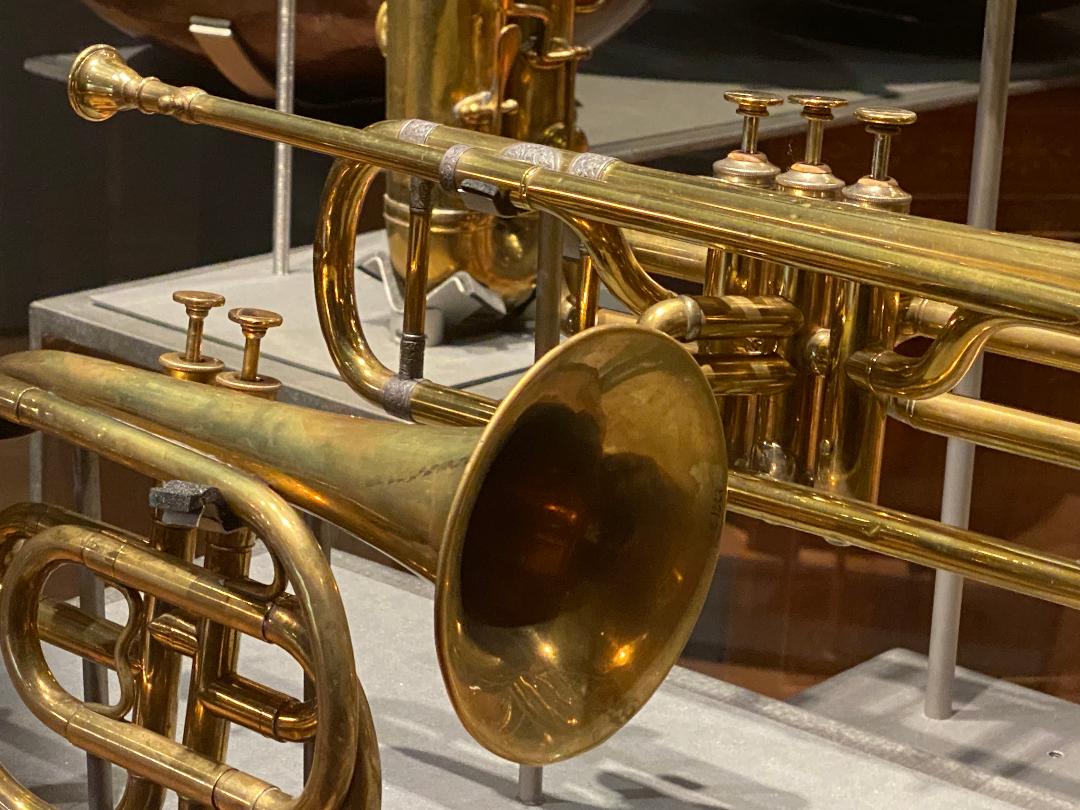
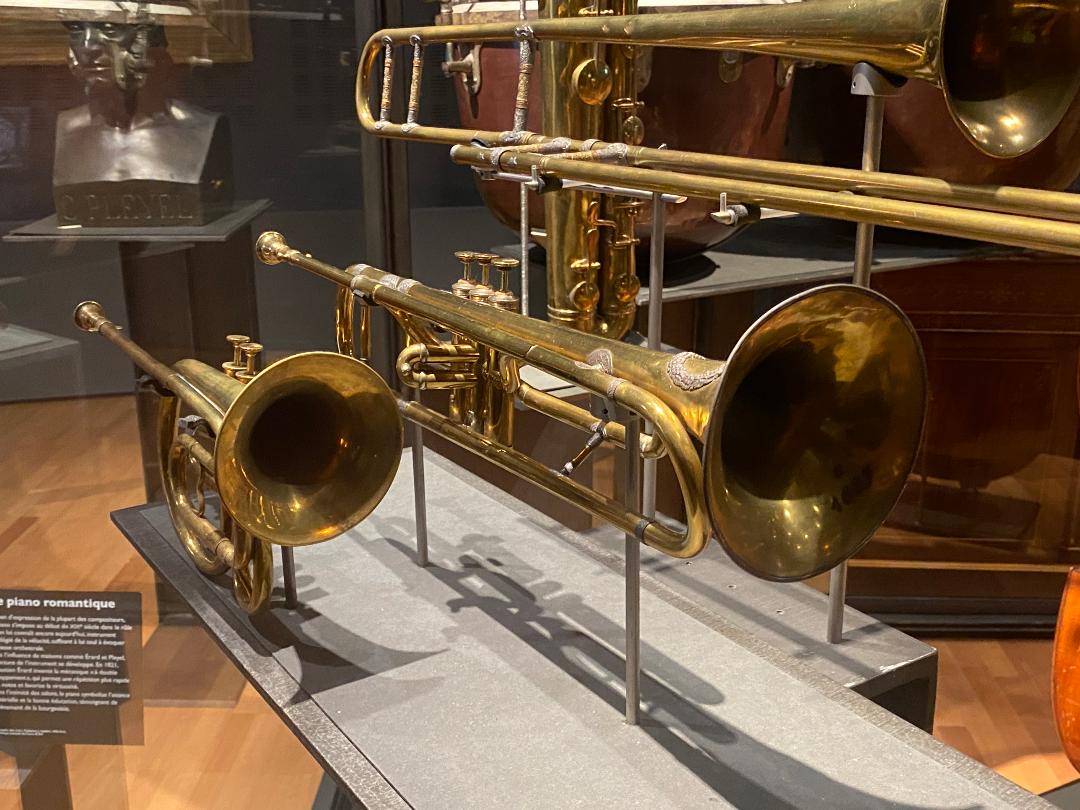
So, I spent my time on the fourth floor. Until then, I had thought that valves were not added to natural trumpets until the 1830s. But I was thinking three valves, and I had always wondered how trumpeters could play the “Trumpet Voluntary,” written by the English composer, Jeremiah Clarke in the 1690s, without valves. Well, it turns out that that piece was the originally written for keyboard instruments. An organist would simply use the trumpet stop. [Maybe trumpeters at that time used keyed trumpets—but that’s another story for me to learn.] I did not see any four-valved trumpets on display.
It also turns out that the transformation of the trumpet (from its natural straight or curved tubal shapes without values to curved, looped shapes with valves) did not take one giant leap from no valves to three valves in the 1830s. In other words, it did not suddenly leap from being able to sound only harmonic tones (like a bugle) to sound all notes in the chromatic scale. It progressed from having no valves to one valve, to two valves, to three valves during the period 1788-1830s. And for the first time in my life, I saw samples of such trumpets in the Paris Music Museum!
Classic 1871 “Egyptian” or “Aida” trumpet
Is this the display spoken of by the Museum Docent?
When did trumpeters begin to play “Trumpet Voluntary” on actual valved trumpets—does it take one, two or three values to play it? In the key of C, I think you could play it on a two-valved trumpet, if the first value permitted you to play the Ds and Fs and the second value permitted you to play the A (along with the first valve) and F#.
The most prolific baroque composer for trumpet was Giuseppi Torelli. He is thought to have composed his Sinfonia with Trumpet in D (G. 8) in the 1690s. Henry Purcell’s The Fairy-Queen was first performed in 1692. Handel’s Water Music Suite No. 2 heavily features trumpets. It premiered in 1717. Vivaldi composed his Concerto for Two Trumpets in ~1720s. Jean-Joseph Mouret composed his Suite de Symphonies in 1729. Its Rondeau is used as the theme music for PBS’s program, Masterpiece. Handel composed his Messiah in 1741. His Music for the Royal Fireworks (1749), especially movements 1 and 4, features trumpets. Leopold Mozart composed his Concerto for Trumpet in D Major in 1762. Hadyn composed his Trumpet Concerto in E-flat major in 1796. Hummel composed his Trumpet Concerto in E Major in 1803. Beethoven composed his Ninth Symphony in 1822-24. What kind of trumpets did trumpeters play for each of these? The first valve was invented in 1788. The second valve was added in 1815.
The addition of three valves made it possible for the trumpet to become a virtuoso instrument. Jean-Baptiste Arban set out to do that very thing. In 1861, he published his amazing Fantaisie Brillante for cornet, requiring exceptional technical skill that would be impossible to play without three valves. Just listen to some recent recordings; for example, Christopher Sala (2015), Sergie Nakariakov (2019), Allen Vizzutti (2021), and Wynton Marsalis (2023).
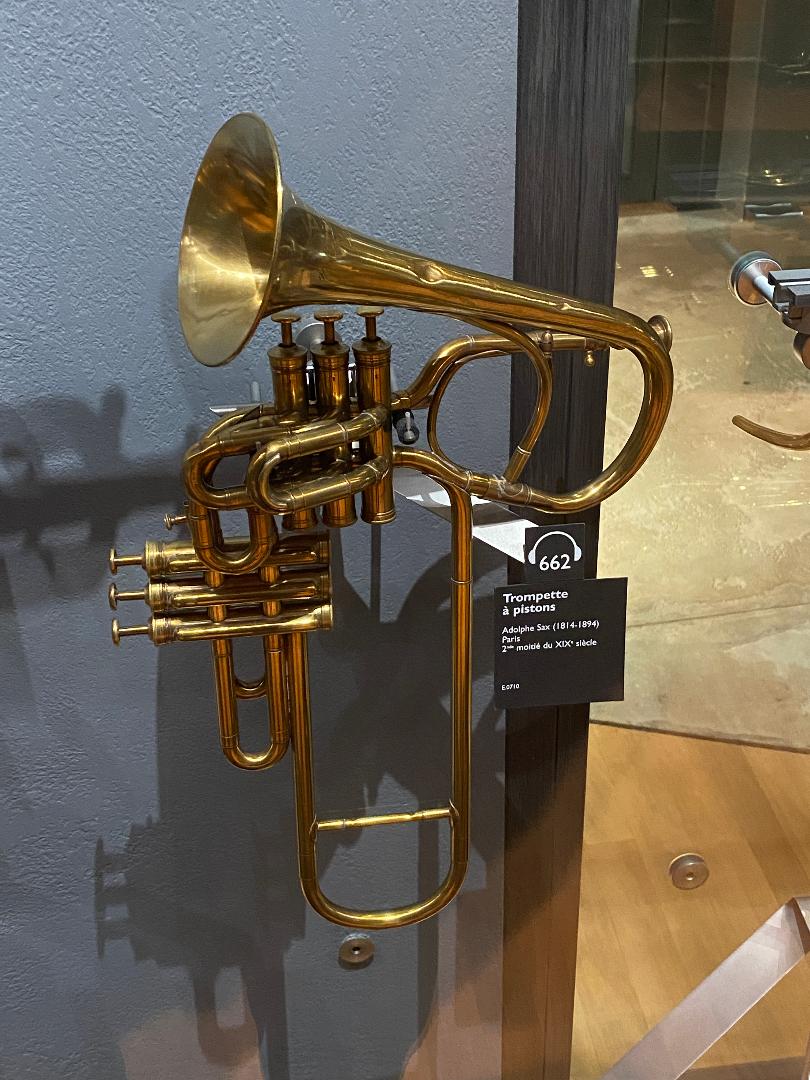
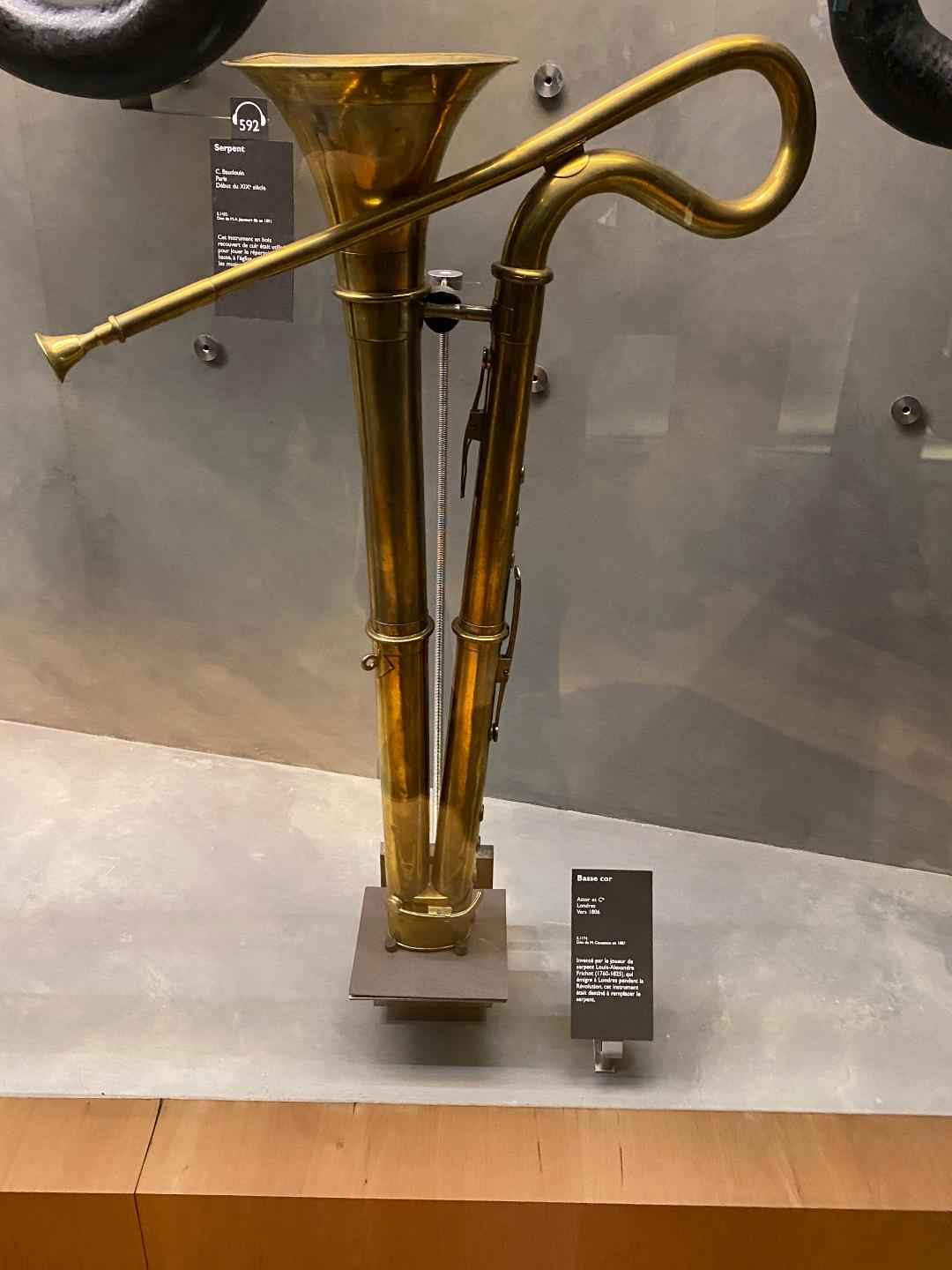
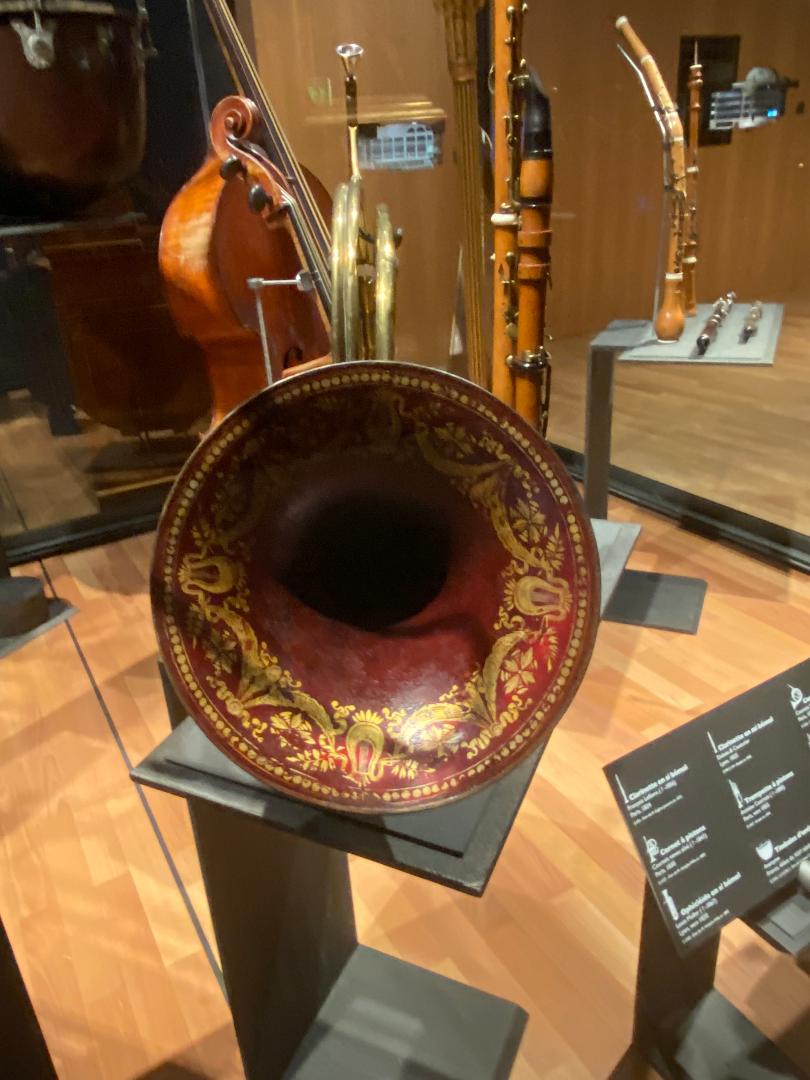
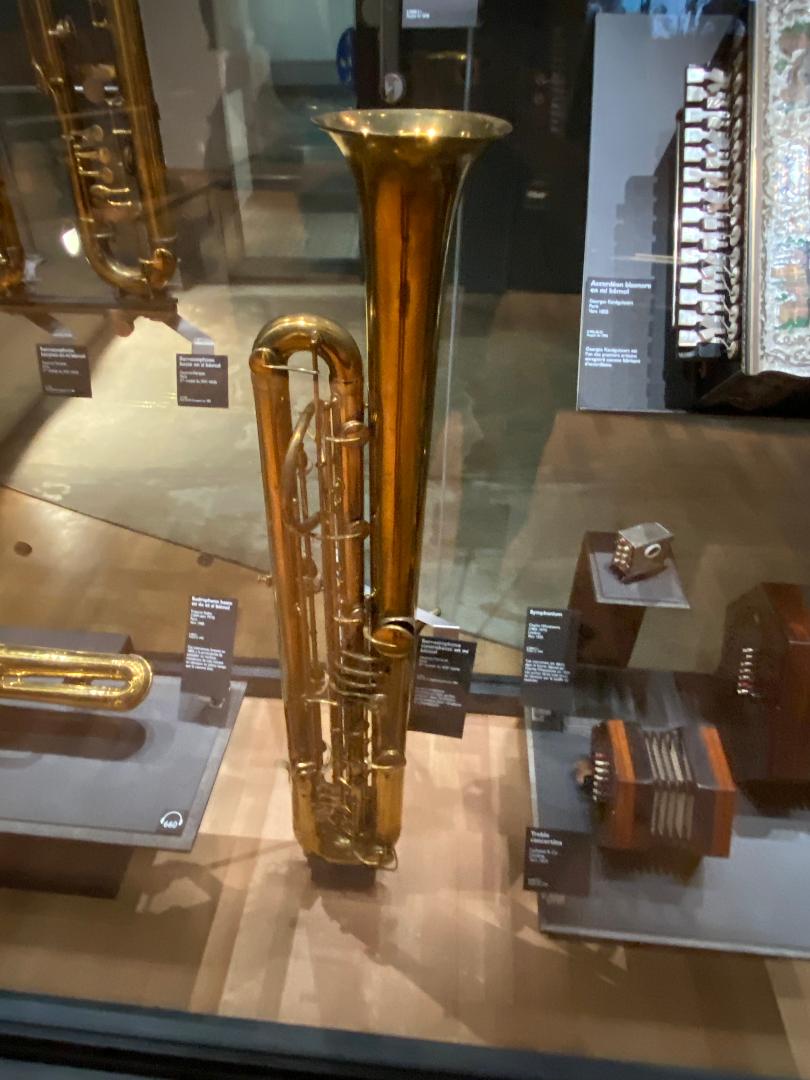
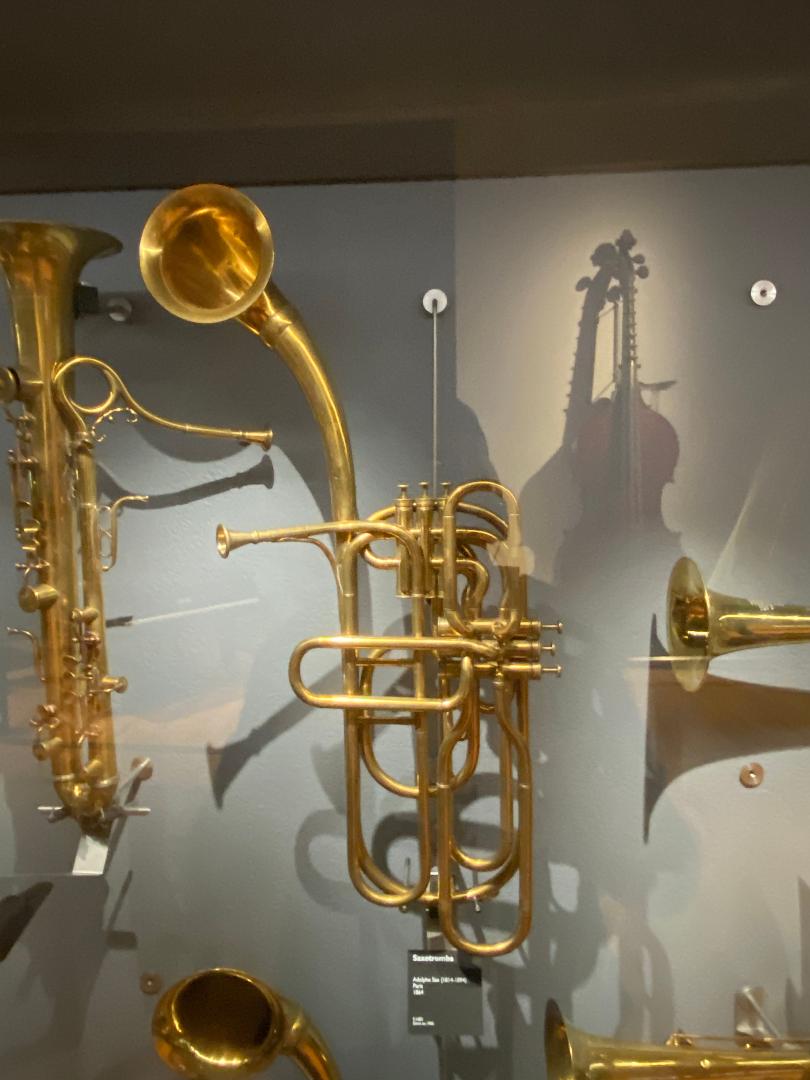
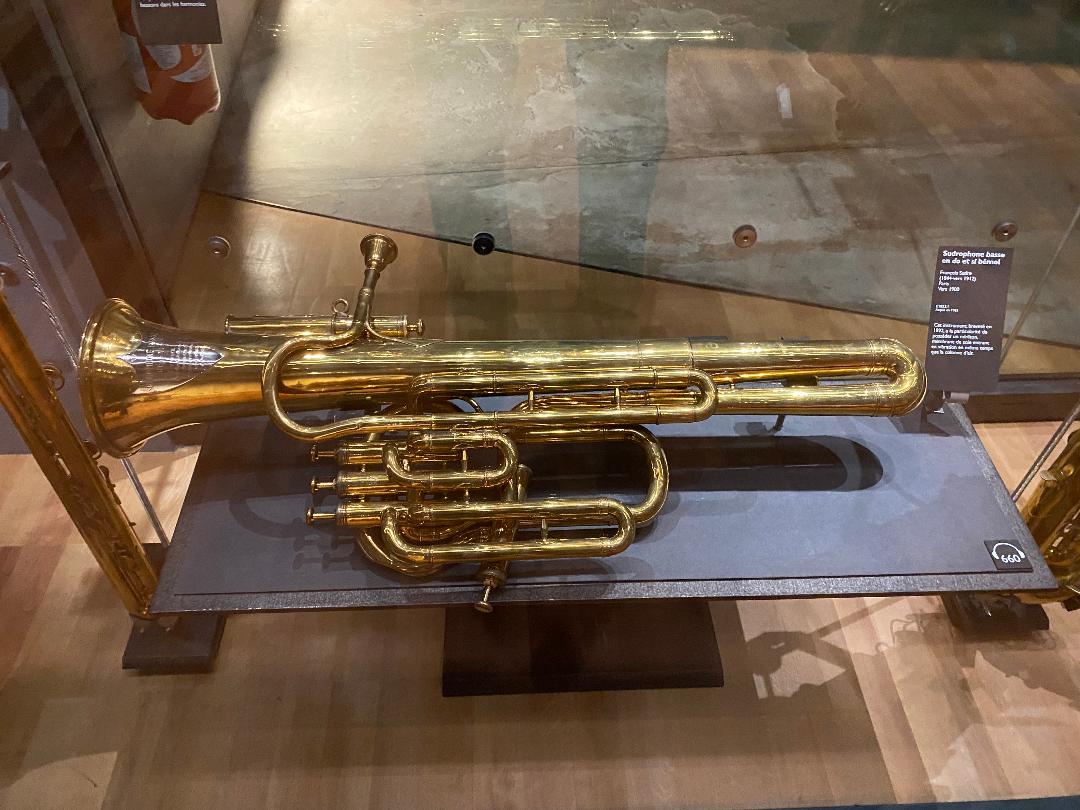
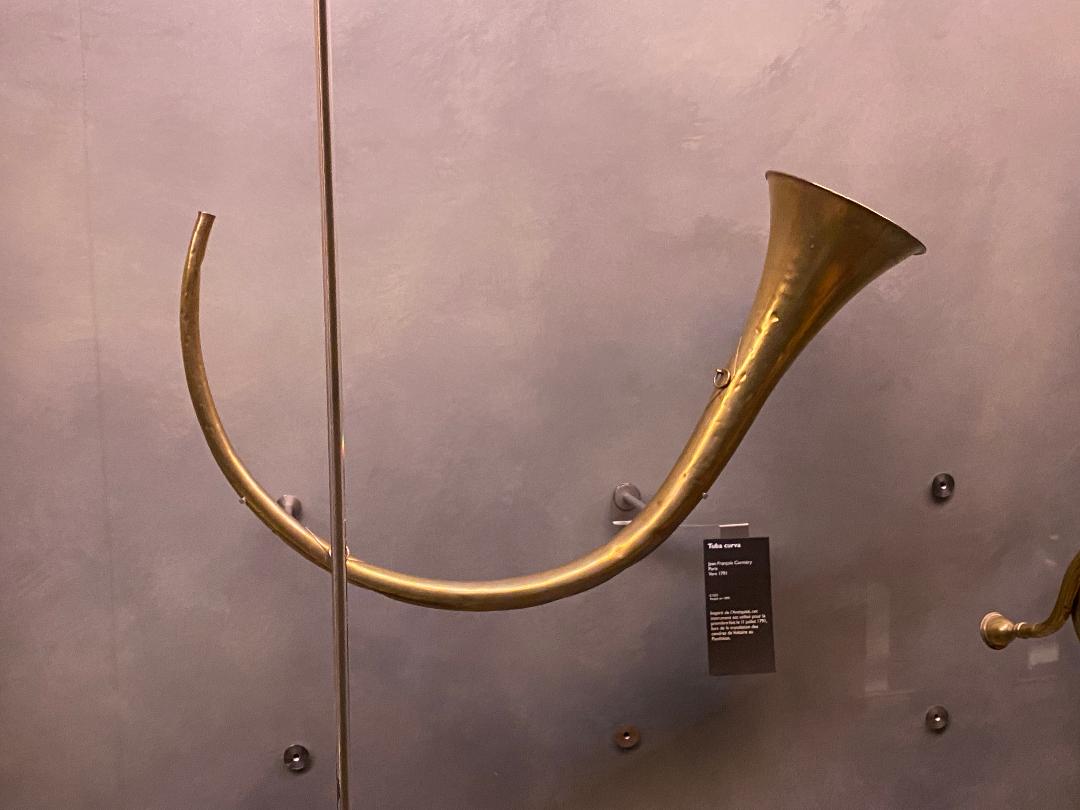
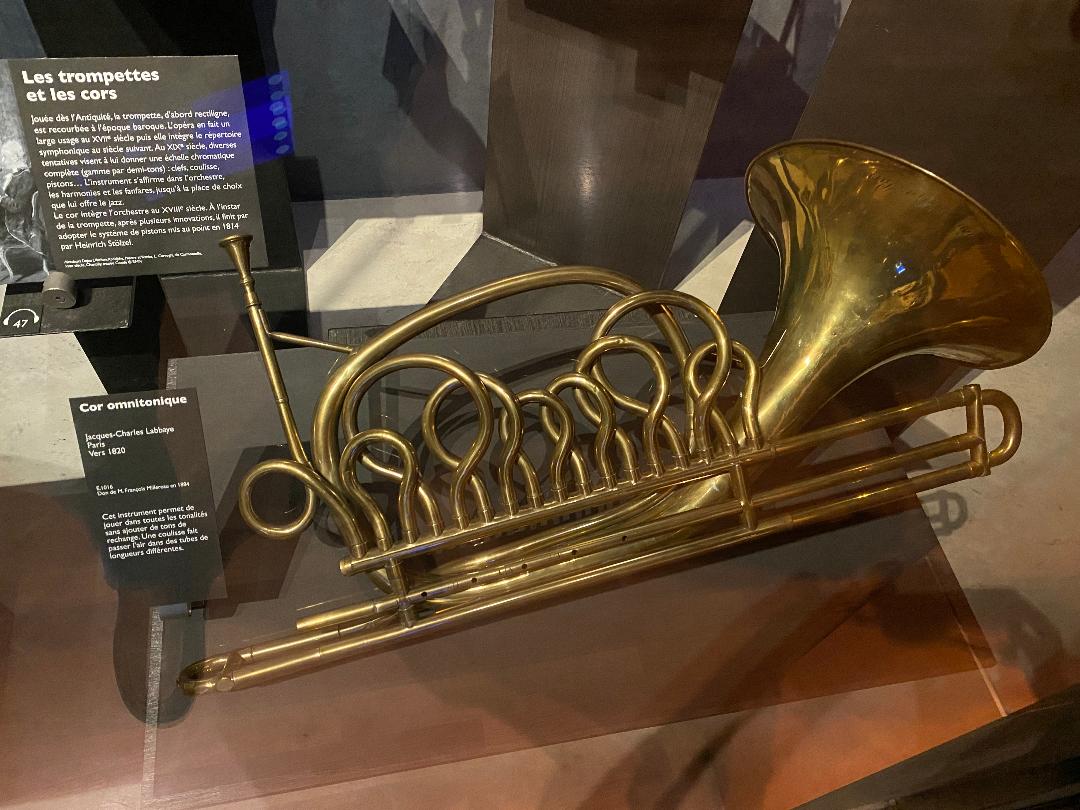
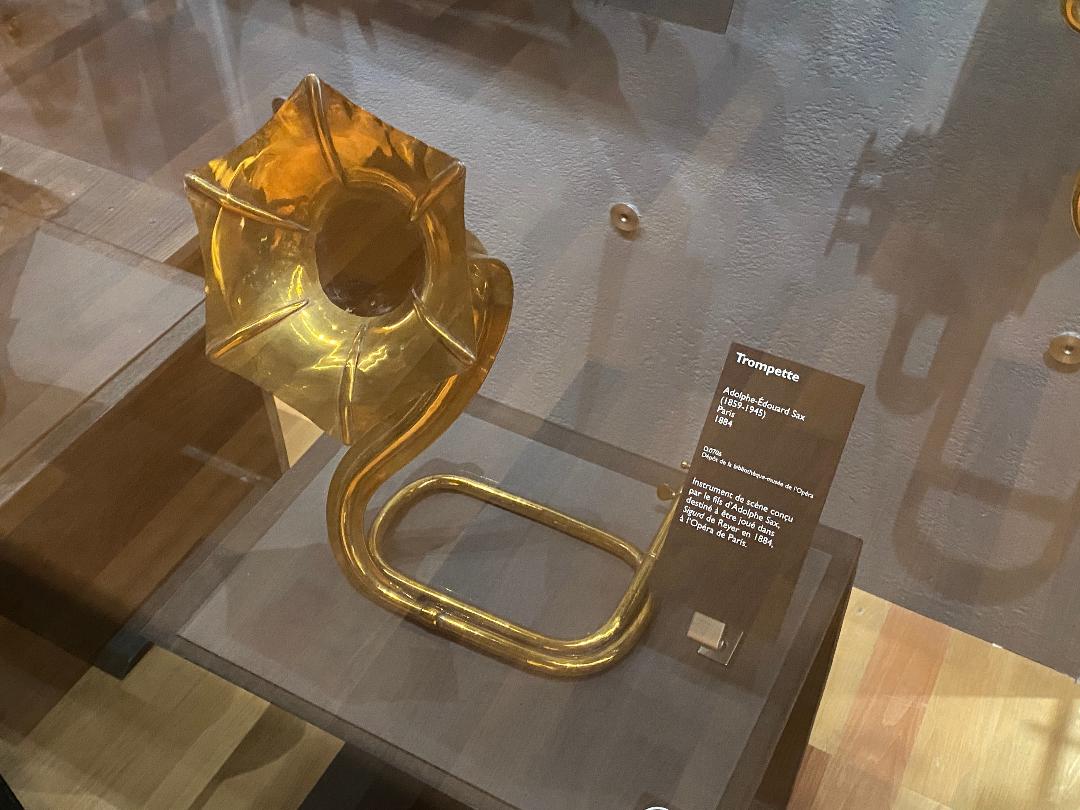
In the museum, I took many photos so that I can now give you a rudimentary tour showing the evolution of the trumpet. There are photos of some very weird-looking instruments, as well as shots of Chopin’s piano, some portraits of composers, and a video of a guest musician playing a forerunner to the French horn that looks somewhat like the modern mellophone. Please click on any photo to enlarge it.
Chopin’s PianoChopin’s piano (left)Video with Sound