Glenn’s Trumpet Notes

News & Tips for Trumpet & Cornet Students

  • January 2026
    S M T W T F S
     123
    45678910
    11121314151617
    18192021222324
    25262728293031
  • Enter your email address to subscribe to this blog and receive notifications of new posts by email.

    Join 89 other subscribers
  • Subscribe

Arcade Mocha Kicks Off Winter Concert at Skyview Junior High in Bothell

Posted by glennled on December 17, 2012

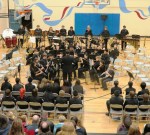
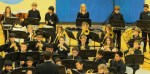
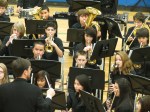
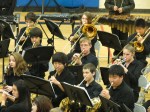
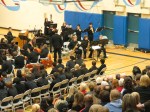
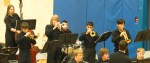
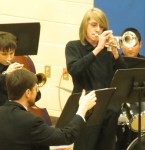
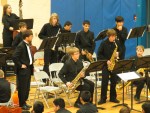
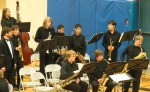
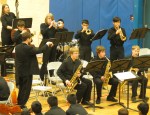
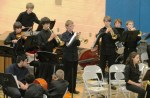
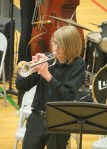
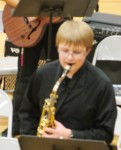
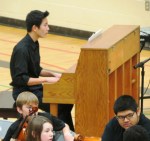
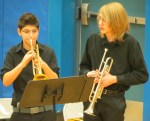
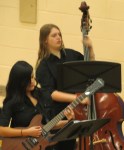
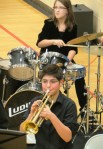
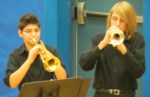
AM LogoAs the fans filled the stands in the gym at Skyview Junior High in Bothell, they were entertained by Arcade Mocha, a jazz combo formed by eight students in 2011. People were coming for the Winter Concert of the orchestra and 7th, 8th, and 9th-grade bands. Arcade Mocha played Christmas songs and other pieces for half an hour before the concert began.

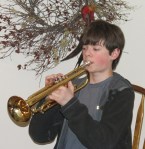
Vaughan has been my trumpet student since 2010

Vaughan has been my trumpet student since 2010

It was their 19th gig so far (see http://www.facebook.com/ArcadeMocha?ref=ts&fref=ts). They play for festivals, auctions, fundraisers, variety shows, promotional events, and such at malls, stores, coffee shops, churches, schools, and more. For example, during the holidays in 2011, they played at the Barnes and Noble Book Fair in Woodinville, and twice in 2012, they played at the Crossroads Mall in Bellevue. Last November, they played at “This is the Night,” the Skyview Spaghetti Dinner, and helped raise $1,700 in funds for the Music Boosters and

Music Department of the school. Musically, they’ve stepped up into jazz circles by playing twice at afternoon gigs at Tula’s Jazz Club in Belltown in Seattle (see www.tulas.com).

This group of talented teenage musicians launched from the Skyview Jr. High music program (see http://www.nsd.org/education/staff/staff.php?sectionid=429).  They practice, using The Real Book of charts, every Saturday at the home of their booking agent, Dianne Kinney, 425-275-8696, dianne@adamkinney.com.

Please click on any photo to enlarge it.

Posted in School Concerts | Tagged: , , , , , , , , , , , | 4 Comments »

“Echo Taps” on Veterans Day 2012—the 150th Anniversary Year of its Composition

Posted by glennled on November 19, 2012

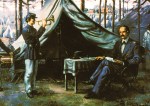
Taps, original painting by Sidney E. King on display at Berkeley Plantation

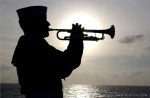
In 1862, when Daniel Adams Butterfield composed “Taps” during the Civil War, there was no Veterans Day. A New Yorker, he was then a Brigadier General and later a Major General in the Union Army. Fifty-six years later in 1918, this national holiday was established (first as Armistice Day) after the end of World War I. Its name was changed to Veterans Day after World War II and is now celebrated annually on 11 November in honor of all American veterans. This year is the 150th anniversary year of “Taps,” the most famous of all American bugle calls. Thus, it came to pass that Richard Haydis and I sounded “Echo Taps” to close the memorial ceremony at Veterans Park in Lynnwood on a rainy Sunday, 11 November 2012.

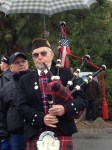
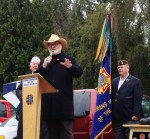
Haydis is a U.S. Coast Guard veteran, and I am a U.S. Navy veteran of the Vietnam era. VFW Post 1040 (see http://vfw1040.org/) hosted the ceremony, where the featured speaker was Michael G. Reagan, U.S. Marine Corps veteran, internationally renown artist and leader of the Fallen Heroes Project (see my post of 19 November 2011, and www.fallenheroesproject.org). The ceremony featured the NW Junior Pipe Band (see www.mwjbp.org) and

Michael G. Reagan, U.S. Marine Corps Veteran, Fallen Heroes Project

Ray Colby, VFW Post 1040 Piper and a U.S. Navy veteran. Cub Scout Pack 331 placed flags in the park and distributed the ceremony programs.During 2012, buglers throughout the nation participated in numerous ceremonies to commemorate the 150th anniversary of “Taps.” The prime event occurred on 22-24 June at Harrison Landing on the grounds of Berkeley Plantation along the James River, southeast of Richmond, Virginia (see www.taps150.org). This was the birthplace of America’s Song of Remembrance.

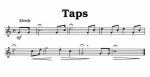
In late June, 1862, after the Seven Days Battles, the Army of the Potomac recuperated at Harrison Landing. Butterfield himself had been wounded.  It is said of Oliver Willcox Norton, bugler of Butterfield’s Brigade, that Butterfield called him to his tent to work on a new bugle call until, as Butterfield put it, he got it smooth, melodious, and musical, suited his ear and taste. Norton was the first to sound “Taps” as we now know it in early July.  Later, in 1898, Norton wrote a letter recalling the incident:

Taps, Butterfield and Norton

“…One day, soon after the seven days battles on the Peninsular, when the Army of the Potomac was lying in camp at Harrison’s Landing, General Daniel Butterfield, then commanding our Brigade, sent for me, and showing me some notes on a staff written in pencil on the back of an envelope, asked me to sound them on my bugle. I did this several times, playing the music as written. He changed it somewhat, lengthening some notes and shortening others, but retaining the melody as he first gave it to me. After getting it to his satisfaction, he directed me to sound that call for Taps thereafter in place of the regulation call. The music was beautiful on that still summer night, and was heard far beyond the limits of our Brigade. The next day I was visited by several buglers from neighboring Brigades, asking for copies of the music which I gladly furnished. I think no general order was issued from army headquarters authorizing the substitution of this for the regulation call, but as each brigade commander exercised his own discretion in such minor matters, the call was gradually taken up through the Army of the Potomac. I have been told that it was carried to the Western Armies by the 11th and 12th Corps, when they went to Chattanooga in the fall of 1863, and rapidly made its way through those armies. I did not presume to question General Butterfield at the time, but from the manner in which the call was given to me, I have no doubt he composed it in his tent at Harrison s Landing…

For a detailed account of the composition of “Taps”, please see “24 Notes That Tap Deep Emotions,” by Jari A. Villanueva, at www.west-point.org/taps/Taps.html.

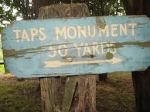
Taps Monument prior to 2012 renovation, Berkeley Plantation

The Virginia Department of the American Legion erected a monument dedicated to “Taps” on a knoll where General Butterfield’s tent stood in July 1862. This is the only such monument in the country. There is a bronze statue of Butterfield in Sakura Park on Claremont Avenue in Manhattan, not far from Grant’s Tomb. And Butterfield is buried at West Point, although he attended Union College (Class of 1849) in Schenectady, not the U.S. Military Academy (see www.union.edu/news/stories/2012/05/sounding-a-solemn-note-taps-turns-150.php).

Incidentally, the call is named “Taps” because at the end of the call, a drummer would play three distinct drum taps at four-count intervals. And as popular and beautiful as it is, “Echo Taps” is not an official bugle call of the U.S. military. Officially, “Taps” is to be sounded by a single bugle.

Photos of the 2012 Lynnwood ceremony are by Andy Dingman. Please click on any image to enlarge it.

Posted in Ceremonies & Celebrations | Tagged: , , , , , , , , , , , , , , , , , , , | Leave a Comment »

Husky Alumni Band Cheers UW to Victory Over Stanford, 17-13

Posted by glennled on October 16, 2012

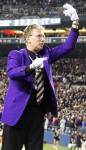
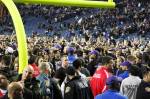
Victory celebration!

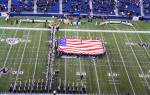
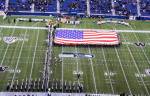
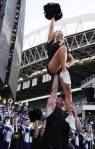
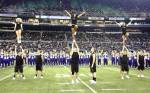
Everyone knows that while Husky Stadium is now being rebuilt for next year, the football team is playing its home games in downtown Seattle at Century Link Field, home of the Seattle Seahawks and Seattle Sounders. Everyone sees the UW Husky Varsity Marching Band on the stadium steps at the north entrance prior to the game, in the south stands during the game, and on the field for pre-game and half-time shows. But who knows whether the Husky Alumni Band is even there—and if so, where are they?

Well, yes, we were there Thursday night (27 September) to see the Huskies upset the 8th-ranked Stanford Cardinal, 17-13. We were seated in the SW quadrant of the stadium—high up in Section 327!—cheering as loudly as everyone else.

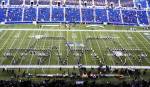
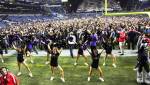
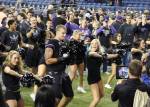
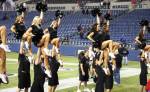
UW Husky Varsity Marching Band

We played at three pep rallies prior to the game, one with the Chinese Dragon at Hing Hay Park in the International District, one in the north parking lot of the stadium, and one in Occidental Street on the west side of the stadium. That earned us free tickets into this big game. Recall that there was a time when it was questionable whether the Husky Alumni Band would have a role to play at the home games this year (see my post of 18 November 2011), but that was settled. We’re there, helping raise money for HMBAA scholarships, and we’re very happy. It’s such fun, and I love playing trumpet. Some of us even joined the massive crowd on the field after the game to celebrate the victory. Go Huskies!

Photos are by Louis Figueroa and Gary Nakayama, courtesy of the UW Husky Varsity Marching Band conducted by Dr. Brad McDavid, Director. Please click on any photo to enlarge it.

Posted in HMBAA - Husky Alumni Band | Tagged: , , , , , , , , , , , , , , , , | Leave a Comment »

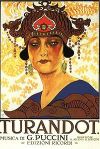
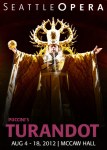
Puccini’s Grandest Opera, “Turandot,” is Different

Posted by glennled on August 31, 2012

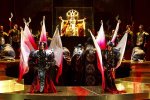
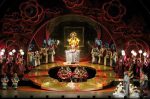
Emperor (upper center), Turandot (middle center), and Prince Calaf (lower right)

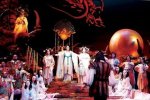
Yes, I’m an opera novice—I’ve seen only three other operas by Giacomo Puccini: La Boheme, Tosca, and Madama Butterfly (see my post of 31 May 2012). None of these prepared me for the showy spectacle of Turandot by the Seattle Opera which my wife and I attended on 5 August at McCaw Hall. And the three others set me up to expect Turandot to end in a very different way.

Speight Jenkins is my opposite. He’s been attending opera for more than 60 years and is General Director of the Seattle Opera. In the August edition of “Encore Arts Programs,” he writes that Turandot was a smash hit when it premiered at Teatro Alla Scala in Milan, Italy on 25 April 1026, sixteen months after Puccini’s death. It scored successes everywhere it was performed, but inexplicably, it disappeared from New York opera after 1930 until it was resurrected in 1961 by the Metropolitan Opera. Nine performances were given that season, evoking ovation after ovation, and “suddenly Turandot leapt onto the gold standard.” According to orchestra conductor Asher Fisch, Puccini operas are so popular that the composer accounts for 25 percent of all the operas produced today (see http://seattletimes.nwsource.com/html/thearts/2018771976_opera29.html).

Then in 1990, writes Jenkins, to celebrate the World Cup of soccer, Placido Domingo, Jose Carreras (Spaniards), and Luciano Pavarotti (Italian) created The Three Tenors. They first performed a concert together on 7 July that year at the ancient Baths of Caracalla in Rome. At the climax, Pavarotti’s sang the aria, “Nessun dorma,” from Act III of Turandot. This became his signature aria. That, coupled with the success of that concert and the tremendous sale of their recording, made the aria synonymous with opera. “Fifty years ago, ‘Nessun dorma’ was just another aria in the Puccini canon, not even one that most opera lovers could recognize,” writes Jenkins. “Now it is clearly the most well known aria in opera to those who have never set foot in an opera house.” See the following performances:

Timur, dethroned king of Tartary, mourns the death of Liu, a slave girl who commits suicide rather than betray Prince Calaf

Puccini died in December, 1924, before finishing Turandot. He left few notes about how he intended to end it. Others finished both the music and libretto. Hence, for me, the surprise ending.

Turandot, based on a Persian fairy tale and set in China, is the story of an icy, man-hating princess named Turandot (soprano). No man shall possess me, she declares, yet there is pressure from the emperor and the people for her to marry. So, if any man of royal blood can solve three riddles, she agrees to marry him. If a man tries and fails, he will be killed. By the time Prince Calaf (tenor) arrives, 40 suitors have been decapitated. He is confident, in love with her, and determined to succeed. He solves the riddles. She still resists, however, so he gives her a means of escape: if by the next dawn she cannot give his name, he will tell it to her and become her 41st victim. Lui, the self-effacing, sacrificing woman who is caretaker of Calaf’s father, is tortured during the night to make her reveal his name. Such is her love for Calaf that she dies rather than do so.  Dawn comes and Calaf tells Turandot his name. Meanwhile, she admits to being attracted to him, unlike any of the others, and in the climax, declares her love and agrees to marry him.  The emperor and the people rejoice!

A Puccini opera ends with a happy marriage? I would never have believed it. My friend John, one of my trumpet students and frequently an extra in numerous operas in Seattle, agrees. “If Puccini had written the ending,” writes John, “I am sure Prince Calaf would have realized his true love was Liu (the slave girl) and then killed Turandot and then killed himself. That’s an Italian ending.”

So, to me, Turandot is different. Not only is it a grand spectacle in which the heroine doesn’t die in a tragic ending, but musically, Puccini pushes the soprano and tenor toward the limits of the range of the human voice. The roles require a full, dramatic, powerful, heroic sound. I may be wrong, but it seems to me there also is more dissonance in the orchestra, which can be almost overpowering at times, and fewer melodies in the score. Here, Puccini is more akin to Wagner than in the other three Puccini operas I’ve attended.

Afterwards, my wife and I talked things over at an outdoor table at Ponti’s Seagood Grill along the Ship Canal near the Fremont Bridge. It’s a favorite restaurant of ours, one we seem to save for special occasions. The opera and dinner were her gifts to me to celebrate my recent birthday. What could be better?  😉

Performance photos are courtesy of the Seattle Opera. Please click on any picture to enlarge it.

Posted in Professional Concerts | Tagged: , , , , , , , , , , , , , | 2 Comments »

Veterans Lead Independence Day Parade in Edmonds on Glorious 4th

Posted by glennled on July 4, 2012

Glenn Ledbetter, Vietnam War Vet, Edmonds Independence Day Parade, 2012. The bugle was a gift from a retired Air Force pilot who purchased it in England.

I’m sure some people in this great nation had as much fun as I did on this Independence Day 2012, but did they get to march in the parade in a small, All-American city as I did in Edmonds, Washington today? More didn’t than did. The thousands of people lining the streets stood, clapped, cheered, and waved minature American flags. My wife took this picture of the Post Bugler, VFW Post 1040, Lynnwood—me—on a perfectly gorgeous day on a glorious 4th. “God Bless America!”

Posted in Ceremonies & Celebrations | Tagged: , , , , , , , | 2 Comments »

“Echo Taps” for War of 1812 Bicentennial Ceremony at Evergreen-Washelli in Seattle

Posted by glennled on July 2, 2012

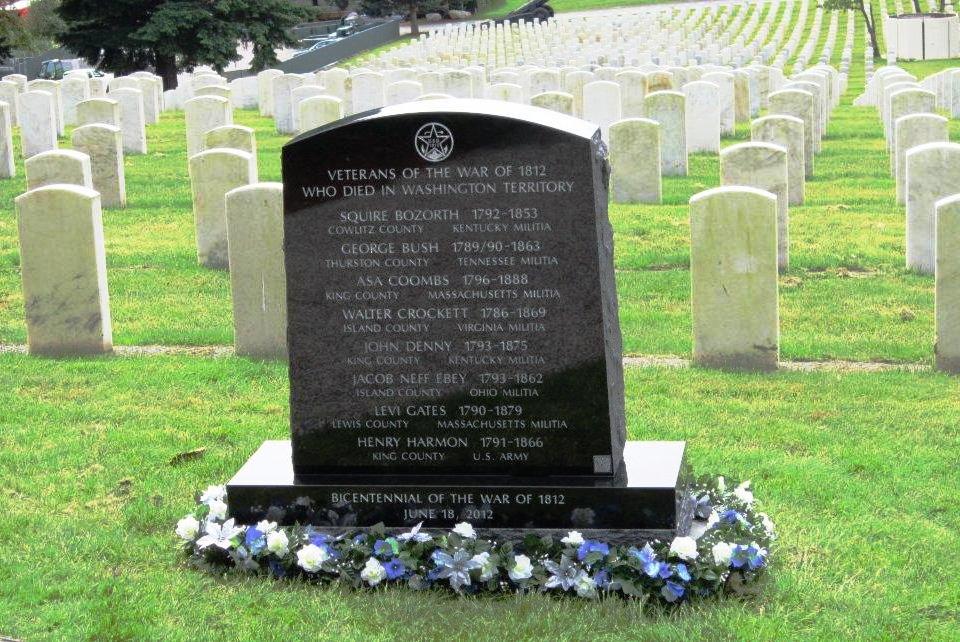
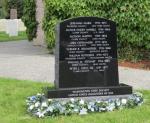
War of 1812 Monument (front side), Veterans Memorial Cemetery, Evergreen-Washelli, Seattle

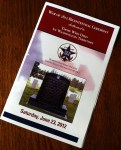
For six years, the Washington State Society, United States Daughters of 1812 (WSSUSD 1812), labored hard on its project to dedicate a monument honoring those veterans of the War of 1812 who died in Washington Territory. At last, the ceremony was held on Saturday, 23 June, at Evergreen-Washelli, Veterans Memorial Cemetery, in north Seattle. The war had started on 18 June, 200 years earlier, when President James Madison signed the declaration passed by Congress.

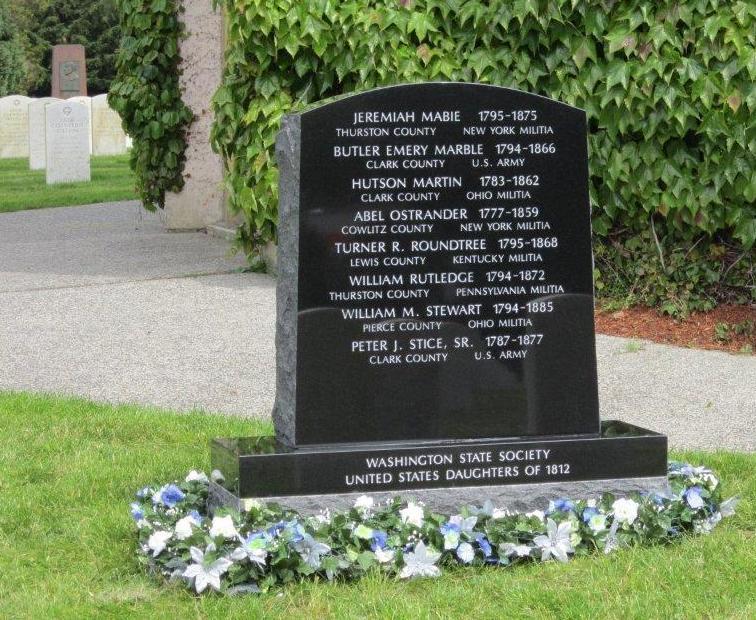
The beautiful monument at the foot of the Bell Tower was unveiled by WSSUSD 1812 President Linda Rae Lind of Bremerton. Inscribed on both sides are the names of 16 veterans for whom there are authentic records verifying that they served in the War of 1812 and died in Washington Territory. (Washington became the 42nd state in 1889.)

War of 1812 Monument (back side), Veterans Memorial Cemetery, Evergreen-Washelli, Seattle

Of the 16, Abel Ostrander was born first (1777) and William M. Stewart died last (1885), a span of 108 years. Ostrander came from New York and died in Cowlitz County in 1859. Stewart (born in 1794) came from Ohio and died in Pierce County.

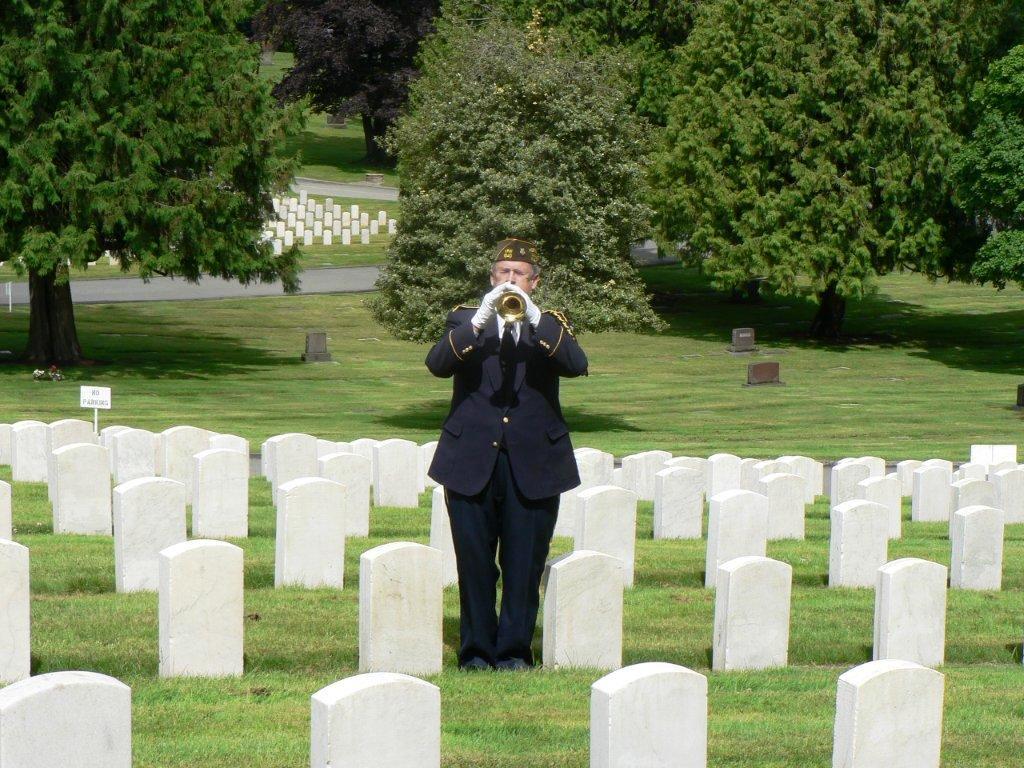
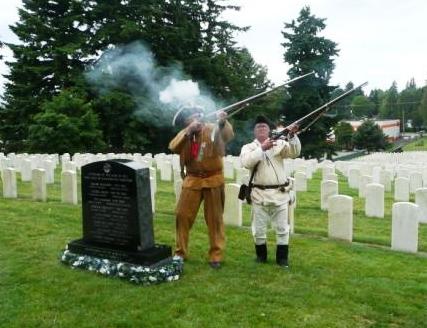
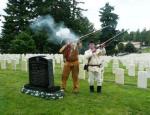
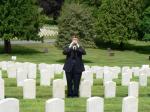
Washington State Archivist, Jerry Handfield, was the guest speaker on this day. To conclude the outdoor ceremony, two members of the Washington State Society of the Sons of the American Revolution (WASSAR) fired their muskets in a rifle salute, immediately followed by the sounding of “Echo Taps” by me and Lt. Col. Bob O’Neal, U.S. Army (Ret.) who is WASSAR Color Guard Commander. I play a 1954 Super Olds cornet, and Bob plays a 1927 King Silvertone trumpet. Incidentally, 2012 is also the 150th anniversary of the composition of “Taps.”

The War of 1812, fought against the British in the U.S.A., Canada, and in the Great Lakes and on the high seas, is sometimes called the Second War of Independence. It is famous for many things still well-known in American culture. Let me list a few: first, the text of our national anthem, “The Star Spangled Banner,” was written by Francis Scott Key during the defense of Ft. McHenry near Baltimore, MD, from British naval bombardment in September, 1814. Second, “Old Ironsides,” the USS Constitution, was never defeated in battle. Named by George Washington, she is the oldest commissioned naval vessel afloat and is berthed in Boston. Third, in the midst of the bloody battle between two frigates, USS Chesapeake and HMS Shannon, Master Commandant James Lawrence, captain of the Chesapeake, mortally wounded, issued his famous, final command to his men, “Don’t give up the ship!”  Fourth, after a naval battle on Lake Erie in September, 1813, Commodore Oliver Hazard

“Echo Taps” for War of 1812 Vets who died in Washington, sounded by Glenn Ledbetter, VFW Post 1040 Bugler, and Col. Bob O’Neal, SAR (not shown)

Gale Palmer and Stan Wills, SAR, fire musket salute

Perry, U.S. Navy, penned the famous words, “We have met the enemy and they are ours…” Fifth, the British burned the White House and the city of Washington in August, 1814. Sixth, in January, 1815, as the war drew to a close, Major General Andrew Jackson (“Old Hickory”) defeated the British Lieutenant General Sir Edward Pakenham in a lop-sided victory at the Battle of New Orleans. Seventh, Robert Fulton invented the “torpedo,” now known as an underwater mine, and designed the world’s first steam-powered warship, Demologos (later renamed Fulton).

The on-site photos in this post are courtesy of the Washington State Society, United States Daughters of 1812. Please click on any image to enlarge it. For further information on the War of 1812 and the organizations mentioned in this post, please see the following:

Posted in Ceremonies & Celebrations | Tagged: , , , , , , , , , , , | Leave a Comment »

More Than 100 Posts—A Milestone for Glennstrumpetnotes.com

Posted by glennled on June 24, 2012

Just keeping count—I have now posted more than 100 articles on this blog. This is the 102nd. Each one falls into one of 13 categories. “Which category has the most posts?” I wondered. Let’s see:

  • School Concerts – 22
  • New Students – Intro Posts – 19
  • HMBAA – Husky Alumni Band – 17
  • Ceremonies & Celebrations – 12
  • Professional Concerts – 9
  • Student Competitions, Honors & Awards – 8
  • Church Music – 6
  • Festivals & Competitions – 5
  • Musical Events at Home – 4
  • Recitals – 2
  • Skyview Junior High – 2
  • Selected Trumpet Music – 1
  • Seminars, Lectures & Workshops – 1
  • Total = 108*

*Six posts appear in more than one category.

Note that on the blog, there is a short paragraph immediately below each post. Its first sentence contains words such as “posted in” or “filed under” and is followed by the name of the category in bold face type. Simply click on that, and all the posts in that category will pop up for you. Good reading!

Posted in Ceremonies & Celebrations, Status, Milestones, Summaries | Tagged: , , , | Leave a Comment »

Nine Students Perform at Trumpet Recital in Edmonds

Posted by glennled on June 12, 2012

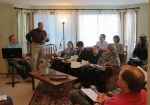
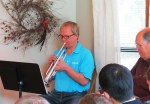
About 40 guests from the Greater Seattle area came to the home of their favorite tutor (me) in Edmonds on Saturday, 9 June, to the 3rd annual trumpet recital featuring my 9 current students. They take lessons from me in their own homes once a week. Eight attend the following schools: Lawton, Crystal Springs, and Tukwila elementary schools; Kamiakin, Kenmore and Skyview junior highs; and Eckstein Middle School. Of these, four students are moving up to Nathan Hale, Inglemoor, and Juanita high schools in the fall. There was a morning and an afternoon session, and each student played two pieces. Refreshments were served after the performances. Most of the music selections come from musicals, movies, the Beatles, and patriotic compositions.  Here is a gallery of photos. Please click on any photo to enlarge it.

Posted in Musical Events at Home, Recitals | Tagged: , , , , , , , , | Leave a Comment »

Church Orchestra and Choir End Season with “Glory”

Posted by glennled on June 9, 2012

‘Twas the last Sunday of the season for the church orchestra and choir, 3 June. Now comes the summer break. Lucky me, I got to play 3rd trumpet when one of the regular players had a conflict. This church conducts three services every Sunday morning, and we played four songs—three at each service. It’s easy to see why our conductor favors the arranger, Dan Galbraith—he’s superb!  He arranged three of the pieces below. And B.J. Davis did a super job, too, arranging Nichole Nordeman’s beautiful song, “Glory.” She is a Dove Award-winning songwriter (see http://www.doveawards.com/).

If you want to look over the scores and hear samples of the orchestration and arrangements, please see the following:

Posted in Church Music | Tagged: , , , , , , , , , , , , , , | Leave a Comment »

Summer Music Festival in Seattle with The Salvation Army’s Temple Brass Band and School of Music

Posted by glennled on June 3, 2012

Puget Brass, a British brass band, since 1999

The Salvation Army, Northwest Division, is hosting a concert on 3 June at 6 p.m. at the Seattle Temple, 9501 Greenwood Ave. N., Seattle. The featured special guest is Puget Brass, a local British brass band of about 30 musicians which performs throughout the Pacific Northwest. Inspired by the movie, Brassed Off, and formed in 1999, Puget Brass performs a varied repertoire from brass band classics and marches to classical, jazz, and popular music. Please see http://pugetbrass.org/.

Also participating are the Seattle Temple Brass Band, Seattle Temple Songsters, and young musicians from The Salvation Army School of Music (SASOM). SASOM offers daily after-school tutoring and music education at the temple location. According to SASOM’s mission statement on Facebook, “We believe music is the key to creating and instilling in every child an appreciation for community, a desire to achieve, and the ability to excel individually and collectively.” See http://www.facebook.com/TSASOM and click on “About.”

Red Kettle Concert Band, Salvation Army, Northwest Division, Seattle

The Salavation Army, Northwest Division, has served Seattle for 125 years (1887-2012). For a synopsis of the history of The Salvation Army itself, see http://www1.usw.salvationarmy.org/usw/www_usw_seatmpl.nsf/vw-dynamic-index/F3B07AB3CC15DE438825766C00133A8C?openDocument&charset=utf-8.

Posted in Professional Concerts | Tagged: , , , , , , , , , , , , , , , | Leave a Comment »