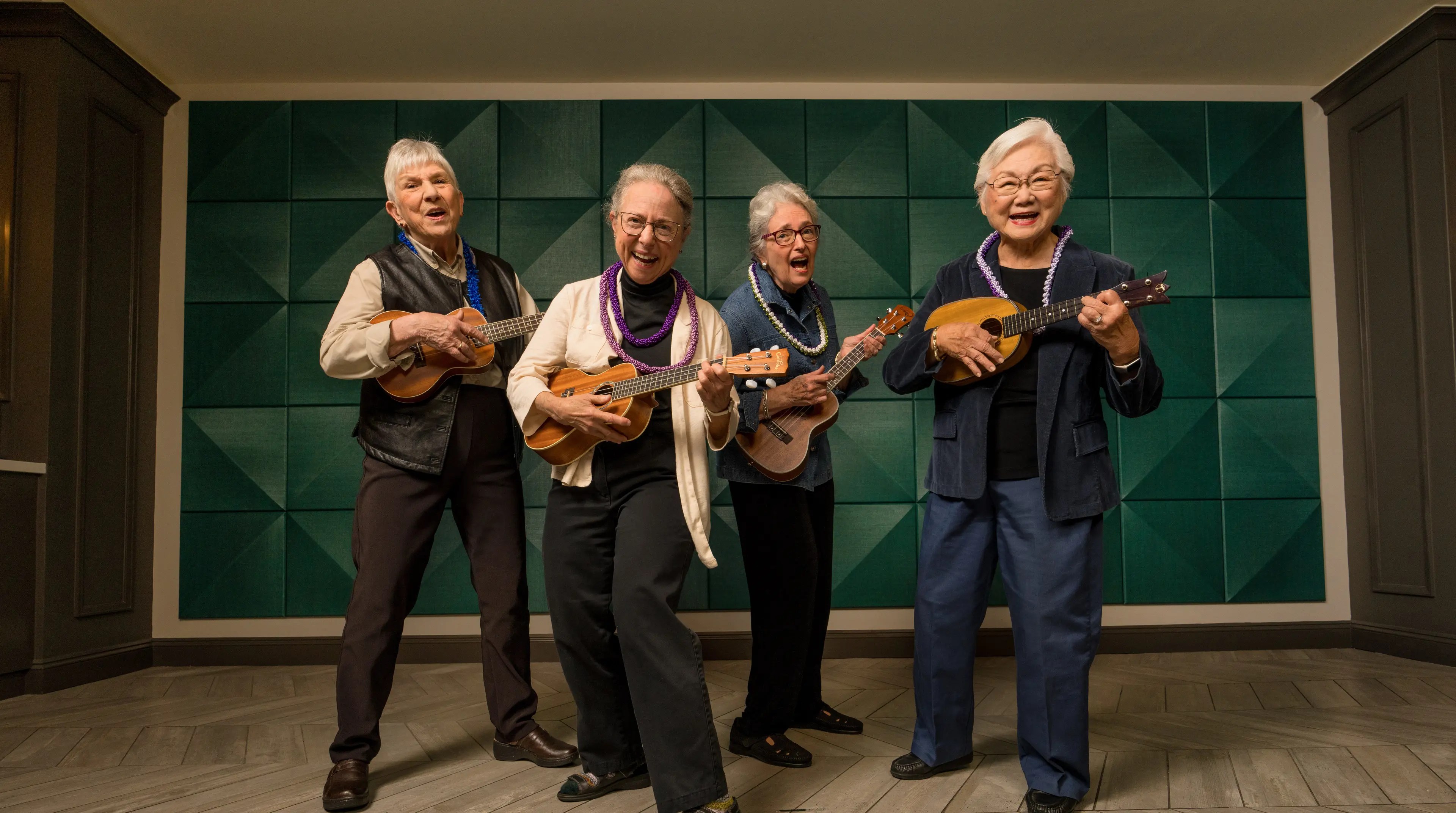
For awhile now, I’ve been wanting to perform one of my six trumpet shows at Mirabella, Seattle. My chance came this spring, thanks to Diana Rawls, Activities Director. On 11 April, I performed “Showtune Favorites”–about two dozen songs from popular musicals and movies familiar to the residents.
Why did I especially want to play there? Because it’s operated by a non-profit organization, occupies a whole city block in downtown Seattle, and is still quite new, opening for business only 15 years ago. I’m impressed!
I used four of my five horns–Getzen trumpet, Super Olds cornet, ACB flugelhorn, and Jupiter pocket trumpet (but not my Getzen bugle). I’ve owned the flugelhorn for only two and a half years, but the cornet for 71 years—Holy Cow! My parents gave it to me when I was a freshman in high school, and it took me to the Texas All-State Band when I was a senior. Love that horn! (Thanks again, Mother and Daddy, may they rest in peace.)
Besides At-Home Care, Mirabella, Seattle offers Independent Living, Assisted Living, Memory Care, and Skilled Nursing and Rehabilitation. Residents from all levels came to my performance. One couple among the audience has lived there since it originally opened!
Photos are courtesy of Mirabella, Seattle. Please click on any photo to enlarge it.
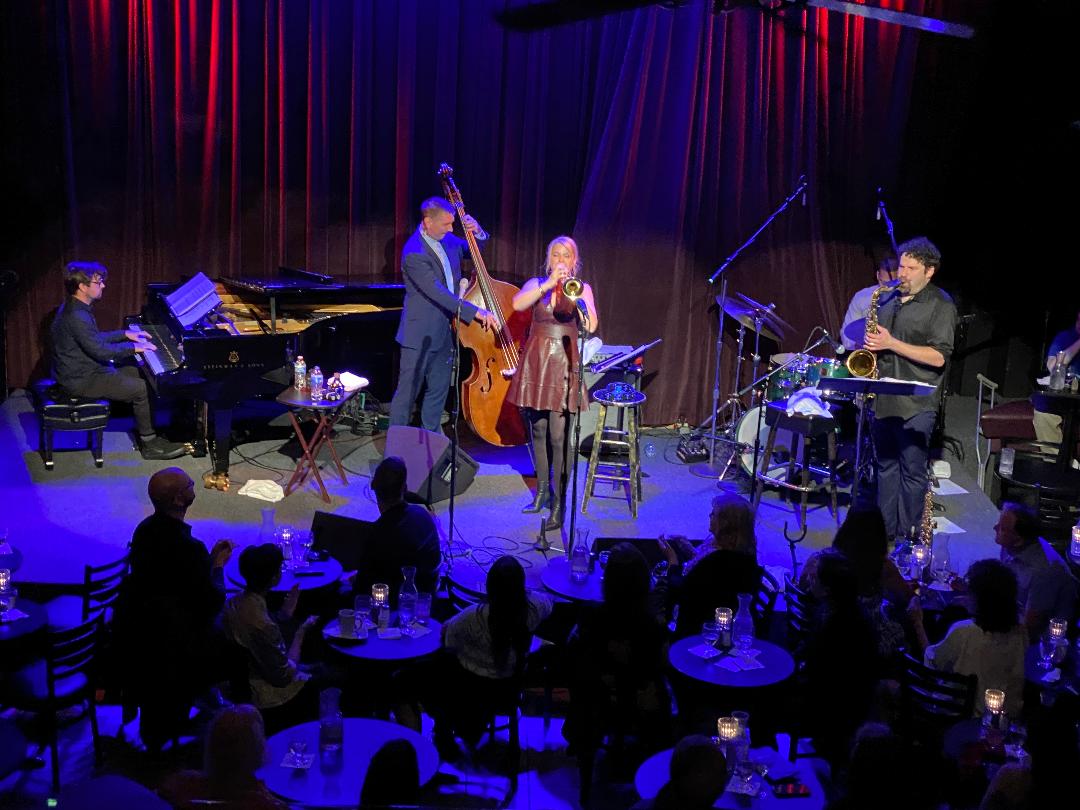
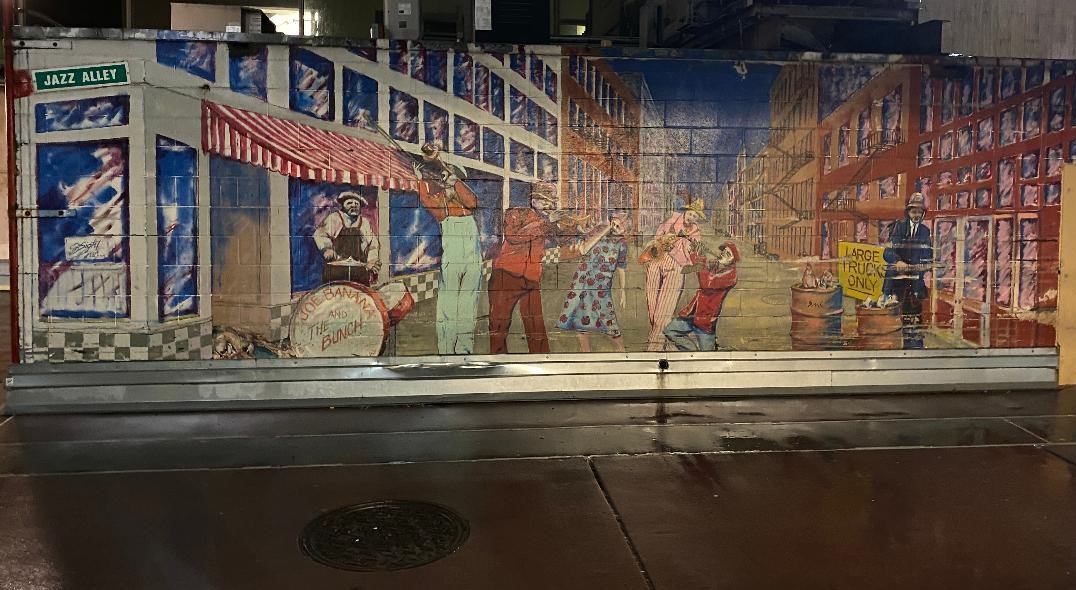
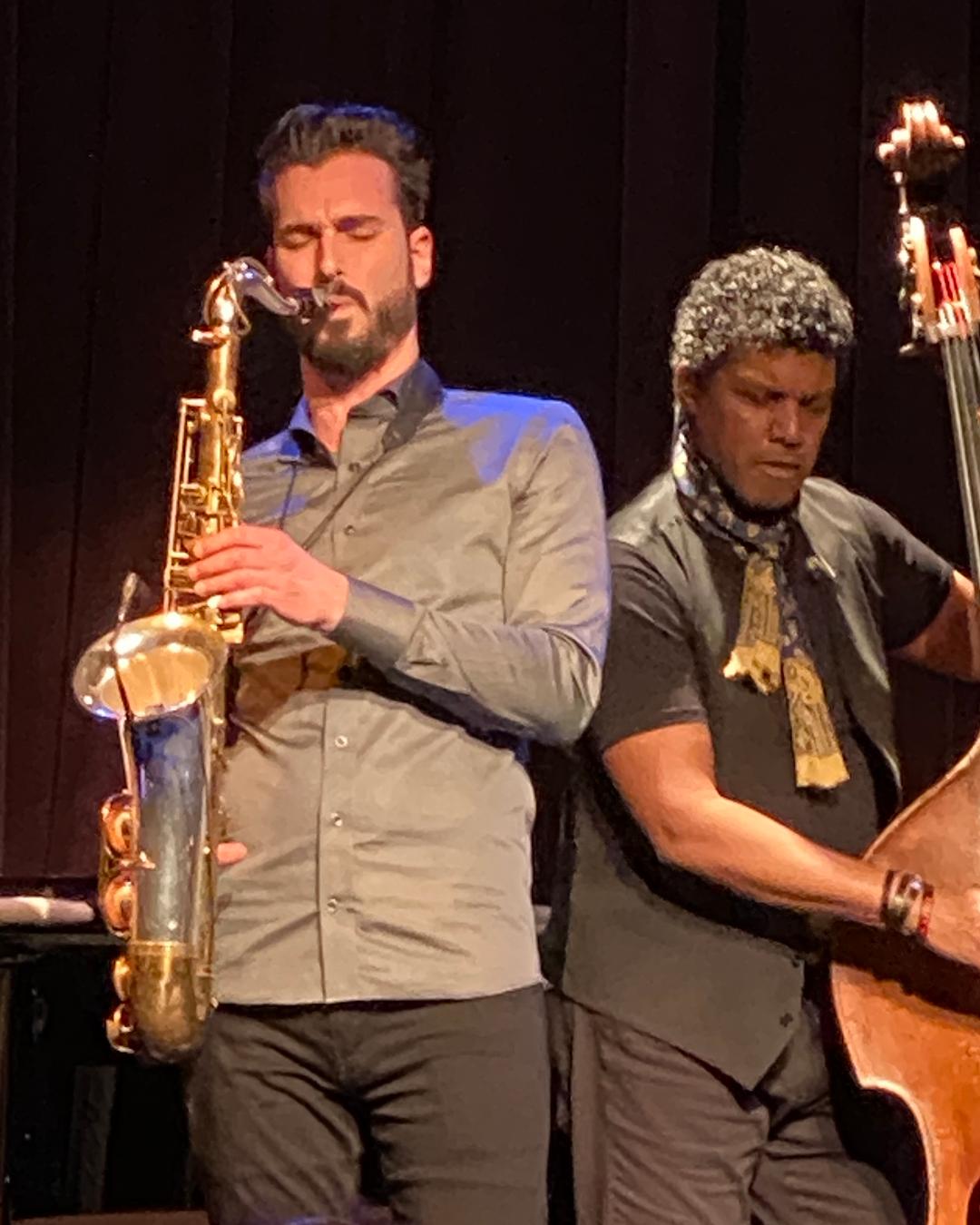
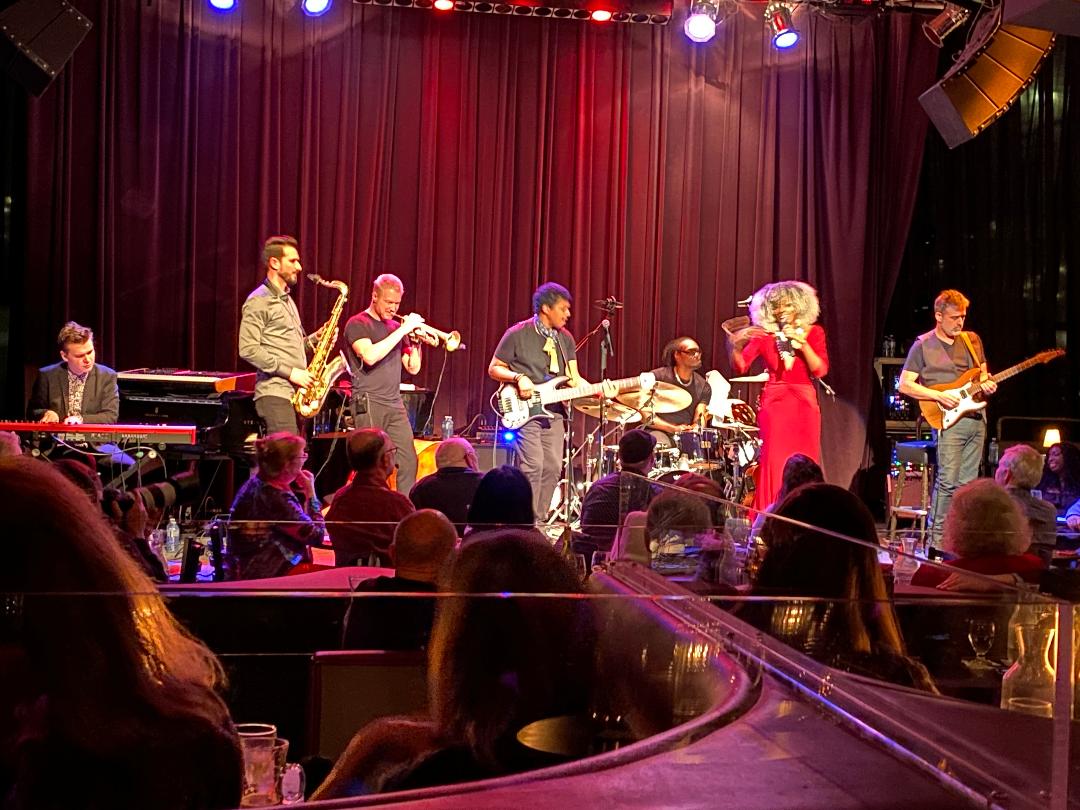
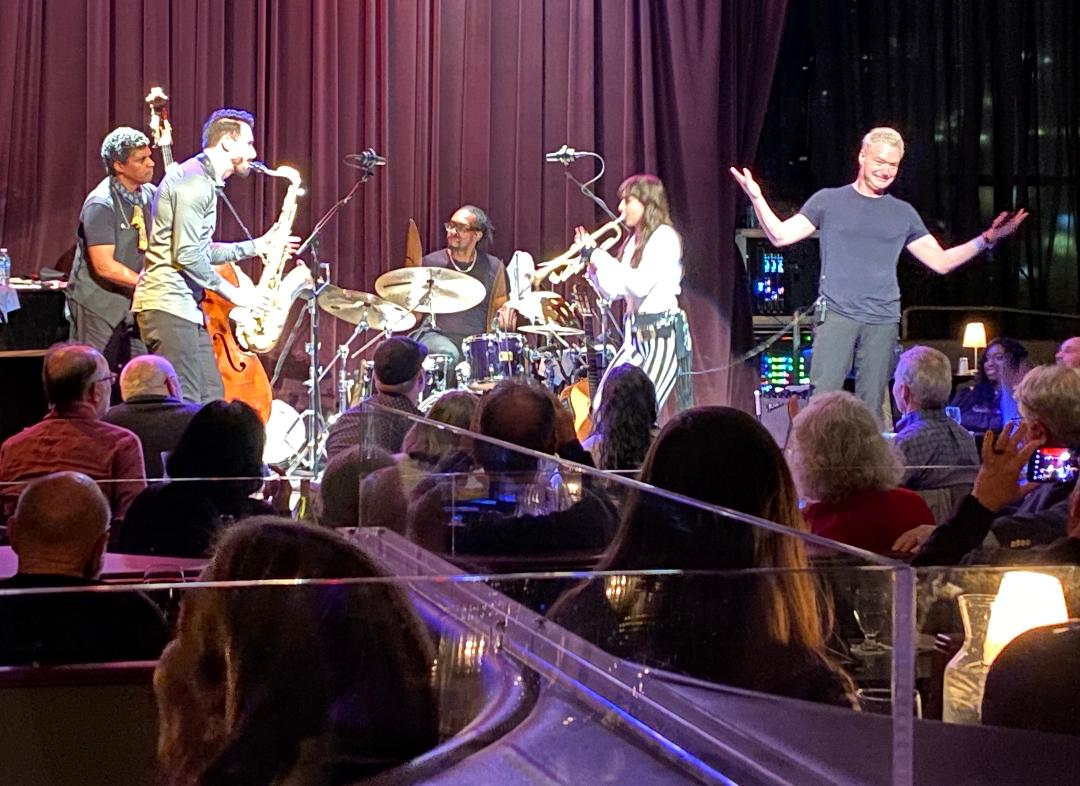
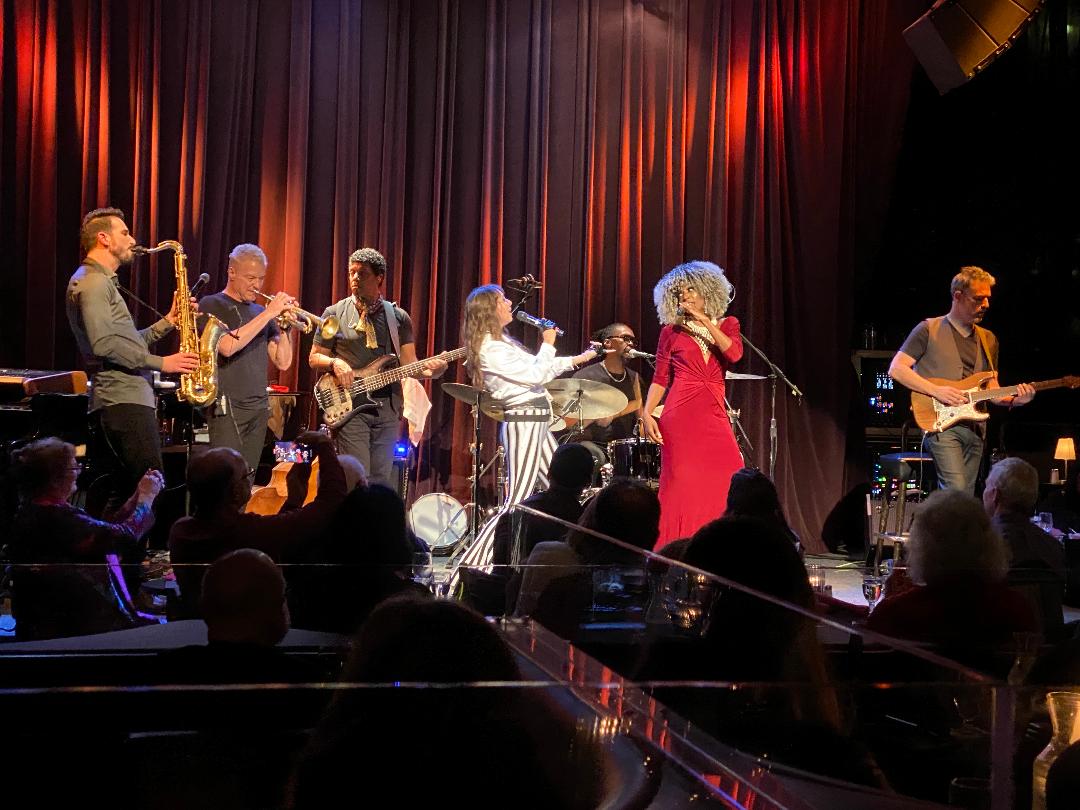
On Wednesday, 24 July, I heard Bria Skonberg and her band at Jazz Alley in Seattle. Nobody plays trumpet like Bria. And she also composes, arranges, and sings.
For about three years, I’ve watched her videos and followed her on Facebook, and as she posted about playing everywhere else but here, mostly on the East Coast and New Orleans, I would comment, “When are you coming to Jazz Alley in Seattle?”
She always replied, “We’re working on it,” until one time she said, “Check the July 2024 schedule.”
Sure enough, she was booked for 23-24 July! So, on the last night, I went and sat in the balcony at table 430. Had a nice side view. After the show, I spoke with her briefly. She wants to come back.
Later, I also spoke to the general manager. “I’ve come here to see Pancho Sanchez, Arturo Sandoval, and Chris Botti. I like her best of all.”
“She belongs with them,” he said.
“She’s so versatile and expressive!” I said. “She talks through the horn. She may not have the range and power of some other trumpeters, but she beats them all in expression. I hope you’ll bring her back.”
“We will!” he said, and we shook hands.
The New York Times wrote, “Ms. Skonberg has become the shining hope of hot jazz, on the strength of a clarion trumpet style indebted to Louis Armstrong, a smooth purr of a singing voice inspired by Anita O’Day.” Coming from British Columbia and now living in New York, she was described in The Wall Street Journal as “one of the most versatile and imposing musicians of her generation.” Her signature composition is “So Is the Day,” with which she closed the show.
Jazz Alley wrote, “Bria has recorded on over 25 albums, has garnered over 13 million streams online and over 85,000 social media followers…She tours constantly, bringing her own signature sounds of fiery trumpet playing, smoky vocals and storytelling together with adventurous concoctions of classic and new.” She’s a Juno Award winner (2017), among other awards. Her 2024 release, What It Means, “tells stories of life lessons that range from upbeat to down-to-earth to emotionally deep, all the while exhibiting both her mastery of the trumpet and her soulful and undeniably connective voice.”
Her parents were in the crowd on that last night. They know—nobody plays the horn like Bria.
“Things Remembered” is the name of one of my favorite one-hour trumpet shows. But that show is not the remembrance that still bothers me. Instead, it’s the memory of those five days, 16 to 20 December just before Christmas. On the 16th, I performed two bugle calls at the Wreaths Across America ceremony in Seattle, which I wrote about in my previous post here. And on the 20th, I performed my trumpet show, “Things Remembered,” at The Bellettini,” in downtown Bellevue. I struggled to play my horns on both days, and afterwards, I did not touch them again for the first four and a half months this year. What happened? Let me tell you.
Suddenly, a few days before the 16th, my buzz into the mouthpiece went bad. My lips would not respond to the air flow unless I blew quite hard. But you can’t play every note of every bugle call or song at “FF” volume. I’d blow, and at first, only air would hiss through the horn before a note would suddenly burst out. It was sort of like stammering or stuttering, when the words just won’t come out of a person’s throat for a few seconds, followed by a shout. I’d lost the ability to fade out down to “pp” and softer. I’d lost some control of dynamics and the ability to express certain emotions through the horn.
At first, I thought it was simply stiff lips that had lost their flexibility from not enough practicing. I thought I could overcome it if I warmed up for at least 20 minutes. But no amount of warming up would eliminate it. On the 16th, my “Assembly” didn’t sound normal. I struggled a bit with “Echo Taps,” too. It didn’t help that I had to stand and play without my cane, hunched over from lower back pain.
So, should I cancel my show at The Bellettini? I love The Bellettini, the staff, and the residents. They had invited me back for the fifth time to present a new show which they had not yet heard.
I couldn’t bear the thought of canceling, even if I wouldn’t sound normal. I had three more practice days to improve. If I didn’t sound better, would they forgive me? Or would they walk out and never invite me back again?
Yamaha Allen Vizzutti, Bach 1.5C, 3C, 8C, and Getzen 3C, 7C trumpet mouthpieces
No amount of practicing changed things. I reached a certain level, and nothing improved beyond that. Then I hit on another idea: what about changing mouthpieces? Up to now, I’d been using only my favorite, the Allen Vizzutti mouthpiece by Yamaha. So, I broke out my entire (but small) collection of six trumpet mouthpieces and tried each one. I got the best results with my Bach 1.5C. Eureka!
I arrived quite early, set up, and went into a side room to warm up for a half hour. Then I came out and did the show—not normal. But no one walked out. They were very tolerant and forgiving, and besides, they were enjoying themselves. After all, we’re all in the same age group–we could be classmates!
Afterwards, numerous residents came up to thank me and say how much they enjoyed the two dozen songs from our era–such great songs with which they could sing along!
And then, a tall man came up, thanked me, and said in a kind voice, “It’s hard to play when the buzz won’t work right, isn’t it?” He said he used to play saxophone and luckily, with a reed mouthpiece, that problem can’t happen.
“Yes,” I said. “But they liked the music and had a good time.”
He agreed sympathetically and complimented me for doing my best on an off day. Was that really all it was—just an off day? I worried that my playing days might be over entirely. I might never play again in public. I simply knew that I would never let myself play like that again.
But the experience of those five days begged the question: what caused this problem? It had never happened to me since I began playing in fifth grade.
I thought, “It must be my two front teeth”—my central incisors in the upper jaw. You see, for those readers who are young, your teeth can start to migrate in old age. Mine had been slowing creeping toward the middle of my mouth for several years, so much so that the left front tooth had actually slid outside and over the right one. It was overlapping and pushing itself outward against my upper lip, and it was probably also pushing the right tooth backwards toward my tongue.
Is this TMI–“Too Much Information?” Well, how else will you know what to do when this happens to you? Keep reading…
I developed a new theory. The crooked front teeth were diverting the air flow, ruining my buzz. So, last January, I went to see my orthodontist, Dr. Zachton Lowe in Shoreline. He advised plastic aligners by Invisalign instead of metal braces. He said it would take about sixteen months to straighten all my teeth.
“Can I play ‘Taps’ on Memorial Day?” I asked.
“Yes, I think so.”
And so, I did! The Bellettini taught me a huge lesson. Please read all about my Memorial Day performances in two blog posts which are soon to be posted in a few days–but first, I’ll post next about the music on our spring trip to Italy and Paris.
Edmonds Community College may have dropped its middle name in April, 2020 (the first Covid year), but none of the many veterans and civilians got confused or lost on 25 May when the college held its traditional early Memorial Day ceremony on campus. I’ve been sounding two bugle calls—“To the Color” and “Taps”—at every such event since 2014.
I use my Getzen field trumpet, starting with my B-flat tuning slide for “To The Color” and my G tuning slide for “Taps.” (For photos and more information about the horn and these slides, see my blog post of 4 May 2015, using the Archives in the left column).
The keynote speaker, Wally Webster II, gave one of the most moving speeches that I have heard at any of these ceremonies. He is a native of southern Alabama. To him, as a young black man, the American flag symbolized his terror of men riding on horseback in white robes and conical hats and burning crosses. Then he joined the U.S. Air Force. He said that his military service at a hospital in Japan, caring for wounded soldiers during the Vietnam War, was one of the two most pivotal events in his life. That’s when his deep pride and gratitude for the USA developed and changed him forever. After a 30-year career in banking, he is now one of the six Trustees of Edmonds College, appointed by the Governor of Washington state.
It’s always nice to be invited back to perform one of my six trumpet shows for the residents of a retirement home. And so it was, on the 4th of March, that I drove to Merrill Gardens retirement community in Burien to present my show, “In Retrospect,” comprised of 25 hit songs from the residents’ era. Last July, I had performed “I Stand for the Flag” (25 patriotic marches, songs and bugle calls) there in my VFW uniform.
Here’s a sample of the popular songs in the “In Retrospect” repertoire:
I Whistle a Happy Tune
When I Fall in Love
You Must Have Been a Beautiful Baby
Dream a Little Dream of Me
I’ve Got the World on a String
Money, Money, Money
You Are My Sunshine
When I’m 64
What a Wonderful World
God Bless America
I use three horns: my trumpet, cornet, and pocket trumpet and by inserting my Denis Wick 4 mouthpiece into the cornet, it sounds much like a flugelhorn. People sing along and I tell a few jokes.
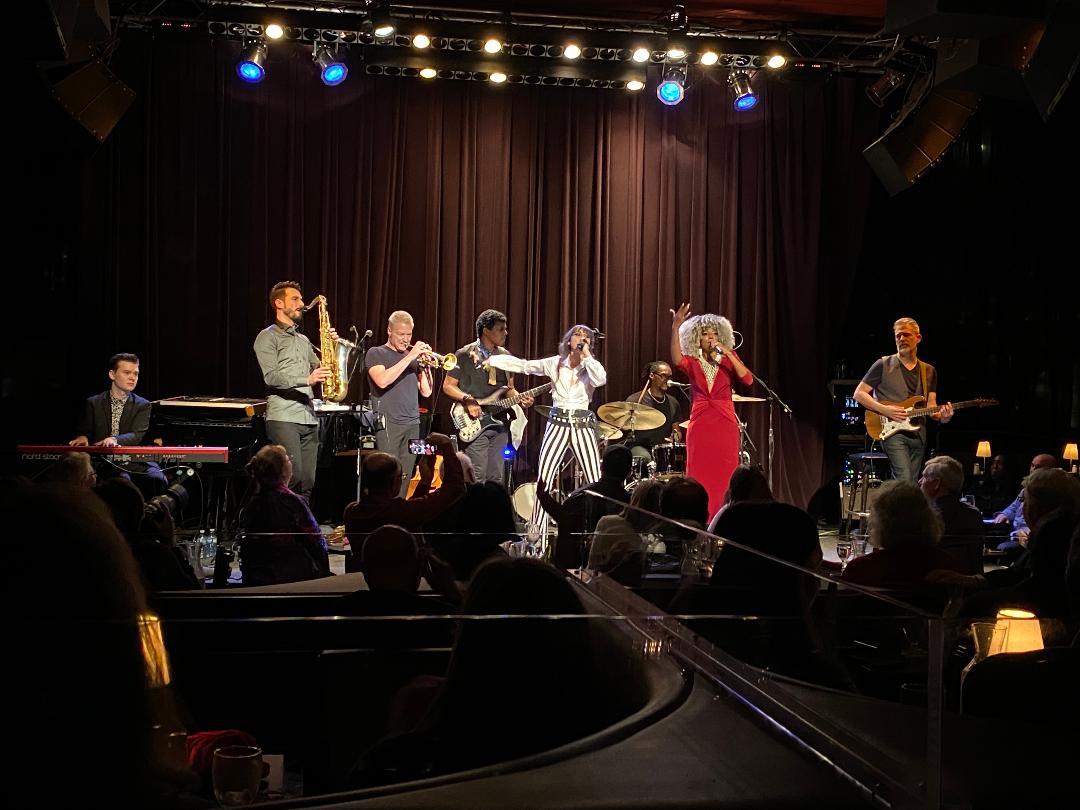
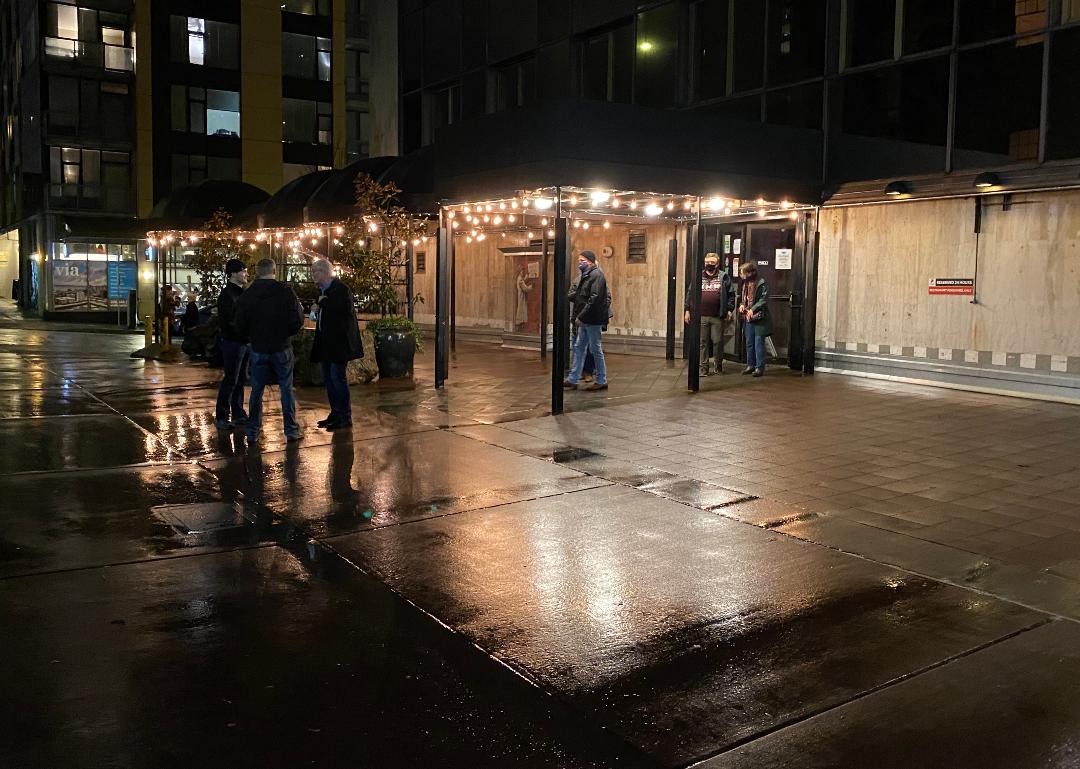
He came here so I had to go–Chris Botti, Dimitriou’s Jazz Alley, Seattle, 11 January 2022, 7:30 p.m. At the entry, they checked my Covid vaccination and booster credentials, and I found my Table 160 (partially obstructed view), $106.50. Halfway into the show, they let me move to an empty table with a perfect view. Bought my favorite cocktail, a “Stinger on the Rocks,” and sipped it all night.
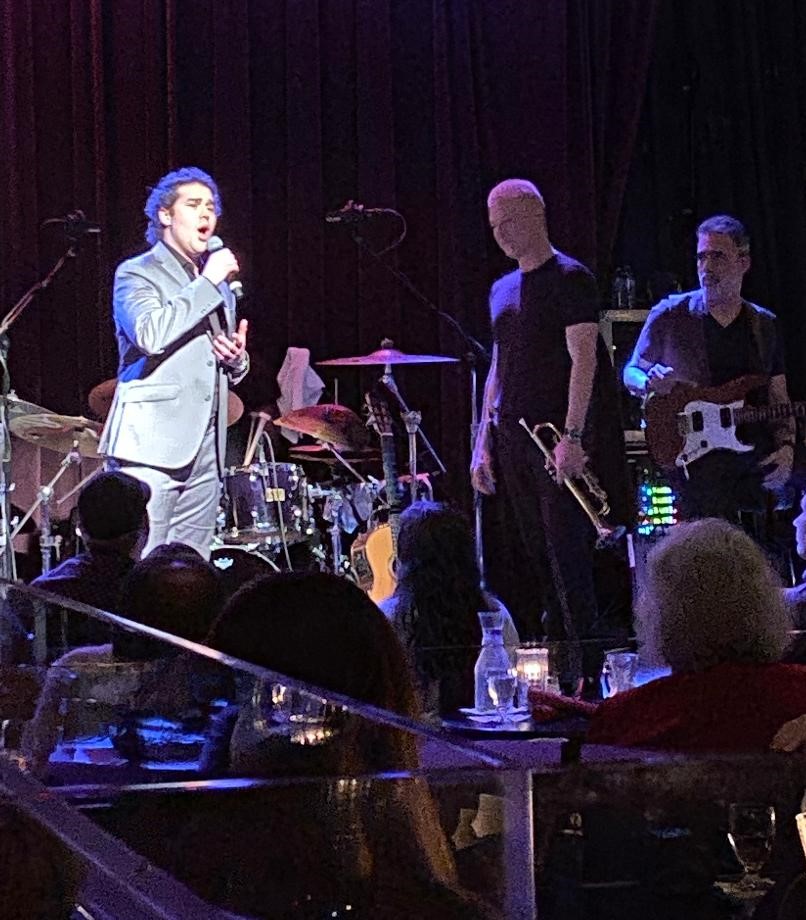
Great show! What Botti can do with his horn is amazing–the variety of sounds, the accuracy of intonation and articulation in all ranges, the styles of music! I never saw him change horns or mouthpieces. And I was impressed with how he sometimes stepped aside into the shadows and featured every member of his troupe, including his five guest performers. I did not recognize most pieces, but I did know “Someone to Watch Over Me,” “When I Fall in Love,” “You Don’t Know Lovin’,” “Blue in Green” (Miles Davis), “In the Wee Small Hours of the Morning,” “I’ve Got You Under My Skin,” “There Will Never Be Another You,” “Time to Say Goodbye,” and Puccini’s aria, “Nessun Dorma” from his opera, Turandot.
Botti’s quintet consists of trumpet, piano/keyboard, bass, guitar, and drums. His five guest performers were Lucia Micarelli, violinist; Sy Smith, female vocalist; Chad LB (Lefkowitz-Brown), tenor saxophonist; Jonathan Johnson, tenor vocalist; and Veronica Swift, female vocalist.
What a great treat it is to hear great performers! Do it.
My 49th trumpet student found me online and signed up for 10 one-hour lessons. We started with the first one on 3 July. His immediate goal is to make the jazz band at Juanita High School (JHS) in Kirkland, where, at age 14, he will be a freshman in September. I’m all in—let’s go for it!
What experience does he have? It’s good that there’re some musicianship in his family. His mother played flute and piccolo, and his older brother, a junior at JHS, plays saxophone. He started band classes in fourth grade at Thoreau Elementary School. When he got to Finn Hill Middle School, he joined the jazz band and played there for three years. Last year, he and another trumpeter usually took the solos. Also, he’s a Boy Scout bugler.
Where to start? I listened to him play. He has excellent range—above high C. His tone is solid but meek. His articulation is accurate. Naturally, he has some weaknesses and bad habits—who doesn’t, especially at his age? That’s why he’s taking lessons! But his attitude is good, and his spirit is pleasant and positive. He has ambition and loves trumpet. He wants to earn the Boy Scout’s Bugling Merit Badge. He fits my tutoring motto—“Become Your Best!”
Next, we considered his equipment. He rents a student-level trumpet and, in time, plans to move up to an intermediate horn. He has a few mouthpieces; we identified the one that gives him the highest range. Later, after school starts, we will identify the one that is the most versatile, responsive and comfortable in the range where he’ll be playing most often.
Third, I asked him what improvements he could make that would enhance his chances of being selected for jazz band. His answer: “dynamics.” To me, that says he wants to improve his technique so that his sound will be more expressive of feelings. In other words, he wants to be able to make the horn “cry and sing and inspire.” Won’t that be fun to teach!
So—I asked his mom to buy three books:
Mel Bay’s Complete Jazz Trumpet Book by William Bay, published by Mel Bay Publications, Inc.
101 Jazz Songs: Trumpet by Hal Leonard Corporation
67 Bugle Calls by Carl Fischer, New Edition
Next week, we’ll have our fourth one-hour lesson. School classes start in less than six weeks on Tuesday, 3 September. Here we go!
Incidentally, he is not my first trumpet student at JHS. Two others are featured in my blog post of 4 June 2013, which contains photos of the JHS Concert Band, Symphonic Band, and Jazz Band at that time. To read about today’s band program at JHS, under the direction of Annemarie Smith, please see https://jhs.lwsd.org/activitiesathletics/performing-arts/band.
He’s about to finish 4th grade at Lockwood Elementary School in Bothell and has a close friend who has registered for band next year—so he’s registered, too. That’s why he chose trumpet. His mother contacted me on 12 March, and we started weekly private lessons on 2 April. He wants to get a head start.
She bought him the instruction book which the band uses, Standard of Excellence, Book I, by Bruce Pearson. We’re working our way through the early pages and the inside back cover, concentrating on “the first six notes,” C through A of the C Major Scale. He’s learning the very basics: how to hold the trumpet properly, sit properly, buzz in the mouthpiece, understand the route of his air through the valves and slides, oil the valves, release the water that collects in the horn, breathe while playing, set his embouchure to sound each different note, read the time signature, recognize the shapes of quarter, half, and whole notes and rests, play different rhythms at different tempos, and so forth and so on.
Every page introduces new things to learn and master. There is so much to remember to do, all it once! Yet it looks so simple—the trumpet has only three buttons—it appears deceptively easy. He has shown me that he can handle it—and he will master it if he practices. He has the natural ability. He already has a head start. He’s getting better, step by step. And so far, he tells me, he likes playing trumpet. I’ve invited him and his family to attend my 10th Annual Trumpet Recital in Edmonds on 25 May as observers. Here’s hoping he attends next year as a participant.
Olds Ambassador cornet in its original case with 1962 Indiana state trumpet competition medal pinned inside the lid (left)
Why does the above headline read, “only 70 years old”? Well, because my student #26 was an 81-year old retired engineer (see my blog post of 18 February 2016), and my student #38 was a 76-year old retired Army veteran (see my blog post of 17 November 2017). The 81-year old played a Kanstul cornet, and the veteran played a Getzen bugle. My new student (#45) plays an Olds Ambassador cornet, and as you may remember, I still play a Super Olds cornet given to me by my parents when I entered high school in 1954.
Olds Ambassador cornet, c. 1961
On 27 December 2018, I had my first private lesson with Victor Snyder at his home in the Bryant neighborhood in Seattle, east of the University of Washington. In fact, in 2015, he retired from UW, where after 20 years of employment, he was the Associate Director, Career Counseling Center [now, Career and Internship Center]. Now that he’s retired, he wants to play cornet again.
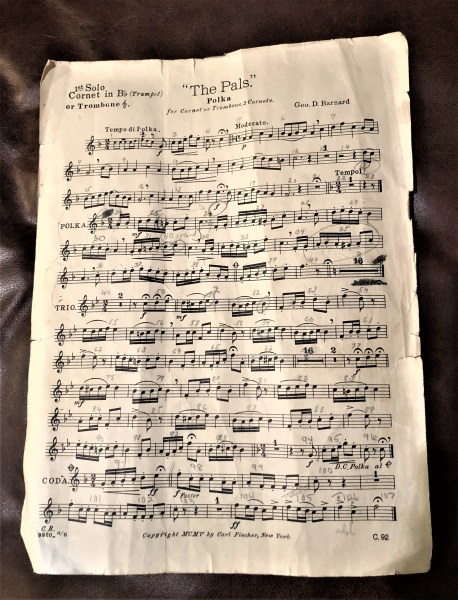
The first time Vic played his cornet was when he was a 7th and 8th grade student at St. Pius Catholic School in Tell City, Indiana. In 1962, while in the 8th grade, he won a state solo competition, was graded “superior,” and was awarded a medal by the Indiana School Music Association. He performed “The Pals” polka by George D. Barnard (see photo). The next year, as a freshman, he started taking band at Tell City High School but then dropped it. Nevertheless, his mother saved his cornet and his music, thinking that since he was talented, he might someday take it up again. I’m sure that would make her happy and proud again.
“The Pals” polka by George D. Barnard can be played as either a solo or duet with piano accompaniment
After high school, Vic earned a Bachelors degree at Kent State University in Ohio, served a tour in the U.S. Navy including being stationed on Whidbey Island in Washington, and then earned a Masters degree at the University of Washington in 1976. The next time he played his cornet was in 1989, twenty-seven years after winning that medal. He took private lessons for about half a year. The tutor assigned him only exercises in Arbans Complete Conservatory Method: Trumpet, but he wanted to play songs, too. As everyone knows, Arbans is a wonderful instruction book and even contains many old songs, but it is designed for advanced students, not beginners or re-starters. He became bored and frustrated and stopped the lessons.
Now, Vic is taking up the horn once again, simply for his own pleasure. Eventually, he might join a combo with a friend and/or play with a community band and such—or not. He’s really doing this to please himself. He found me through http://www.takelessons.com. His weekly lessons are one-hour long, and he often practices twice a day. He’s working his way through two exercise books that are more appropriate for his current performance level:
Rubank Elementary Level, Cornet or Trumpet by A. F. Robinson.
Progressive Beginner Trumpet by Peter Gelling.
The skills are coming back, but in addition, Vic is learning much more than he ever did. He knows that I host an annual recital in my home in late May or early June. Perhaps by then, he will be able to play “The Pals” again, but if he wants to play something else, we’ll find the right thing. I’m betting that his mom, who passed away in 2005, would be proud to hear him once more—after all, he’s only 70 and has many more miles yet to go.
What do you do as a parent when your child is in 5th grade, wants to play trumpet, and attends a school where there is no band program? This parent rented a horn and started teaching him some music on her own last January. But he quickly adapted so well and got so good that she soon realized that what she was teaching him using the piano at home was not teaching him the trumpet.
So she found me on the internet through Lessons In Your Home, http://www.lessonsinyourhome.com. We began with his first lesson on 6 March, using the instruction book, Progressive Beginner Trumpet, by Peter Gelling (see https://www.amazon.com/CP69122-Progressive-Beginner-Peter-Gelling/dp/1864691220). When I first listened to him play, I found that he already has a solid tone, strong sense of rhythm, and a range up to C on the staff—things that it takes many 5th graders in band about 6 months to develop.
My 41st trumpet student is an enthusiastic, eager boy who will turn 11 this summer and is multi-talented—he loves sports, too! His eyes are bright, and his smile is ready and wide. Some techniques come quickly and easily to him. His mom says he loves music—he whistles and sings a lot. She says he needs challenges, responds to goals, and likes structure and assignments. (That sounds like a good formula for success, doesn’t it?) But at Queen Anne Elementary in Seattle, he attends a 45-minute music class only once a week. There are a few trumpeters besides himself, but “it’s not exactly band.” It’s a music program that the school started just this year.
So, here we go! Taking private lessons involves a lot of practice, and practice requires a lot of repetition. That can get old—gotta keep it fun. Along with his excellent disposition and talent, does he also have patience and tenacity? How can I help him handle obstacles and frustration? The instruction book we’re using is well-suited for him. And my motto is printed on my business card—“Become Your BEST!” Let’s make it happen.















![1[1] (2)](https://glennstrumpetnotes.com/wp-content/uploads/2019/07/11-2.jpg?w=464) What experience does he have? It’s good that there’re some musicianship in his family. His mother played flute and piccolo, and his older brother, a junior at JHS, plays saxophone. He started band classes in fourth grade at Thoreau Elementary School. When he got to Finn Hill Middle School, he joined the jazz band and played there for three years. Last year, he and another trumpeter usually took the solos. Also, he’s a Boy Scout bugler.
What experience does he have? It’s good that there’re some musicianship in his family. His mother played flute and piccolo, and his older brother, a junior at JHS, plays saxophone. He started band classes in fourth grade at Thoreau Elementary School. When he got to Finn Hill Middle School, he joined the jazz band and played there for three years. Last year, he and another trumpeter usually took the solos. Also, he’s a Boy Scout bugler.![th[4]](https://glennstrumpetnotes.com/wp-content/uploads/2019/04/th4.jpg) He’s about to finish 4th grade at Lockwood Elementary School in Bothell and has a close friend who has registered for band next year—so he’s registered, too. That’s why he chose trumpet. His mother contacted me on 12 March, and we started weekly private lessons on 2 April. He wants to get a head start.
He’s about to finish 4th grade at Lockwood Elementary School in Bothell and has a close friend who has registered for band next year—so he’s registered, too. That’s why he chose trumpet. His mother contacted me on 12 March, and we started weekly private lessons on 2 April. He wants to get a head start.

![little-einsteins-quincy[1]](https://glennstrumpetnotes.com/wp-content/uploads/2018/03/little-einsteins-quincy1.png?w=133)
 Glenn's Trumpet Notes