Glenn’s Trumpet Notes

News & Tips for Trumpet & Cornet Students

  • April 2026
    S M T W T F S
     1234
    567891011
    12131415161718
    19202122232425
    2627282930  
  • Enter your email address to subscribe to this blog and receive notifications of new posts by email.

    Join 88 other subscribers
  • Subscribe

Does Rossini’s “Cinderella” Opera from 1817 Play Well in 2013?

Posted by glennled on January 22, 2013

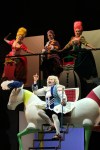
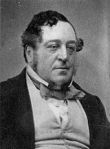
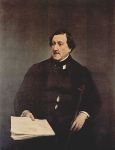
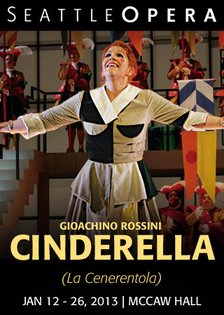
On Sunday, 13 January, it was time for my wife and me (opera novices) to be re-introduced to Gioachino Antonio Rossini, the blog_poster_cinderella, 1-13-13composer whose nickname was “The Italian Mozart.” We were both familiar with The Barber of Seville, but it was so long ago, we can hardly be sure of when, where and what. So off we drove to McCaw Hall not knowing what to expect to see and hear at the Seattle Opera’s matinee performance of Cinderella (La Cenerentola)—almost 200 years after it premiered at Teatro Valle, Rome, 25 January 1817.
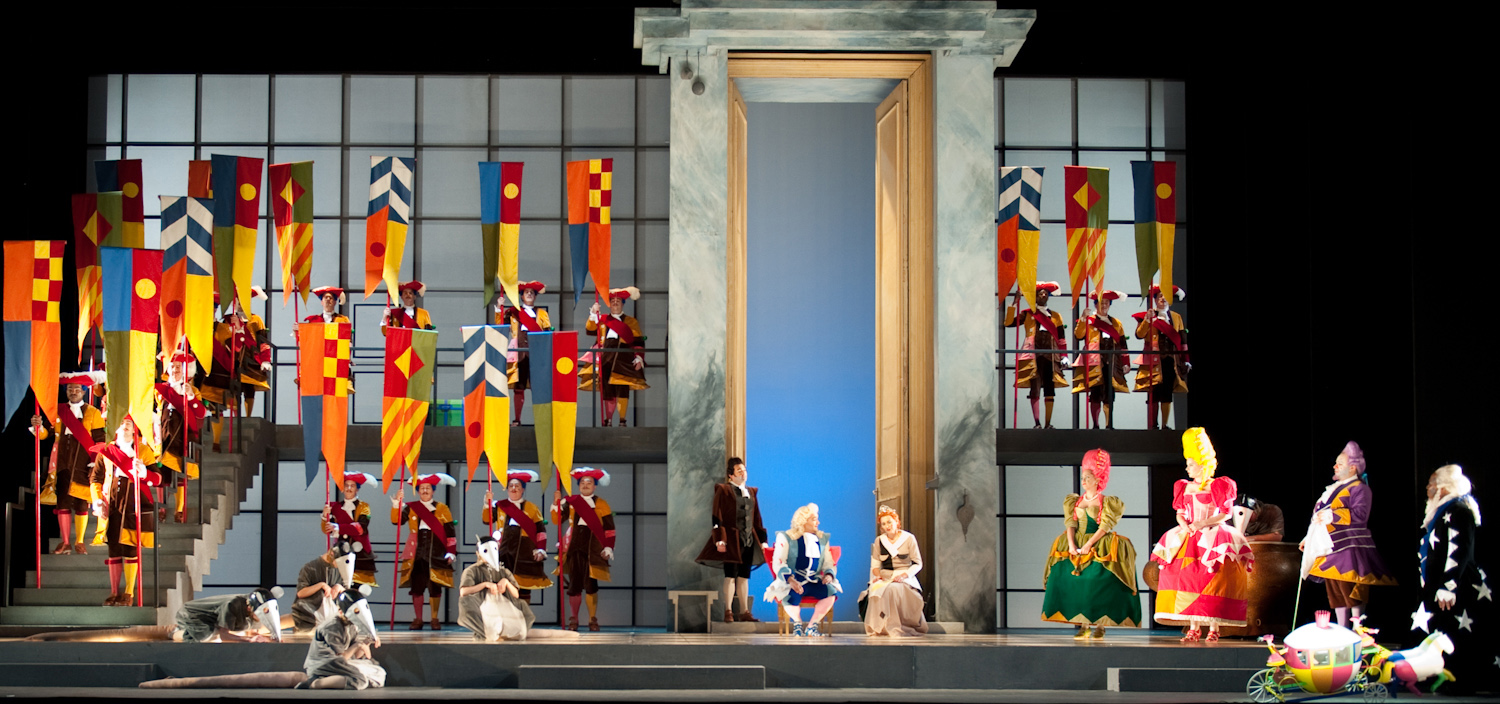
The prince wins Cinderella in Seattle Opera’s La Cenerentola, with sets and costumes designed by Joan Guillén - Photo © Elise Bakketun

Prince Ramiro wins Cinderella in Seattle Opera’s “La Cenerentola,” with sets and costumes designed by Joan Guillén – Photo © Elise Bakketun

It turns out that Rossini’s Cinderella is a romantic comedy of the bel canto (“Beautiful Singing”) kind. The story was altered by librettist Jacopo Ferretti both in characters and in plot, but yes, in the end, the prince does get the lovely, virtuous Cinderella as his bride. This takes two acts stretched over three hours (including a half-hour intermission). During the pursuit, there are lots of laughs and some extraordinary singing.

The basic premise of the opera, writes Spreight Jenkins, General Director of the Seattle Opera, is that the prince wants to marry someone who loves him for himself, not his position, power or wealth.  That romantic ideal still plays well in 2013 in Western society, does it not? Cinderella, called Angelina in this opera, is a forward-looking person who also will marry only for love but wants respect, too. She is not a male-dominated person, and she is not ambitious to become a princess. She stands up for herself, knows what she wants, and wins it fair and square on her terms—her man must be willing to make an effort to win her. This idea of feminity is still modern and plays well in 2013 in America and elsewhere, does it not? Jenkins writes in Encore, “There’s a lot of humor, but we see in Angelina a far more recognizable and believable young woman than many created in the nineteenth century. She is generous when she wins, and altogether she is a really charming person who might fit very well into the twenty-first century.”

Here’s what the bel canto style meant when it was dominant from the 18th century until about 1840, according to the experts at Wikipedia:

  • an impeccable legato production throughout the singer’s (seamless) range
  • the use of a light tone in the higher registers
  • an agile, flexible technique capable of dispatching ornate embellishments
  • the ability to execute fast, accurate divisions
  • the avoidance of aspirates and eschewing a loose vibrato
  • a pleasing, well-focused timbre
  • a clean attack
  • limpid diction
  • graceful phrasing rooted in a complete mastery of breath control

    Alidoro (Arthur Woodleyj), tutor to Prince Ramiro, has other plans for Cinderella - Photo by Alan Alabastro.

    Alidoro (Arthur Woodleyj), tutor to Prince Ramiro, has other plans for Cinderella – Photo by Alan Alabastro.
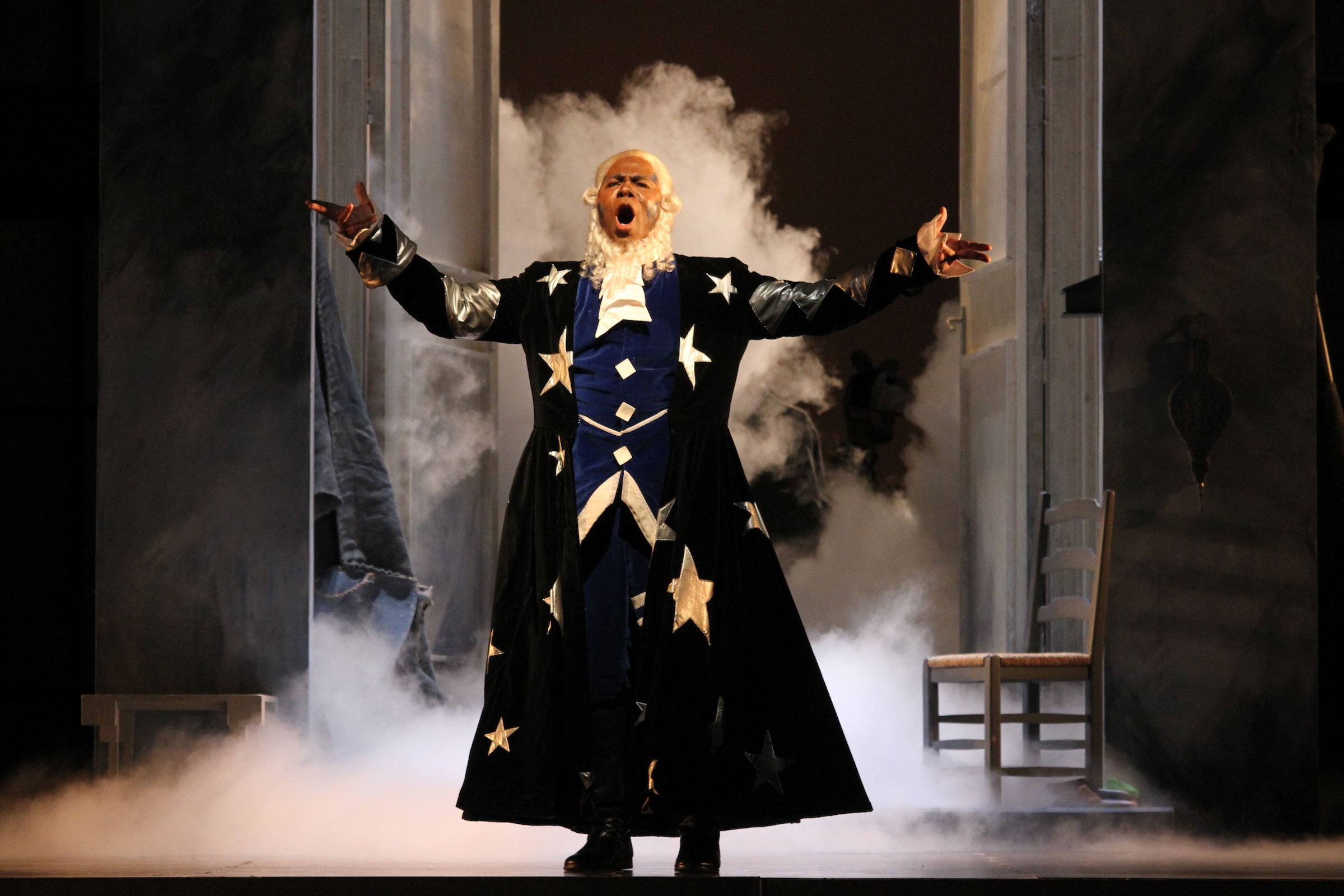
The music was written to show off the exceptional quality of the singers’ voices. I especially enjoyed the various ensembles. The precision of the attacks, phrasing, and breath control were remarkable and often, as intended, funny! I imagine it would be quite challenging and possibly exhausting to sing for so long in that style. Among the voices I enjoyed the most were those of Angelina (Cinderella), mezzo-soprano; Alidoro, bass; Dandini, baritone; and Don Magnifico, bass.
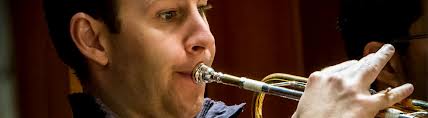
Courtesy of Seattle Symphony & Opera Players' Organization

Courtesy of Seattle Symphony & Opera Players’ Organization

I enjoyed listening to the orchestra, too, hearing and watching how the music from the pit matched the action on stage. It’s great fun to play trumpet in the orchestra of a musical or an opera. I did both long ago on the college level—but now I’m just a happy spectator. I wonder if any of my trumpet students will ever have that wonderful experience. I hope so. That would please me, as did this .  😉  Please click on any photo to enlarge it:

Posted in Professional Concerts | Tagged: , , , , , , , , , , , , , , , , | Leave a Comment »

Dire Straits: “They don’t give a damn about any trumpet playing band”

Posted by glennled on January 17, 2013

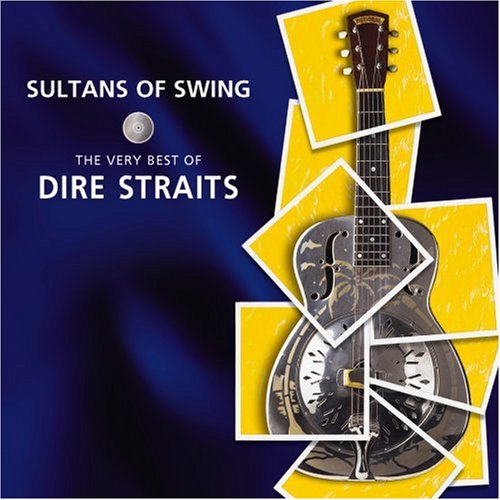
dire-straits-sultans-of-swingLately, I’ve been listening again to Dire Straits, a British rock band led by Mark Knopfler. Their biggest selling album, Brothers in Arms, has sold over 30 million copies, and their worldwide album sales exceed 120 million. The band’s career spanned a combined total of 15 years (1977-1988, 1991-1995). Their most popular songs include “Sultans of Swing,” “Money for Nothing,” “Walk of Life,” “Brothers in Arms,” “Lady Writer,” “Romeo and Juliet,” “Tunnel of Love,” “Private Investigations,” “So Far Away,” and “Your Latest Trick.”

In the “Sultans of Swing” song, a crowd of young boys in the honky tonk, “dressed in their best brown baggies and their platform soles,” are drunk as they listen to a band called the Sultans of Swing. Two lines, sung with dripping disdain, catch my ear: “They don’t give a damn about any trumpet playing band, It ain’t what they call rock and roll…”

Well, now, wait just a minute! You can’t dismiss all us horns. Those boys obviously don’t know their jazz music history and don’t even care about learning it either. No, even though the Sultans of Swing may play some swing music on their rock and roll instruments (guitars, keyboards, synthesizer, and percussion), that’s not the swing music of the great Swing Band Era, ~1936-1944. And all those big bands did feature trumpeters—and some great ones, too!

Want to hear some swing trumpeters from a time long gone by? Try these, for seven of the best:

Yeah, that was then, way back when I was a boy. Today, I also love the “Sultans of Swing” by Dire Straits even though they trash us trumpeters. But someday, they, too, will be bye-gones, like brown baggies and platform shoes.   😉

Please click on any image to enlarge it.

Posted in Selected Trumpet Music | Tagged: , , , , , , , , , , , , , , , , , , | 4 Comments »

“Mele Kalikimaka” Honors Lost Family Matriarch on Christmas Eve at Home

Posted by glennled on January 12, 2013

Glenn Ledbetter plays "Mele Kalikimaka" on his Super Olds Cornet (1954)

Glenn Ledbetter plays “Mele Kalikimaka” on his Super Olds Cornet (1954)

Our family tradition on Christmas Eve includes singing Christmas carols after dinner and before opening gifts. My wife plays piano as we sing, and a few years ago, we added a couple of trumpet solos to the program. This year, I played “Mele Kalikimaka” because on all our minds was the recent loss of my wife’s mother, Ruth, who died peacefully on 12 October. This was our first Christmas without her.

To Ruth, Hawaii was paradise. She and her husband, Mac, first went to Waikiki to celebrate their 25th wedding anniversary. They always returned annually until he passed away, and then she continued to go back. In all, she vacationed there for 39 straight years! She was a bright spirit, and we miss her so much.

“Mele Kalikimaka” means “Merry Christmas,” and Robert Alex Anderson wrote the song in 1949. Bing Crosby and The Andrews Sisters recorded the song in 1950 on Decca 27228 (78 rpm)/9-27228 (45 rmp). To hear their recording, please see http://www.youtube.com/watch?v=WJhYrC8Rq8w.

For my second trumpet solo, I played “Angels We Have Heard on High,” a traditional French carol.

Posted in Musical Events at Home | Tagged: , , , , , , , , | 9 Comments »

“Taps” for Wreaths Across America Memorial Service at Evergreen-Washelli in Seattle

Posted by glennled on January 9, 2013

Courtesy of Wreaths Across America (WAA)

Courtesy of Wreaths Across America (WAA)

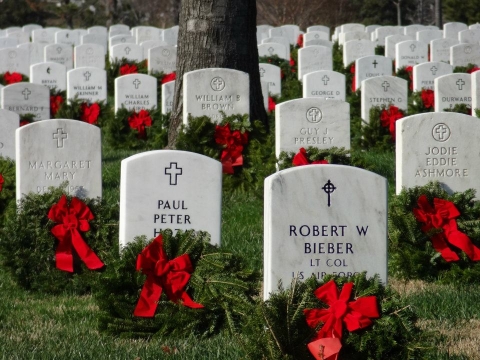
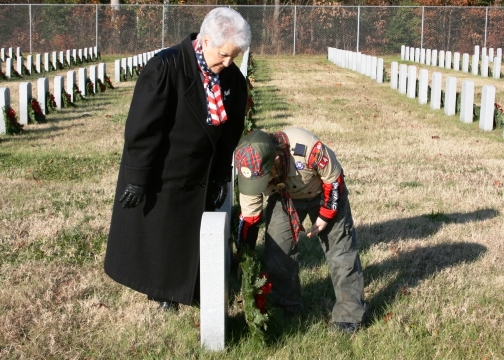
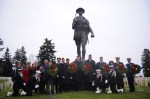
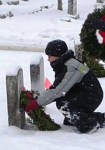
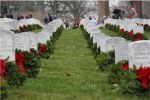
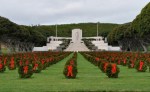
Last month on 15 December 2012, Wreaths Across America (WAA) sponsored and coordinated the placement of 420,000 remembrance wreaths by almost 200,000 volunteers on the headstones of our nation’s fallen military in 825 locations in America and abroad. At Arlington National Cemetery in Virginia, more than 20,000 volunteers laid 110,662 wreaths. This was the 21st annual wreath-laying event.

Courtesy of WAA

Courtesy of WAA

In 1992 in Harrington, Maine, as the Christmas holiday season drew to a close, the Worcester Wreath Company found itself with a surplus of fresh, evergreen wreaths. The owner, Morrill Worcester, made arrangements to have the wreaths placed in one of Arlington cemetery’s older sections where fewer visitors were coming each year. A local trucking company transported the wreaths to Virginia, and American Legion, VFW, and other volunteers decorated each wreath with the traditional, hand-tied red bows and laid them on the headstones. There was also a special ceremony at the Tomb of the Unknown Soldier.

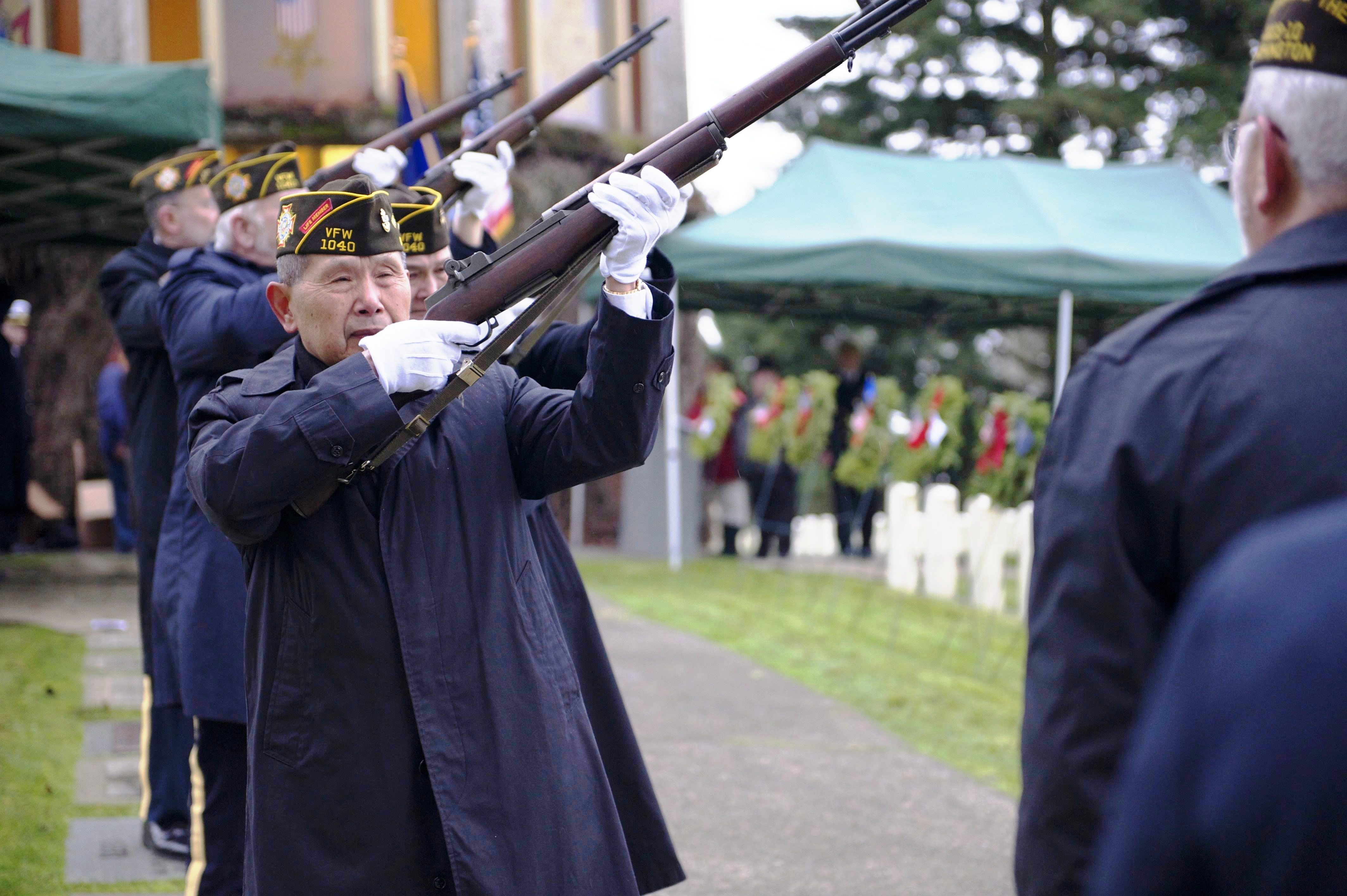
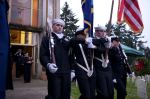
VFW Post 1040 Honor Guard, WAA ceremony, Veterans Memorial Cemetery, Evergreen-Washelli, Seattle, 12-15-’12. Photo by Nathan W. Bradshaw, PA3, USCG.

VFW Post 1040 Honor Guard, WAA ceremony, Veterans Memorial Cemetery, Evergreen-Washelli, Seattle, 12-15-’12. Photo by Nathan W. Bradshaw, PA3, USCG.

That started the annual pilgrimage to and event at Arlington National Cemetery which continues today. Others across the nation wanted to participate in their own national, state, and local cemeteries, and so in 2007, WAA was created. The mission of this non-profit organization, now based in Columbia Falls, Maine, is to “Remember, Honor, Teach.”

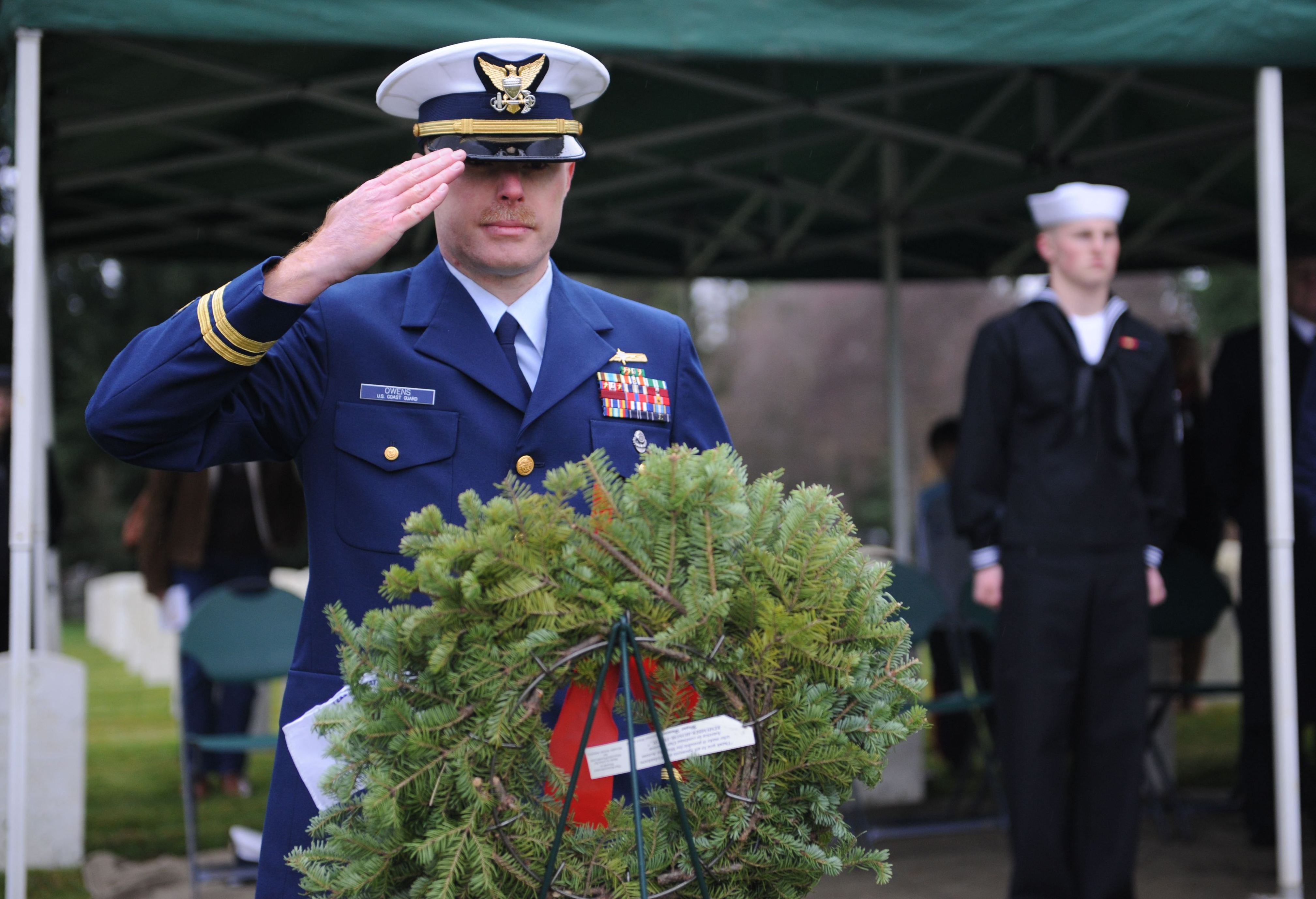
Lt, U.S. Coast Guard. Photo by Nathan Bradshaw, PA3, USCG

In the state of Washington, 18 cemeteries are affiliated with WAA. The four largest are the Tahoma National Cemetery in Kent (23,000+ graves; 15,500 veteran graves and 13,000  veteran columbarium niches); Evergreen-Washelli-Veterans Memorial Cemetery in north Seattle (5,000+ veteran graves); Mountain View Cemetery in Walla Walla (37,000 graves; 2,500 veteran graves); and Washington State Veterans Cemetery in Medical Lake (550 veteran graves).

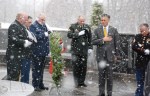
At Veterans Memorial Cemetery at Washelli, this was the 3rd annual wreath laying ceremony sponsored by the Navy Wives Club #277. King5-TV again covered the event in a superb report. Please see http://www.king5.com/video/yahoo-video/200-wreaths-cemetery-183725091.html. You’ll see the VFW Post 1040 Honor Guard fire three perfect rifle volleys, hear the post piper play some of “Amazing Grace,” and hear me play “Taps” in the background as the reporter tells the story. For a description of the previous year’s event, please see my post of 16 December 2011.

Please click on any photo to enlarge it. Here are links to the websites of other organizations mentioned in this post:

Posted in Ceremonies & Celebrations | Tagged: , , , , , , , , , | Leave a Comment »

Exceptional “Winter All Bands Concert” by Hamilton International Middle School in Seattle

Posted by glennled on December 24, 2012

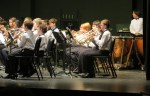
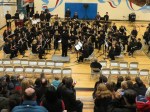
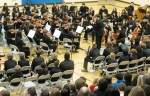
Symphonic Band, Hamilton International Middle School, Seattle

Symphonic Band, Hamilton International Middle School, Seattle

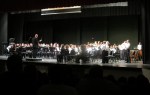
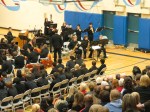
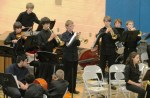
“The music program at Hamilton is thriving,” said Daniel Rowe, Music Director of Bands, “and we’re making beautiful music!” The standing-room only audience responded in loud applause as the Symphonic Band from Hamilton International Middle School (HIMS) prepared to play the concluding, ever-popular piece, “Sleigh Ride,” by Leroy Anderson. The two-hour Winter All Bands Concert was held on 13 December in Lincoln High School Auditorium in Wallingford in Seattle.

The Finale: Leroy Anderson's "Sleigh Ride"

Concert Finale: Leroy Anderson’s “Sleigh Ride”

The total membership of the four bands at Hamilton is 295 student musicians: the Beginning Band has 58 members, Cadet (86), Concert (75) and Symphonic (76). That’s almost one-third of the entire student body of about 1,000. The growth that’s underway is exceptional. Mr. Rowe recalled that the Concert Band had 31 members only three years ago. Some 600 students are involved in the bands, orchestras, jazz ensembles, and choir. The music program is supported by the non-profit organization, The Friends of Music at Hamilton International (FOMAHI)—see www.fomahi.org, which coordinated arrangements for this concert. This year, Hamilton musicians will perform in almost 40 concerts.  Before Mr. Rowe came to Hamilton, he taught in the highly successful music program at Eckstein Middle School (see my post of 14 December 2011).

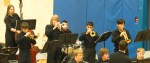
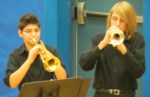
Six trumpeters in the Cadet Band, HIMS

Six trumpeters in the Cadet Band, HIMS

I went to hear one of my trumpet students, a 6th grader, perform in the Cadet Band. On top of that, I got an unexpected surprise—my very first cornet student also performed in the Symphonic Band (see my post of 14 August 2009). He’s now an 7th grader, and he switched to tuba last year. Both these students had made the Seattle Public Schools’ All-City Honors Elementary Band (see my posts of 10 April 2011 and 2 April 2012). It was a thrill to me to see and hear them both perform on the same stage on the same night! Both come from great families, and it was fun to see the relatives there, too.

Each band had its highlights, and I’ll mention only a few. The Cadet Band featured its 15 trumpeters in “Trumpets of Symphony Hall” by Don Brubaker. Among the four pieces played by the Concert Band, “The Hunger Games,” arranged by Jay Bocook, was very impressive. The clarinet soloist, Sadie Morriss, accompanied by the Symphonic Band, drew a standing ovation for her performance of “Viktor’s Tale” by John Williams. And the Symphonic Band demonstrated its high skill level by performing the superb “My Neighbor Totoro” by Joe Hisaishi, arranged by Yo Goto.

Please click on any photo to enlarge it.

Posted in School Concerts | Tagged: , , , , , , , , , , , , , , , , , , , , | 4 Comments »

Photo Gallery of Winter Concert at Skyview Jr. High in Bothell, 12-12-’12

Posted by glennled on December 20, 2012

Please click on any of the 32 photos to enlarge it.

Posted in School Concerts, Skyview Junior High | Tagged: , , , , , , , , , , , , | 6 Comments »

Arcade Mocha Kicks Off Winter Concert at Skyview Junior High in Bothell

Posted by glennled on December 17, 2012

AM LogoAs the fans filled the stands in the gym at Skyview Junior High in Bothell, they were entertained by Arcade Mocha, a jazz combo formed by eight students in 2011. People were coming for the Winter Concert of the orchestra and 7th, 8th, and 9th-grade bands. Arcade Mocha played Christmas songs and other pieces for half an hour before the concert began.

Vaughan has been my trumpet student since 2010

Vaughan has been my trumpet student since 2010

It was their 19th gig so far (see http://www.facebook.com/ArcadeMocha?ref=ts&fref=ts). They play for festivals, auctions, fundraisers, variety shows, promotional events, and such at malls, stores, coffee shops, churches, schools, and more. For example, during the holidays in 2011, they played at the Barnes and Noble Book Fair in Woodinville, and twice in 2012, they played at the Crossroads Mall in Bellevue. Last November, they played at “This is the Night,” the Skyview Spaghetti Dinner, and helped raise $1,700 in funds for the Music Boosters and

Music Department of the school. Musically, they’ve stepped up into jazz circles by playing twice at afternoon gigs at Tula’s Jazz Club in Belltown in Seattle (see www.tulas.com).

This group of talented teenage musicians launched from the Skyview Jr. High music program (see http://www.nsd.org/education/staff/staff.php?sectionid=429).  They practice, using The Real Book of charts, every Saturday at the home of their booking agent, Dianne Kinney, 425-275-8696, dianne@adamkinney.com.

Please click on any photo to enlarge it.

Posted in School Concerts | Tagged: , , , , , , , , , , , | 4 Comments »

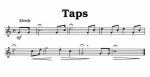
“Echo Taps” on Veterans Day 2012—the 150th Anniversary Year of its Composition

Posted by glennled on November 19, 2012

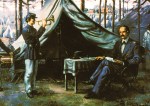
Taps, original painting by Sidney E. King on display at Berkeley Plantation

In 1862, when Daniel Adams Butterfield composed “Taps” during the Civil War, there was no Veterans Day. A New Yorker, he was then a Brigadier General and later a Major General in the Union Army. Fifty-six years later in 1918, this national holiday was established (first as Armistice Day) after the end of World War I. Its name was changed to Veterans Day after World War II and is now celebrated annually on 11 November in honor of all American veterans. This year is the 150th anniversary year of “Taps,” the most famous of all American bugle calls. Thus, it came to pass that Richard Haydis and I sounded “Echo Taps” to close the memorial ceremony at Veterans Park in Lynnwood on a rainy Sunday, 11 November 2012.

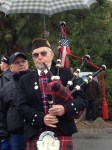
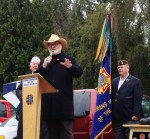
Haydis is a U.S. Coast Guard veteran, and I am a U.S. Navy veteran of the Vietnam era. VFW Post 1040 (see http://vfw1040.org/) hosted the ceremony, where the featured speaker was Michael G. Reagan, U.S. Marine Corps veteran, internationally renown artist and leader of the Fallen Heroes Project (see my post of 19 November 2011, and www.fallenheroesproject.org). The ceremony featured the NW Junior Pipe Band (see www.mwjbp.org) and

Michael G. Reagan, U.S. Marine Corps Veteran, Fallen Heroes Project

Ray Colby, VFW Post 1040 Piper and a U.S. Navy veteran. Cub Scout Pack 331 placed flags in the park and distributed the ceremony programs.During 2012, buglers throughout the nation participated in numerous ceremonies to commemorate the 150th anniversary of “Taps.” The prime event occurred on 22-24 June at Harrison Landing on the grounds of Berkeley Plantation along the James River, southeast of Richmond, Virginia (see www.taps150.org). This was the birthplace of America’s Song of Remembrance.

In late June, 1862, after the Seven Days Battles, the Army of the Potomac recuperated at Harrison Landing. Butterfield himself had been wounded.  It is said of Oliver Willcox Norton, bugler of Butterfield’s Brigade, that Butterfield called him to his tent to work on a new bugle call until, as Butterfield put it, he got it smooth, melodious, and musical, suited his ear and taste. Norton was the first to sound “Taps” as we now know it in early July.  Later, in 1898, Norton wrote a letter recalling the incident:

Taps, Butterfield and Norton

“…One day, soon after the seven days battles on the Peninsular, when the Army of the Potomac was lying in camp at Harrison’s Landing, General Daniel Butterfield, then commanding our Brigade, sent for me, and showing me some notes on a staff written in pencil on the back of an envelope, asked me to sound them on my bugle. I did this several times, playing the music as written. He changed it somewhat, lengthening some notes and shortening others, but retaining the melody as he first gave it to me. After getting it to his satisfaction, he directed me to sound that call for Taps thereafter in place of the regulation call. The music was beautiful on that still summer night, and was heard far beyond the limits of our Brigade. The next day I was visited by several buglers from neighboring Brigades, asking for copies of the music which I gladly furnished. I think no general order was issued from army headquarters authorizing the substitution of this for the regulation call, but as each brigade commander exercised his own discretion in such minor matters, the call was gradually taken up through the Army of the Potomac. I have been told that it was carried to the Western Armies by the 11th and 12th Corps, when they went to Chattanooga in the fall of 1863, and rapidly made its way through those armies. I did not presume to question General Butterfield at the time, but from the manner in which the call was given to me, I have no doubt he composed it in his tent at Harrison s Landing…

For a detailed account of the composition of “Taps”, please see “24 Notes That Tap Deep Emotions,” by Jari A. Villanueva, at www.west-point.org/taps/Taps.html.

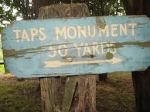
Taps Monument prior to 2012 renovation, Berkeley Plantation

The Virginia Department of the American Legion erected a monument dedicated to “Taps” on a knoll where General Butterfield’s tent stood in July 1862. This is the only such monument in the country. There is a bronze statue of Butterfield in Sakura Park on Claremont Avenue in Manhattan, not far from Grant’s Tomb. And Butterfield is buried at West Point, although he attended Union College (Class of 1849) in Schenectady, not the U.S. Military Academy (see www.union.edu/news/stories/2012/05/sounding-a-solemn-note-taps-turns-150.php).

Incidentally, the call is named “Taps” because at the end of the call, a drummer would play three distinct drum taps at four-count intervals. And as popular and beautiful as it is, “Echo Taps” is not an official bugle call of the U.S. military. Officially, “Taps” is to be sounded by a single bugle.

Photos of the 2012 Lynnwood ceremony are by Andy Dingman. Please click on any image to enlarge it.

Posted in Ceremonies & Celebrations | Tagged: , , , , , , , , , , , , , , , , , , , | Leave a Comment »

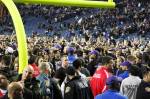
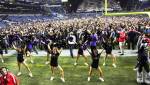
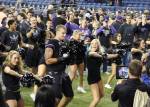
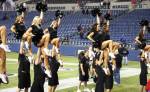
Husky Alumni Band Cheers UW to Victory Over Stanford, 17-13

Posted by glennled on October 16, 2012

Victory celebration!

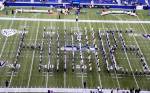
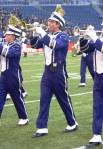
Everyone knows that while Husky Stadium is now being rebuilt for next year, the football team is playing its home games in downtown Seattle at Century Link Field, home of the Seattle Seahawks and Seattle Sounders. Everyone sees the UW Husky Varsity Marching Band on the stadium steps at the north entrance prior to the game, in the south stands during the game, and on the field for pre-game and half-time shows. But who knows whether the Husky Alumni Band is even there—and if so, where are they?

Well, yes, we were there Thursday night (27 September) to see the Huskies upset the 8th-ranked Stanford Cardinal, 17-13. We were seated in the SW quadrant of the stadium—high up in Section 327!—cheering as loudly as everyone else.

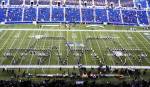
UW Husky Varsity Marching Band

We played at three pep rallies prior to the game, one with the Chinese Dragon at Hing Hay Park in the International District, one in the north parking lot of the stadium, and one in Occidental Street on the west side of the stadium. That earned us free tickets into this big game. Recall that there was a time when it was questionable whether the Husky Alumni Band would have a role to play at the home games this year (see my post of 18 November 2011), but that was settled. We’re there, helping raise money for HMBAA scholarships, and we’re very happy. It’s such fun, and I love playing trumpet. Some of us even joined the massive crowd on the field after the game to celebrate the victory. Go Huskies!

Photos are by Louis Figueroa and Gary Nakayama, courtesy of the UW Husky Varsity Marching Band conducted by Dr. Brad McDavid, Director. Please click on any photo to enlarge it.

Posted in HMBAA - Husky Alumni Band | Tagged: , , , , , , , , , , , , , , , , | Leave a Comment »

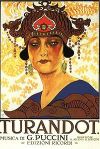
Puccini’s Grandest Opera, “Turandot,” is Different

Posted by glennled on August 31, 2012

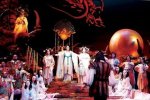
Emperor (upper center), Turandot (middle center), and Prince Calaf (lower right)

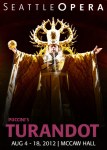
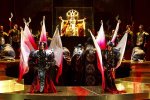
Yes, I’m an opera novice—I’ve seen only three other operas by Giacomo Puccini: La Boheme, Tosca, and Madama Butterfly (see my post of 31 May 2012). None of these prepared me for the showy spectacle of Turandot by the Seattle Opera which my wife and I attended on 5 August at McCaw Hall. And the three others set me up to expect Turandot to end in a very different way.

Speight Jenkins is my opposite. He’s been attending opera for more than 60 years and is General Director of the Seattle Opera. In the August edition of “Encore Arts Programs,” he writes that Turandot was a smash hit when it premiered at Teatro Alla Scala in Milan, Italy on 25 April 1026, sixteen months after Puccini’s death. It scored successes everywhere it was performed, but inexplicably, it disappeared from New York opera after 1930 until it was resurrected in 1961 by the Metropolitan Opera. Nine performances were given that season, evoking ovation after ovation, and “suddenly Turandot leapt onto the gold standard.” According to orchestra conductor Asher Fisch, Puccini operas are so popular that the composer accounts for 25 percent of all the operas produced today (see http://seattletimes.nwsource.com/html/thearts/2018771976_opera29.html).
Then in 1990, writes Jenkins, to celebrate the World Cup of soccer, Placido Domingo, Jose Carreras (Spaniards), and Luciano Pavarotti (Italian) created The Three Tenors. They first performed a concert together on 7 July that year at the ancient Baths of Caracalla in Rome. At the climax, Pavarotti’s sang the aria, “Nessun dorma,” from Act III of Turandot. This became his signature aria. That, coupled with the success of that concert and the tremendous sale of their recording, made the aria synonymous with opera. “Fifty years ago, ‘Nessun dorma’ was just another aria in the Puccini canon, not even one that most opera lovers could recognize,” writes Jenkins. “Now it is clearly the most well known aria in opera to those who have never set foot in an opera house.” See the following performances:

Timur, dethroned king of Tartary, mourns the death of Liu, a slave girl who commits suicide rather than betray Prince Calaf

Puccini died in December, 1924, before finishing Turandot. He left few notes about how he intended to end it. Others finished both the music and libretto. Hence, for me, the surprise ending.

Turandot, based on a Persian fairy tale and set in China, is the story of an icy, man-hating princess named Turandot (soprano). No man shall possess me, she declares, yet there is pressure from the emperor and the people for her to marry. So, if any man of royal blood can solve three riddles, she agrees to marry him. If a man tries and fails, he will be killed. By the time Prince Calaf (tenor) arrives, 40 suitors have been decapitated. He is confident, in love with her, and determined to succeed. He solves the riddles. She still resists, however, so he gives her a means of escape: if by the next dawn she cannot give his name, he will tell it to her and become her 41st victim. Lui, the self-effacing, sacrificing woman who is caretaker of Calaf’s father, is tortured during the night to make her reveal his name. Such is her love for Calaf that she dies rather than do so.  Dawn comes and Calaf tells Turandot his name. Meanwhile, she admits to being attracted to him, unlike any of the others, and in the climax, declares her love and agrees to marry him.  The emperor and the people rejoice!

A Puccini opera ends with a happy marriage? I would never have believed it. My friend John, one of my trumpet students and frequently an extra in numerous operas in Seattle, agrees. “If Puccini had written the ending,” writes John, “I am sure Prince Calaf would have realized his true love was Liu (the slave girl) and then killed Turandot and then killed himself. That’s an Italian ending.”

So, to me, Turandot is different. Not only is it a grand spectacle in which the heroine doesn’t die in a tragic ending, but musically, Puccini pushes the soprano and tenor toward the limits of the range of the human voice. The roles require a full, dramatic, powerful, heroic sound. I may be wrong, but it seems to me there also is more dissonance in the orchestra, which can be almost overpowering at times, and fewer melodies in the score. Here, Puccini is more akin to Wagner than in the other three Puccini operas I’ve attended.

Afterwards, my wife and I talked things over at an outdoor table at Ponti’s Seagood Grill along the Ship Canal near the Fremont Bridge. It’s a favorite restaurant of ours, one we seem to save for special occasions. The opera and dinner were her gifts to me to celebrate my recent birthday. What could be better?  😉

Performance photos are courtesy of the Seattle Opera. Please click on any picture to enlarge it.

Posted in Professional Concerts | Tagged: , , , , , , , , , , , , , | 2 Comments »